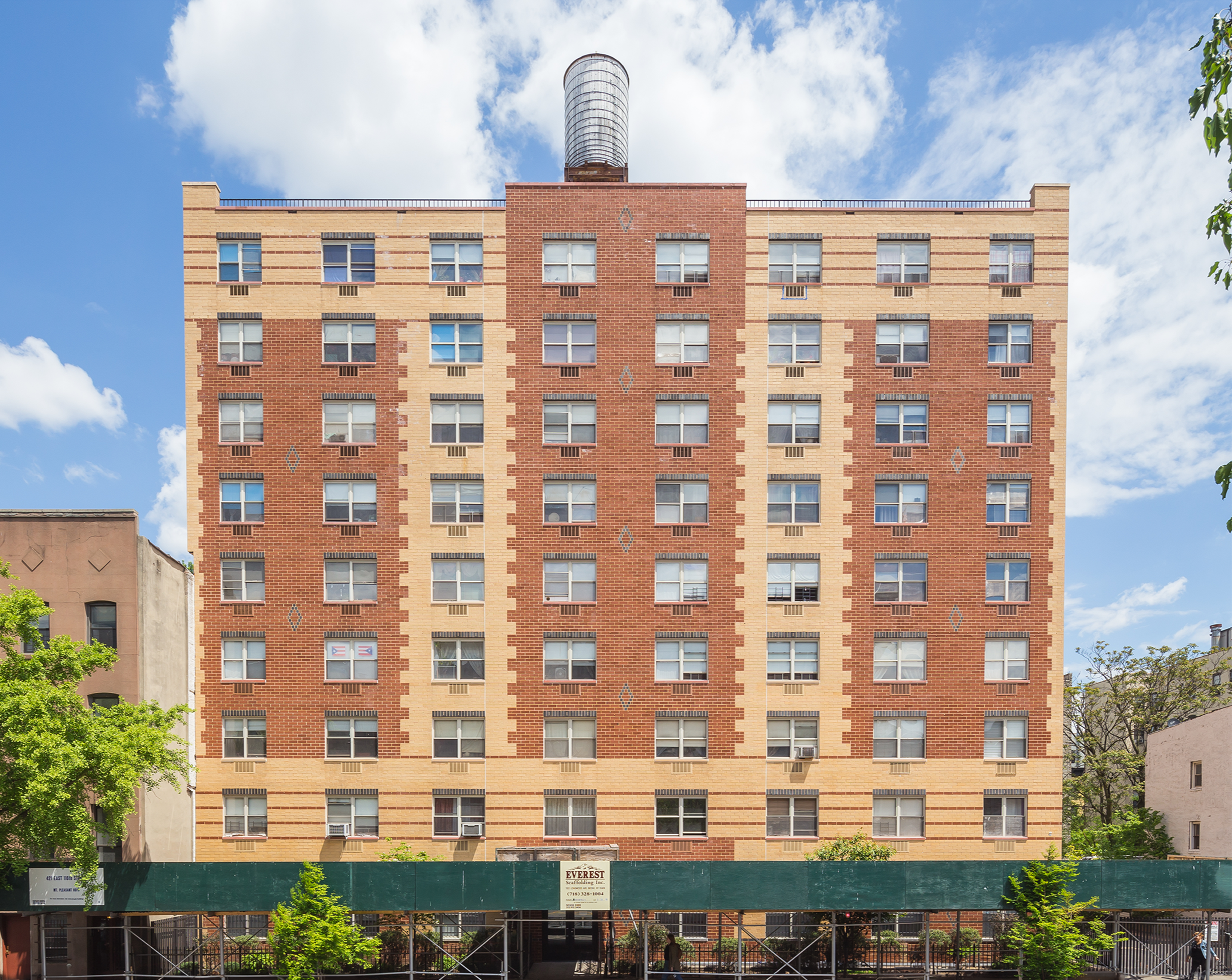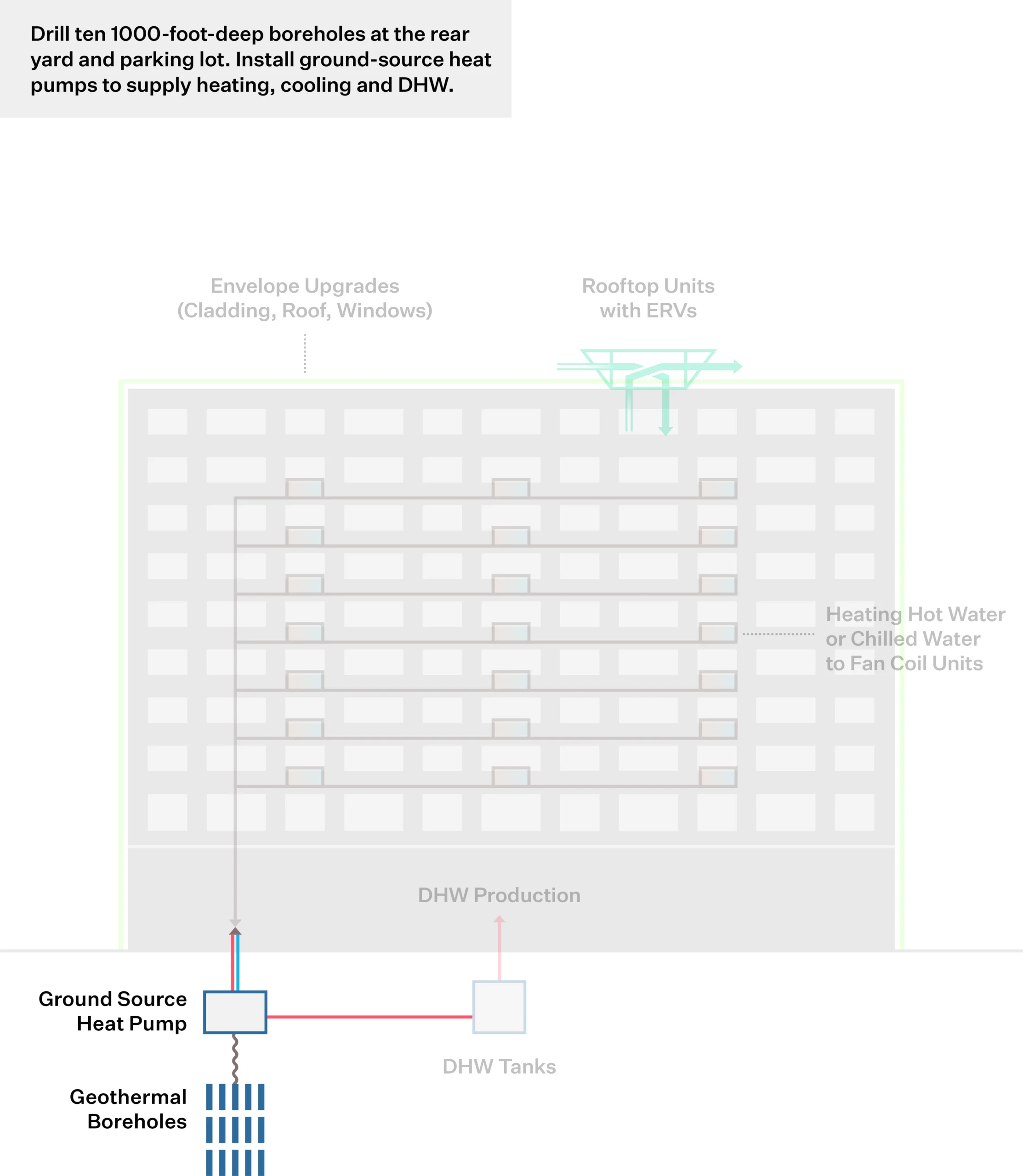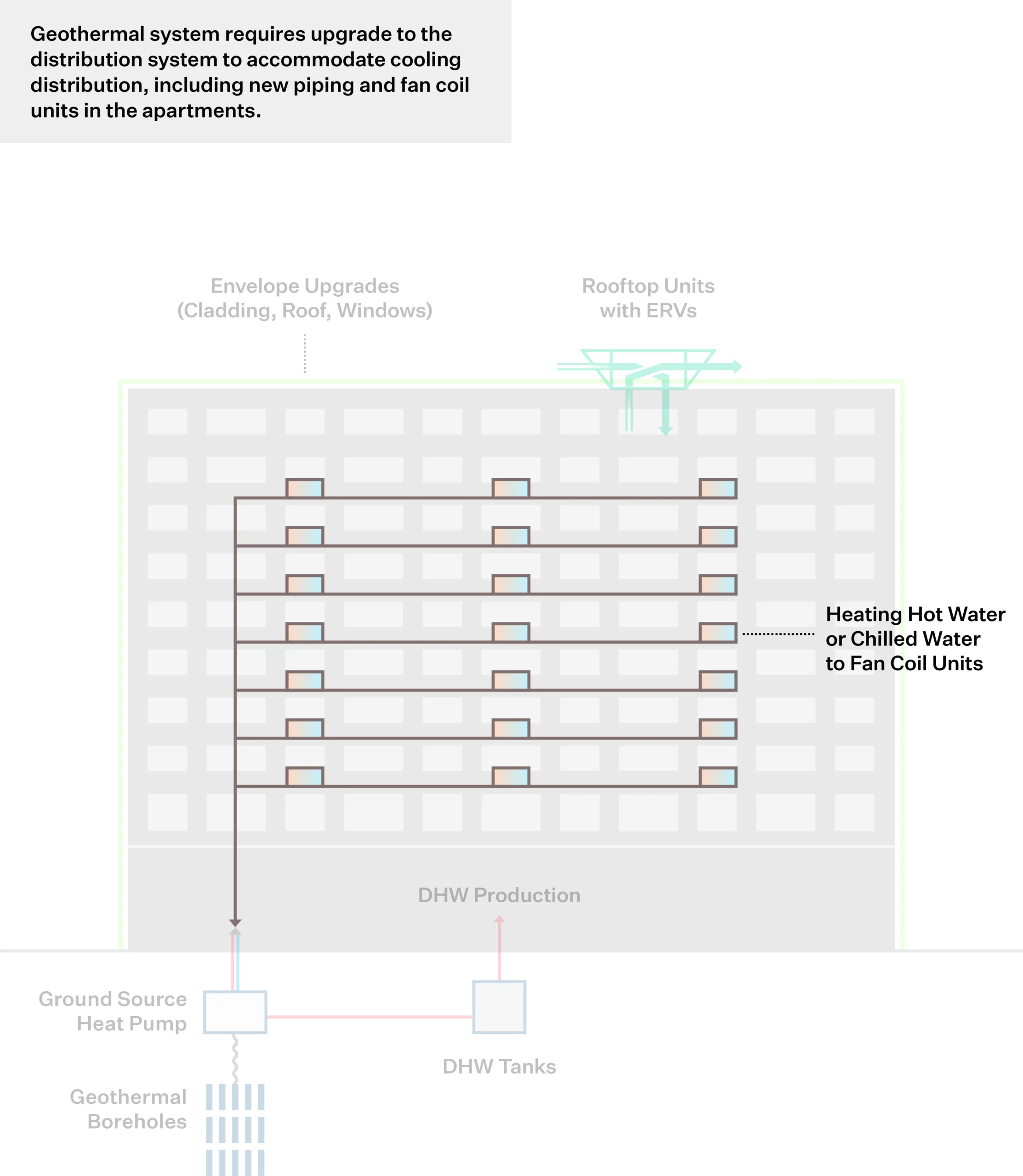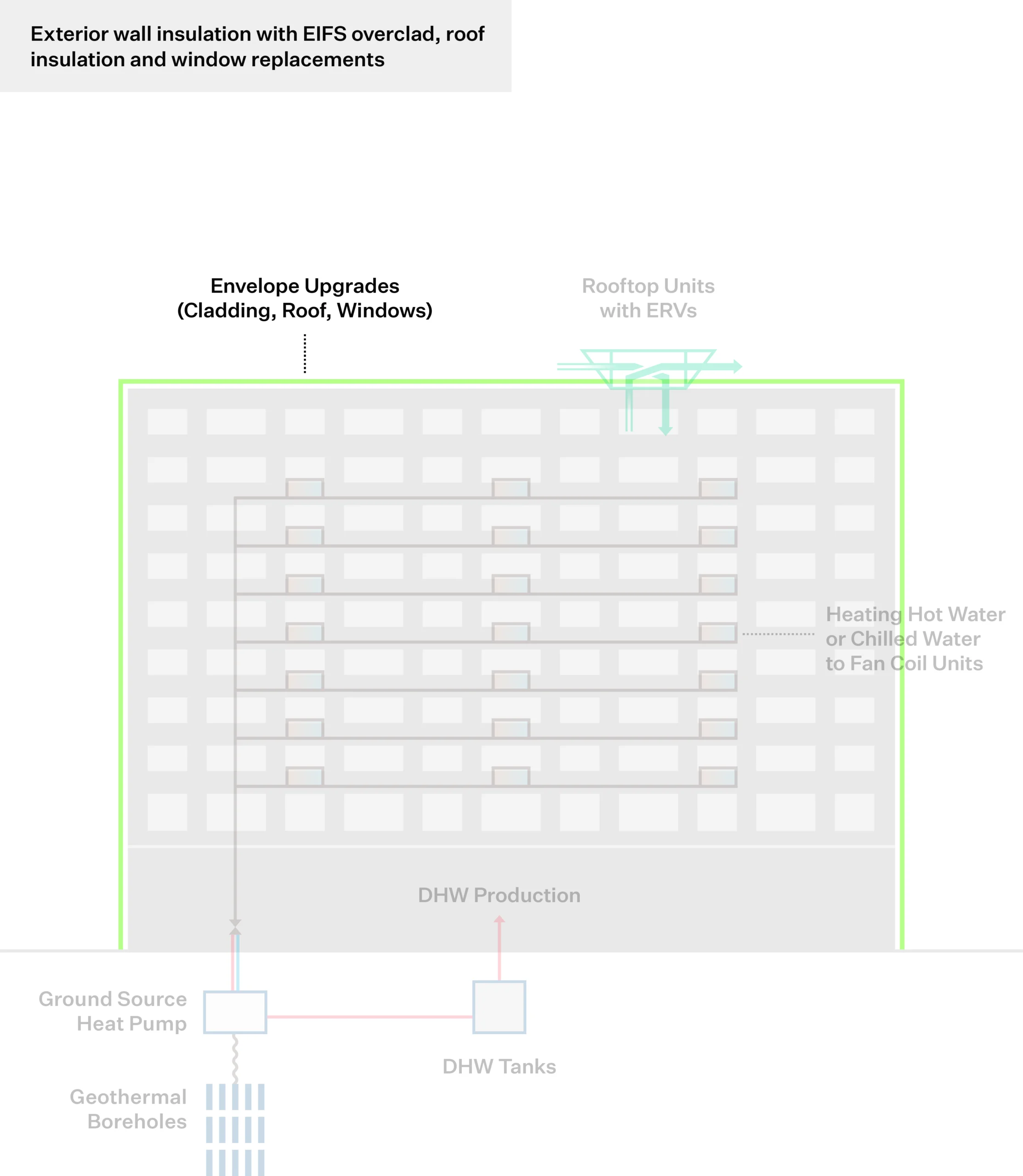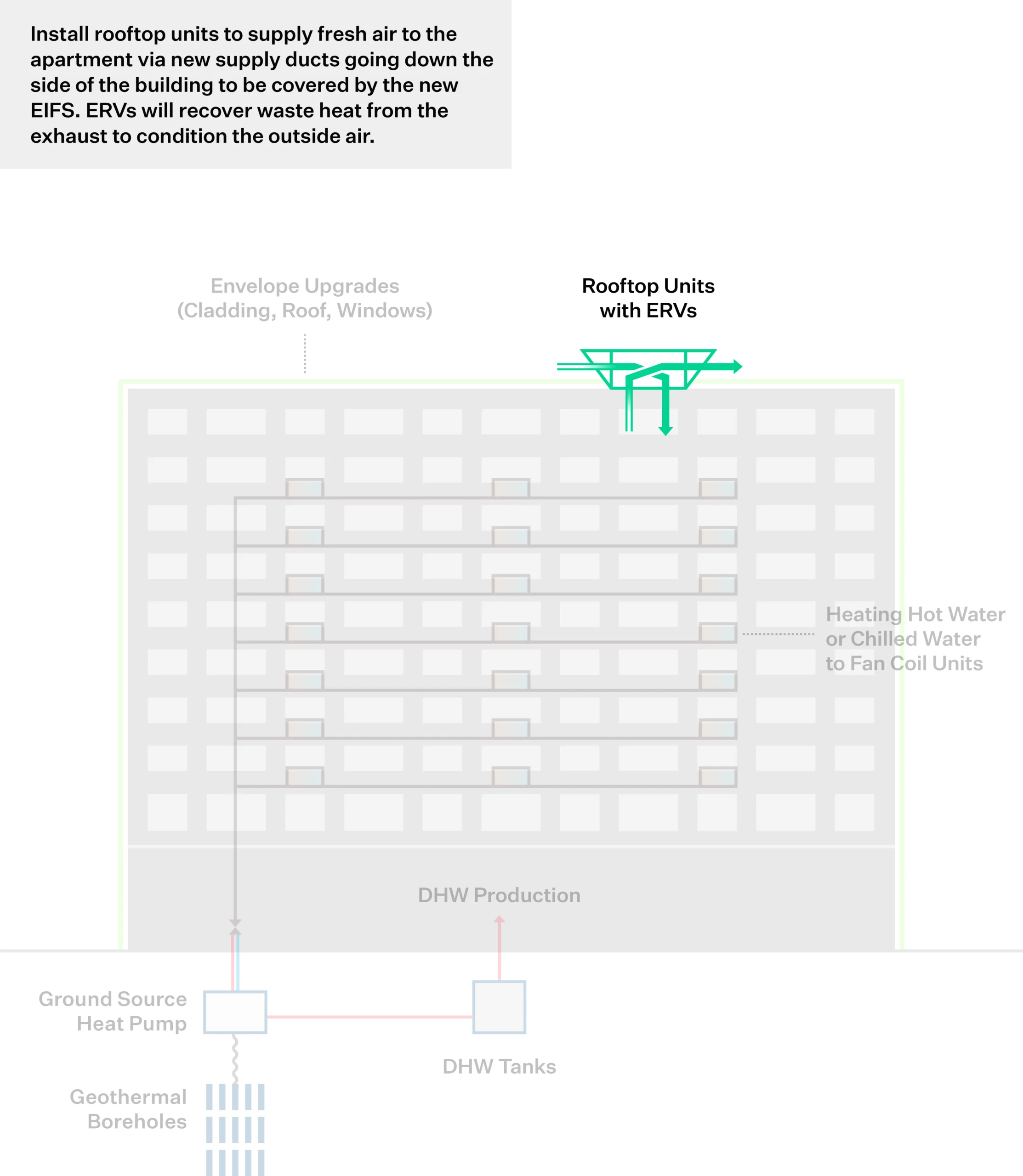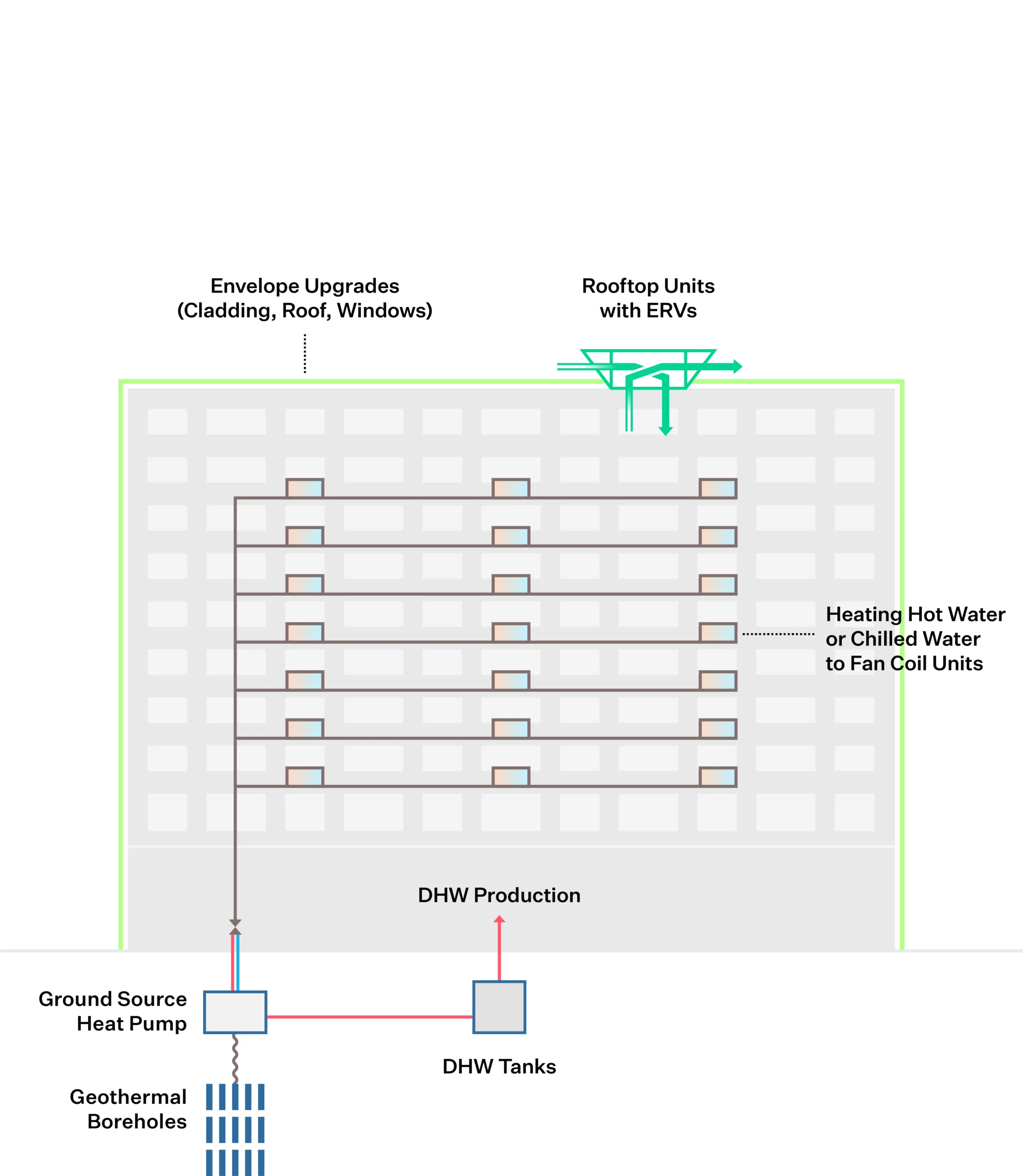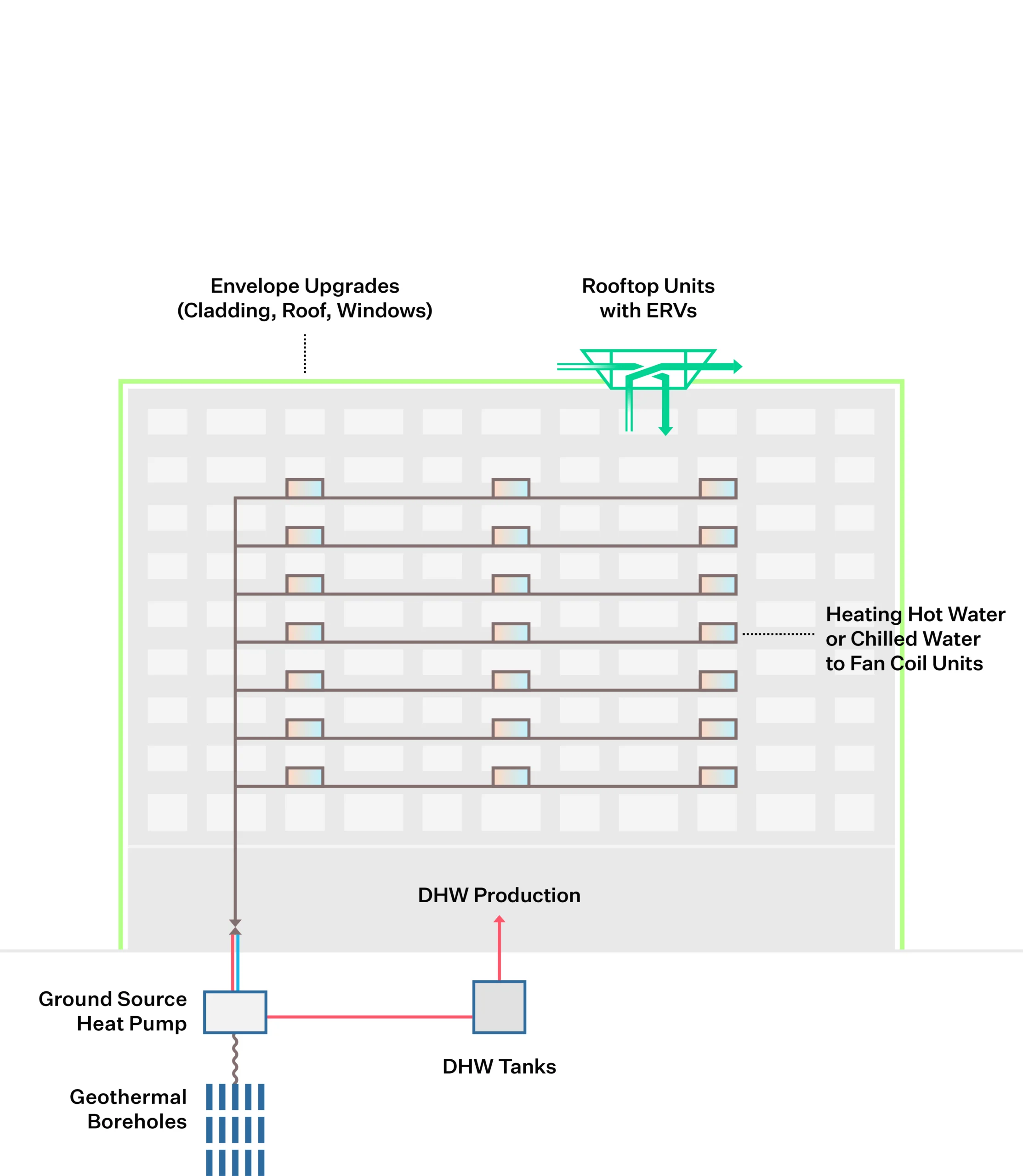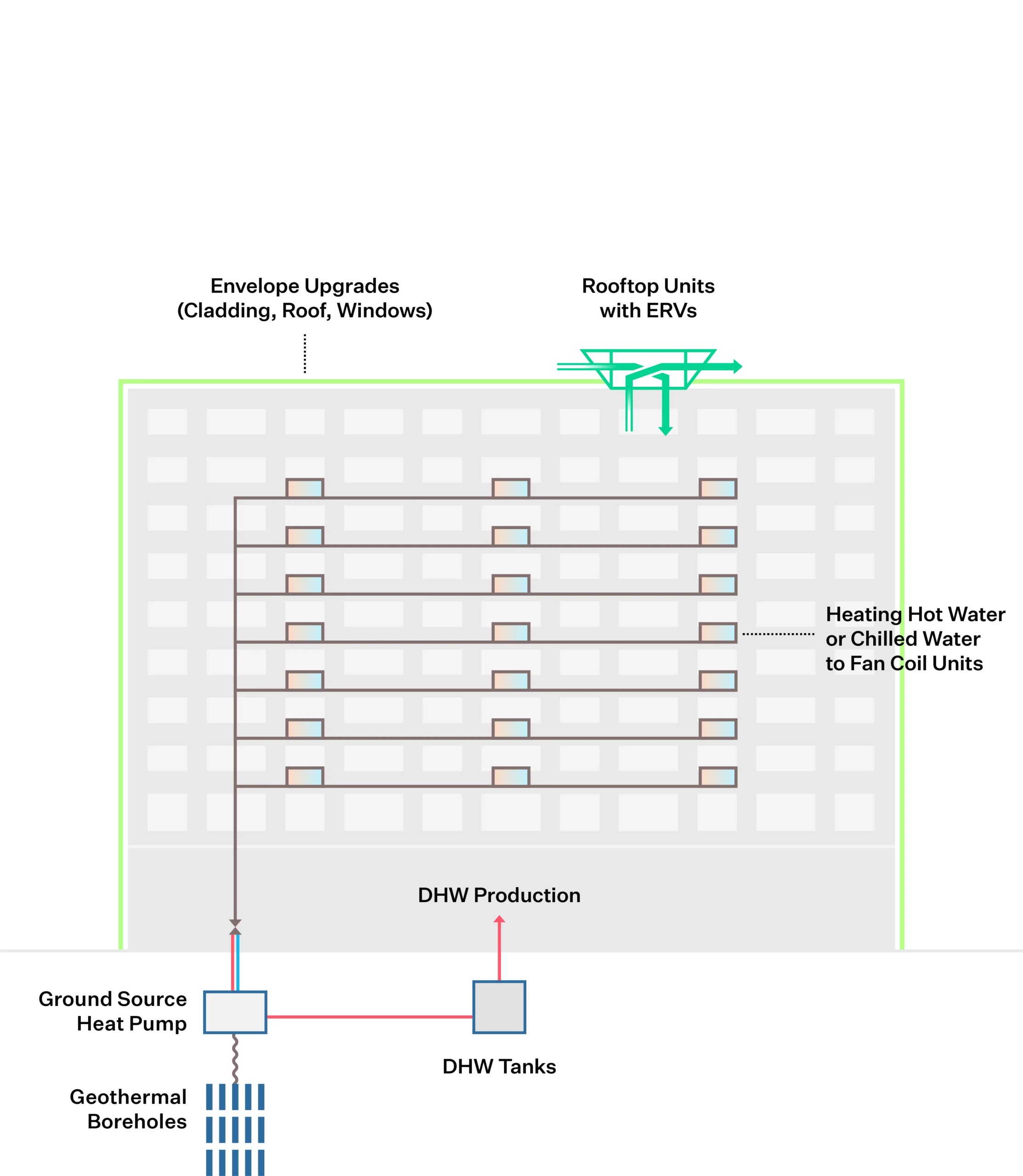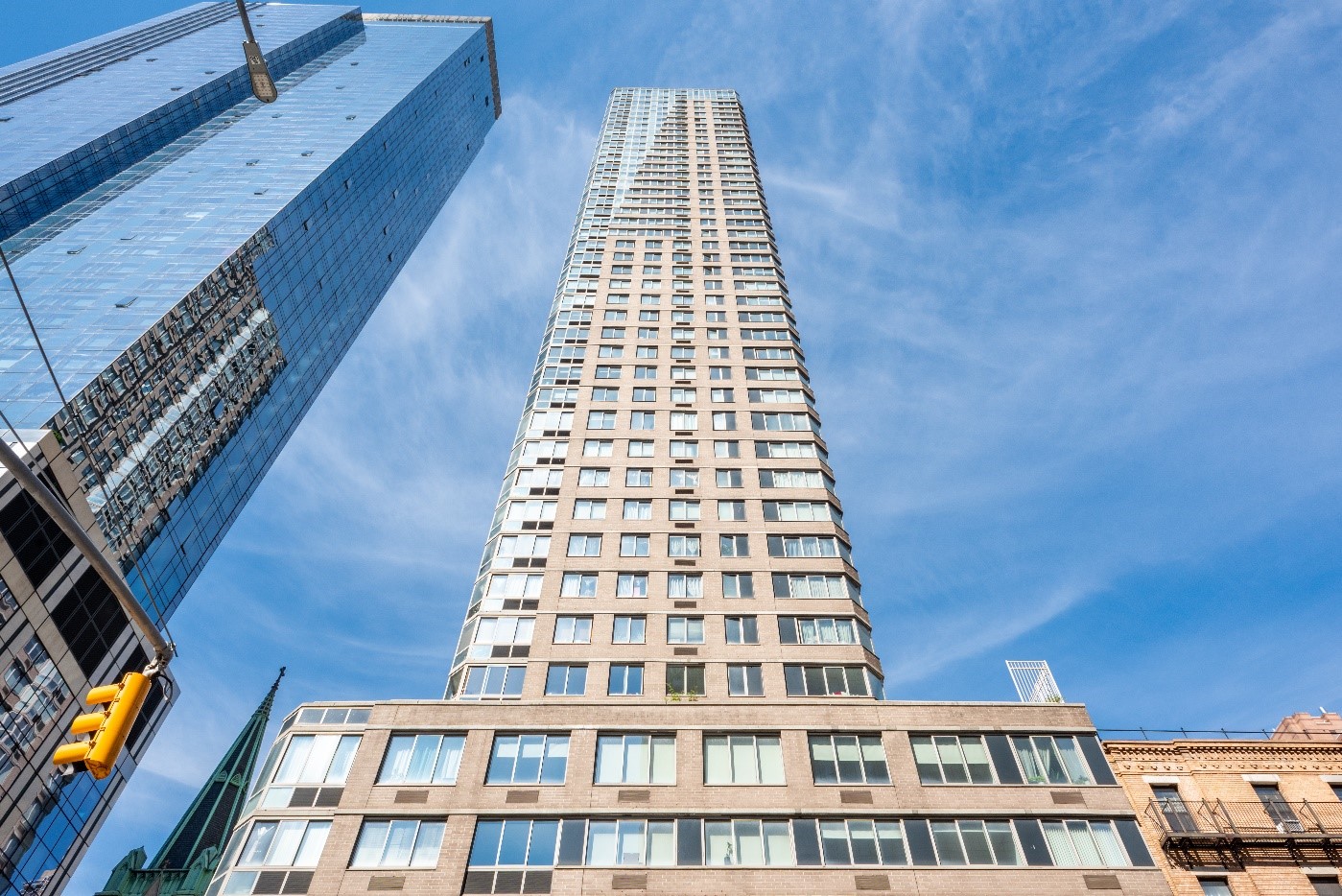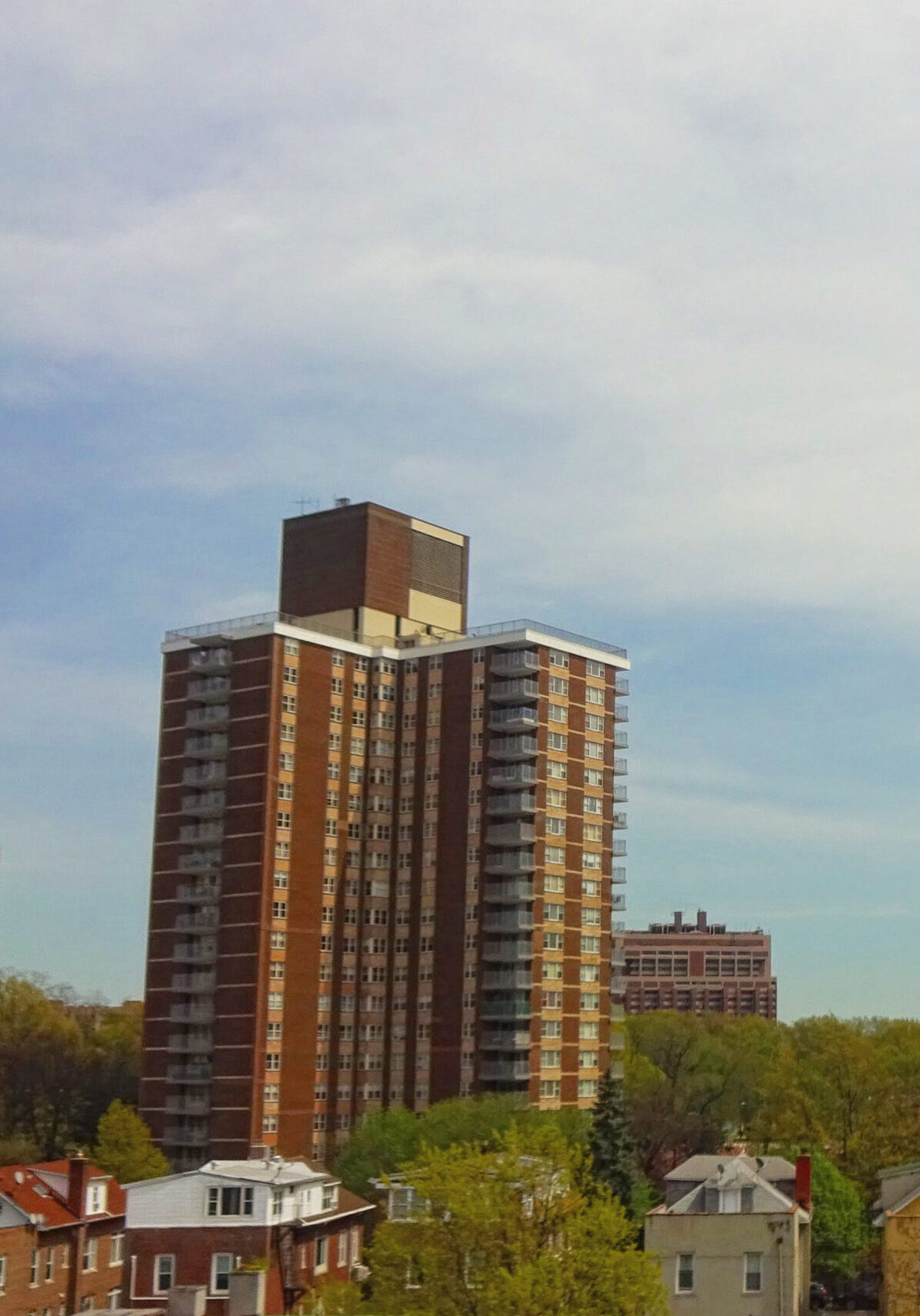





































































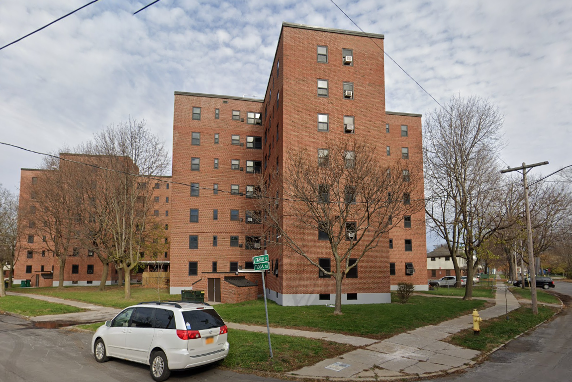
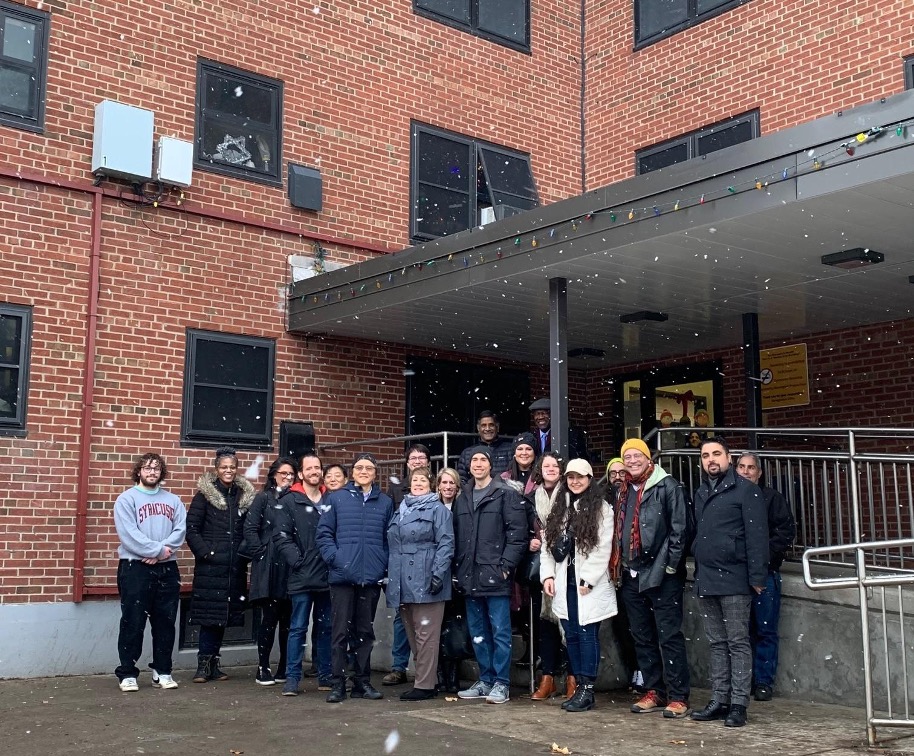
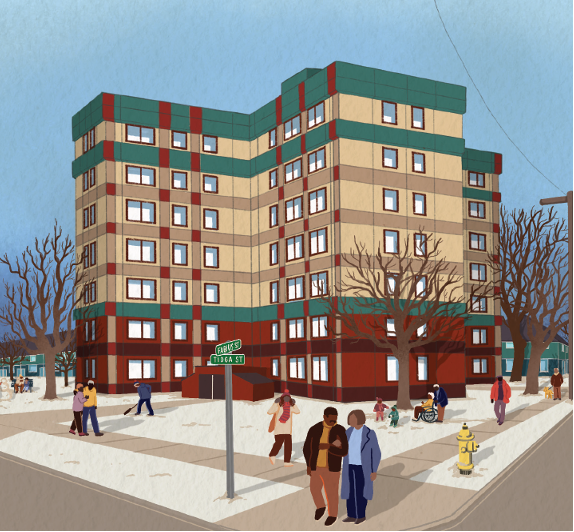
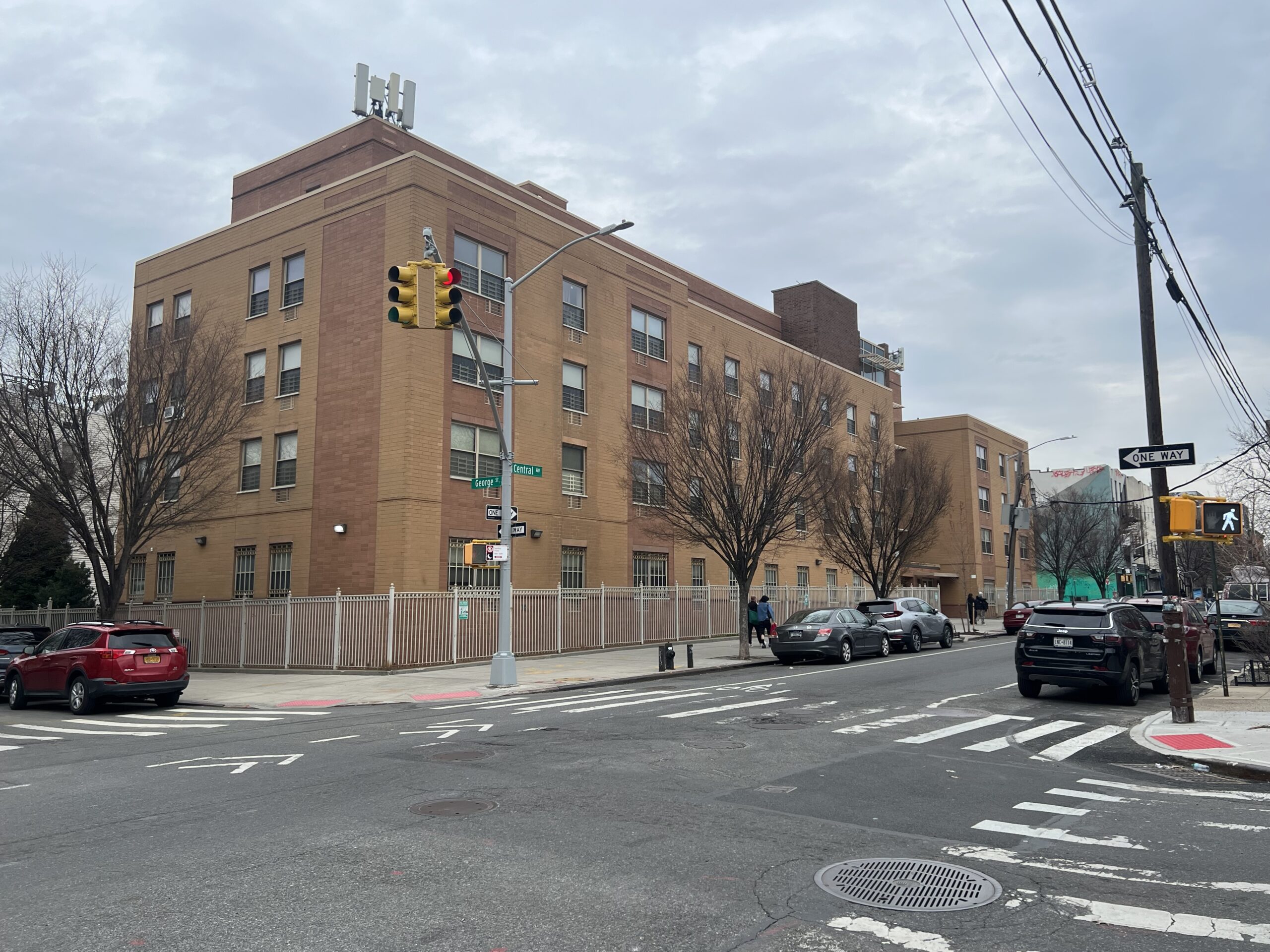
Noll Apartments, located at 43 Central Avenue, and Melrose Apartments, located at 63 Central Avenue, are neighboring buildings in Brooklyn, New York. The buildings are 6 stories and total 131,865 square feet with 98 affordable apartment units. The decarbonization retrofit planned for these buildings includes a package of measures that will:
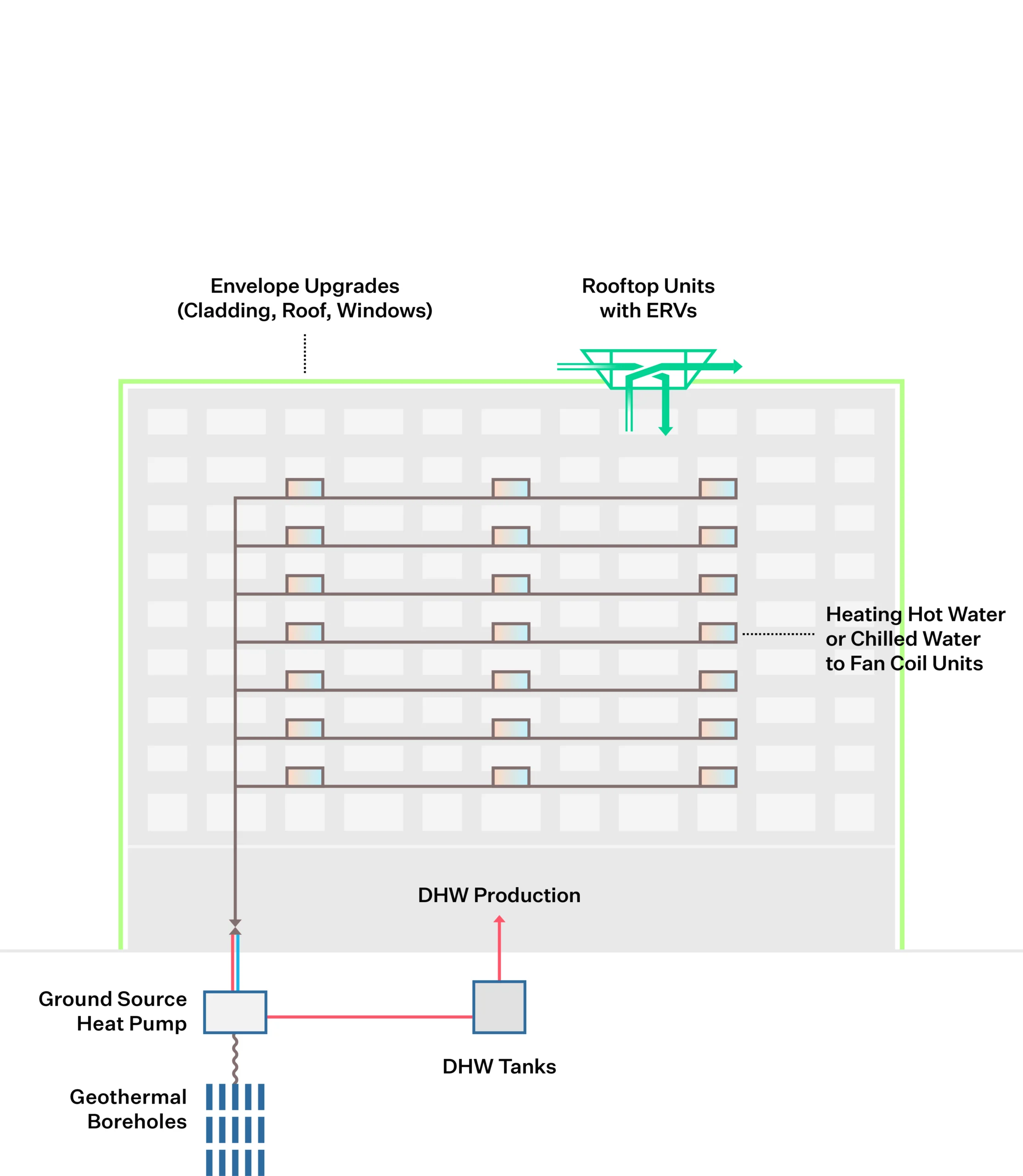
Combine all mechanical equipment into a single central plant serving both buildings which will facilitate thermal energy recovery, allow for the integration of future decarbonized thermal energy sources, and reduce first- and ongoing maintenance costs.
Electrify, and recover energy for, loads currently served by fossil fuels (heating and domestic hot water).
Improve the energy efficiency of the buildings by reducing thermal loads through ventilation energy recovery and envelope improvements
Reduce construction costs by avoiding the staggering of measure implementation where possible.
Creating resilient and sustainable communities are key components of RiseBoro’s mission. The principles of energy efficiency, improved health outcomes, reduced consumption, and responsible use of natural resources are core beliefs of the organization.
Project Highlights
Lessons Learned
The project used the Resource Efficient Decarbonization (RED) methodology to consider various technical and financial options and determine the optimal decarbonization pathway.
Lessons Learned
The project utilizes existing technology in a creative new application to greatly reduce the initial costs of electrification.
Emissions Reductions
61%
A displacement strategy approach was developed to maximize cost-efficacy of decarbonization without burdening affordable housing residents and operators, resulting in a 61% projected energy use reduction for the building by the end of the Empire Building Challenge project.
Step 1
Step 1: Examine Current Conditions
A baseline assessment is key to understanding current systems and performance, then identifying conditions, requirements or events that will trigger a decarbonization effort. The assessment looks across technical systems, asset strategy and sectoral factors.
Building System Conditions

Equipment nearing end-of-life
New heat source potential
Comfort improvements
Indoor air quality improvements
Facade maintenance
Efficiency improvements
Asset Conditions
Capital event cycles
Owner sustainability goals
Market Conditions

Technology improves
Market supply changes
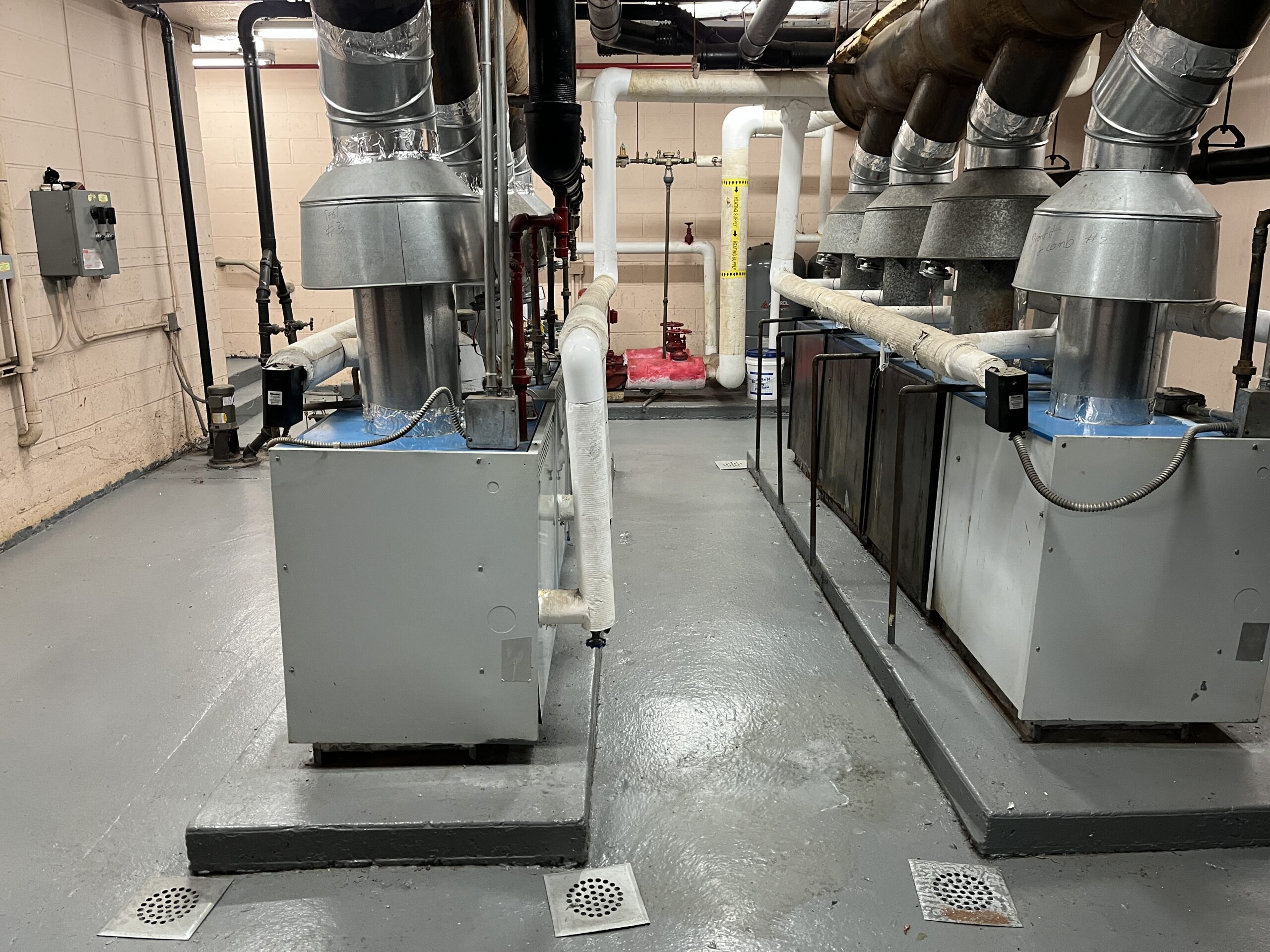
Noll Apartments and Melrose Apartment contain the original HVAC equipment from their construction in the early- and mid-2000s that is nearing the end of its useful life. This aging equipment, considered alongside a recent recapitalization event, presents an opportunity to focus on improving energy efficiency and reducing carbon emissions. Additionally, these buildings are part of a tranche of buildings in the RiseBoro portfolio constructed prior to the adoption of more aggressive energy efficiency approaches. Implementation of the decarbonization retrofits will not only lower the buildings’ emissions, but will also bring energy performance up to, or higher than, other buildings in the portfolio. The Empire Building Challenge program provided a unique opportunity at a convenient time to create a holistic roadmap and retrofit plan.
Step 2
Step 2: Design Resource Efficient Solutions
Effective engineering integrates measures for reducing energy load, recovering wasted heat, and moving towards partial or full electrification. This increases operational efficiencies, optimizes energy peaks, and avoids oversized heating systems, thus alleviating space constraints and minimizing the cost of retrofits to decarbonize the building over time.
Existing Conditions
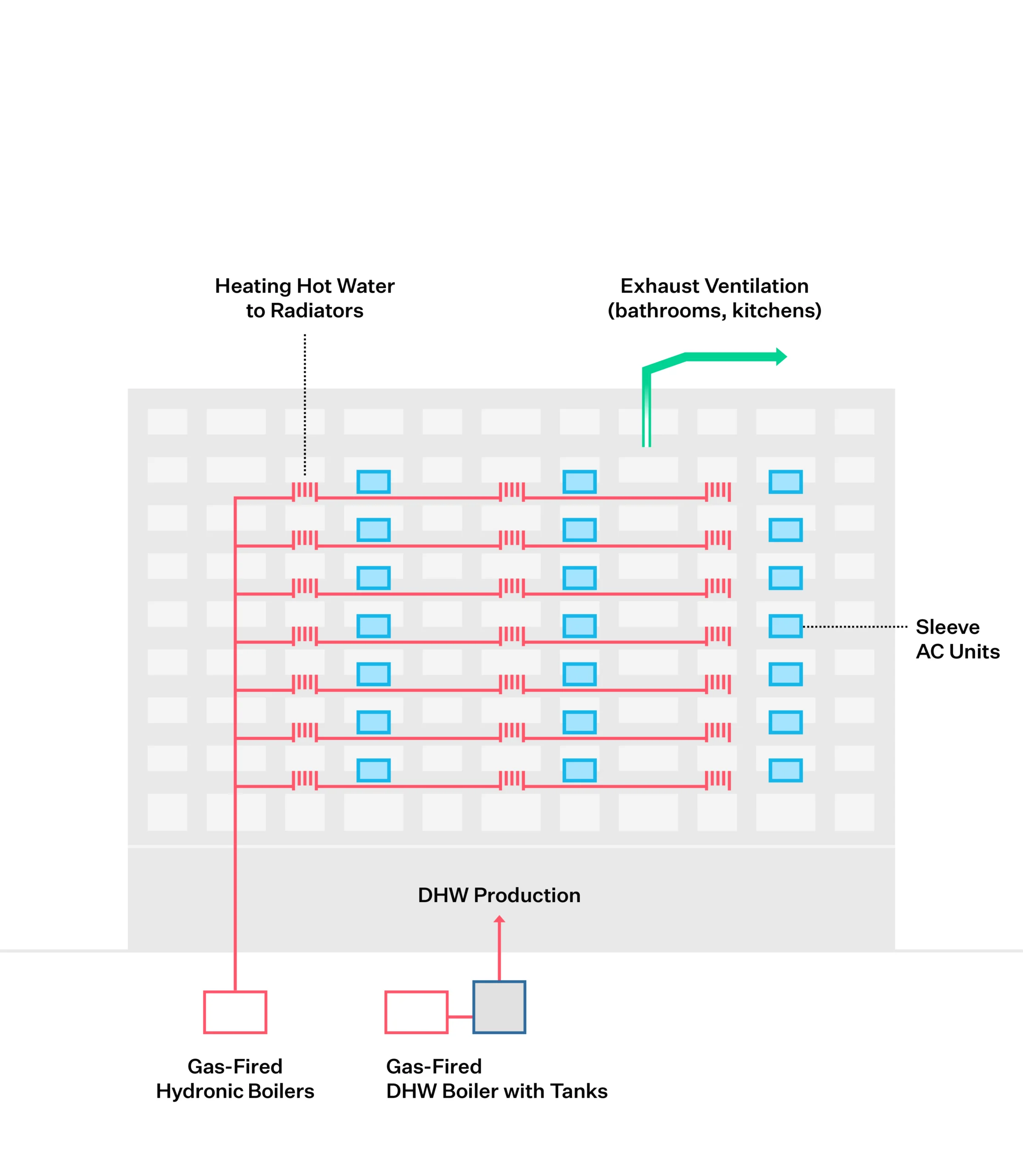
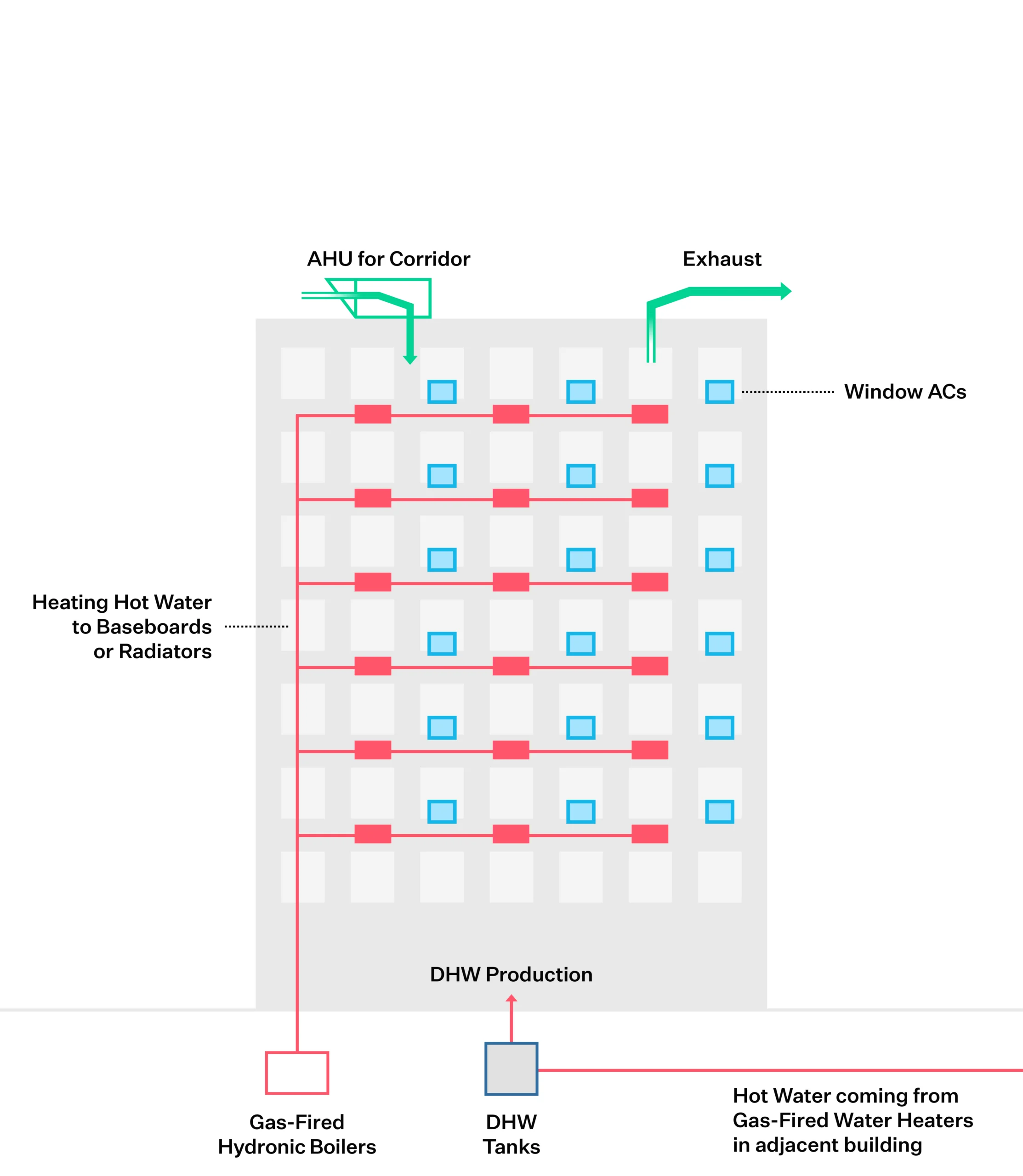
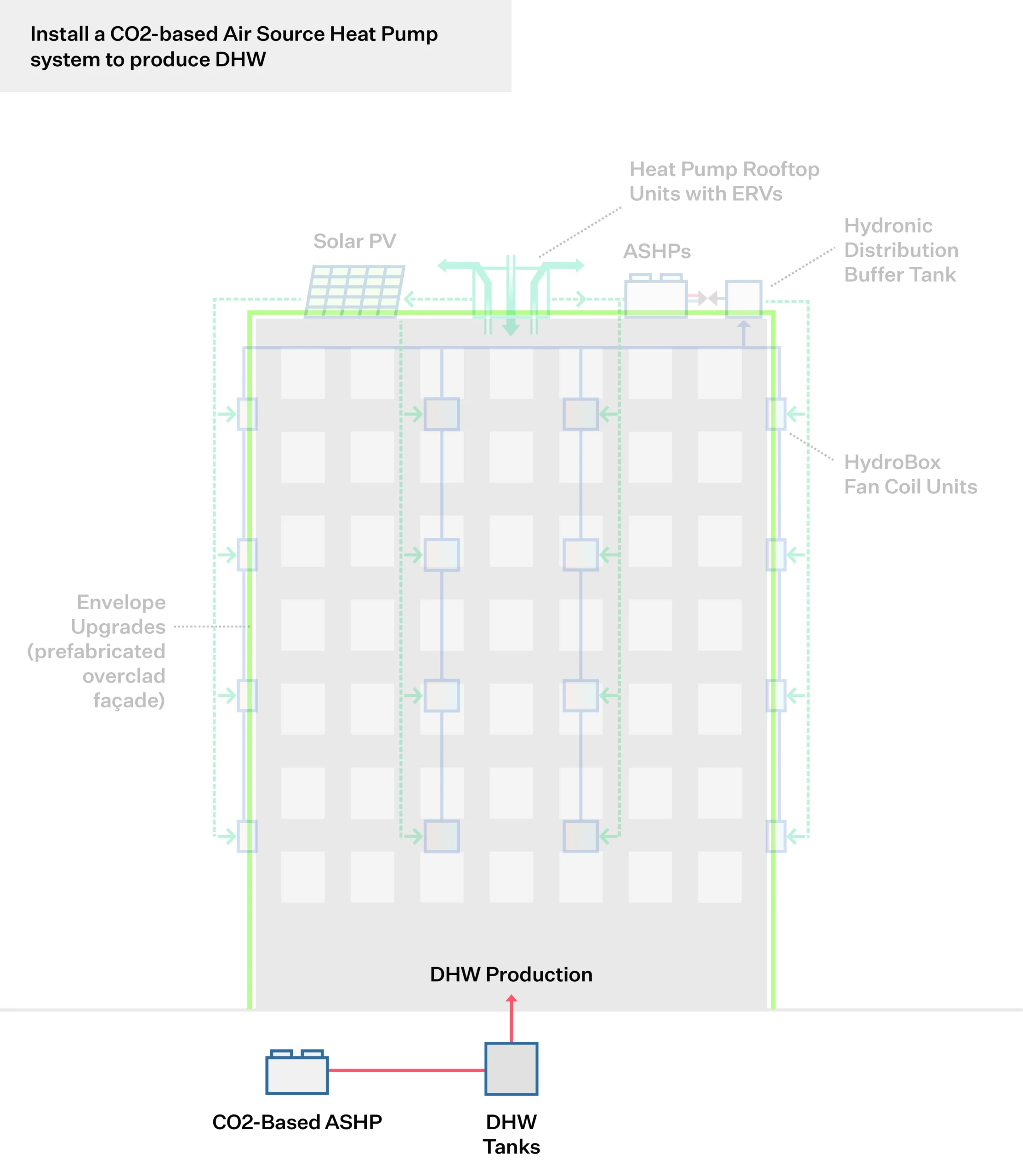
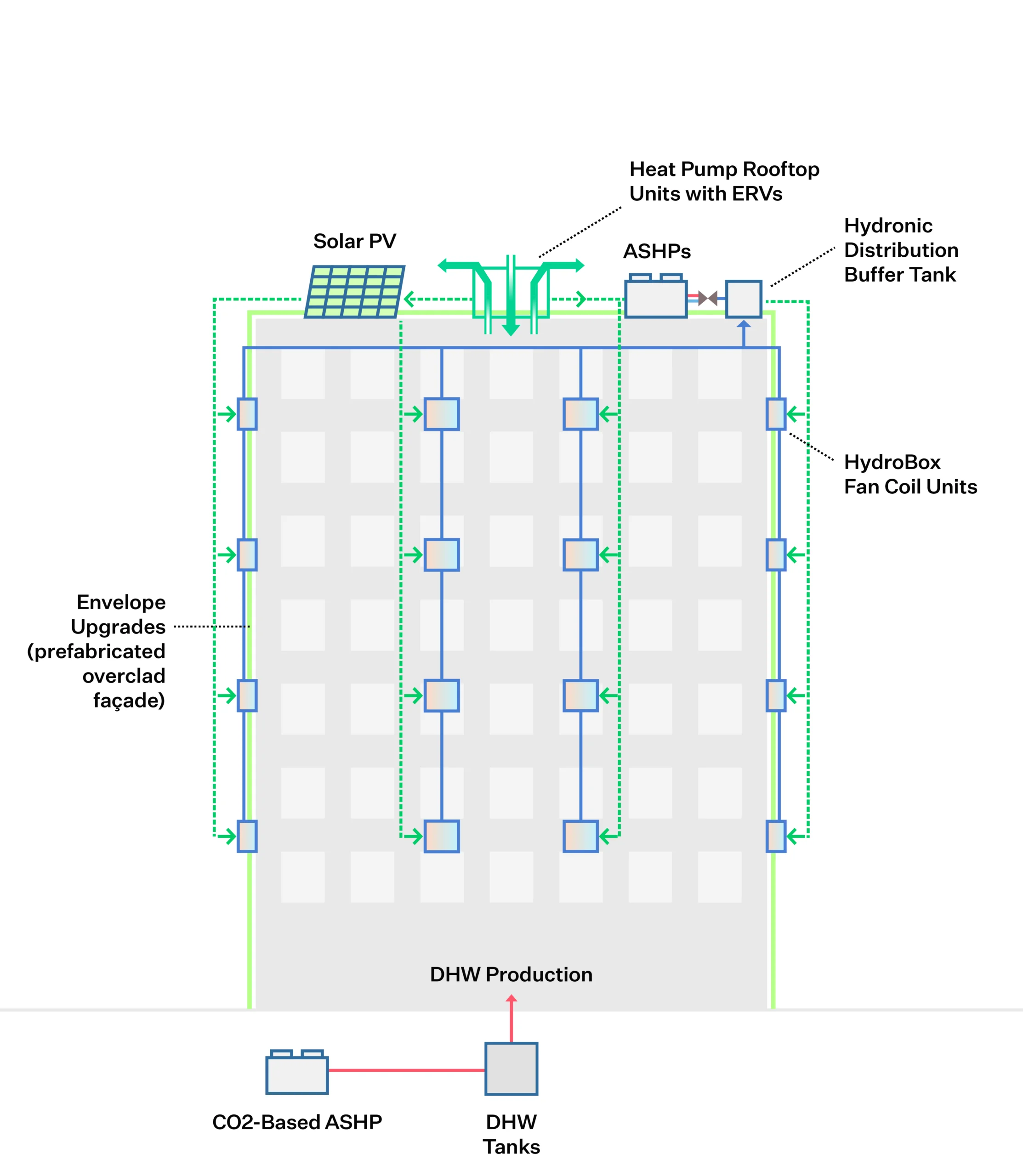
This diagram illustrates the building prior to the initiation of Strategic Decarbonization planning by the owners and their teams.
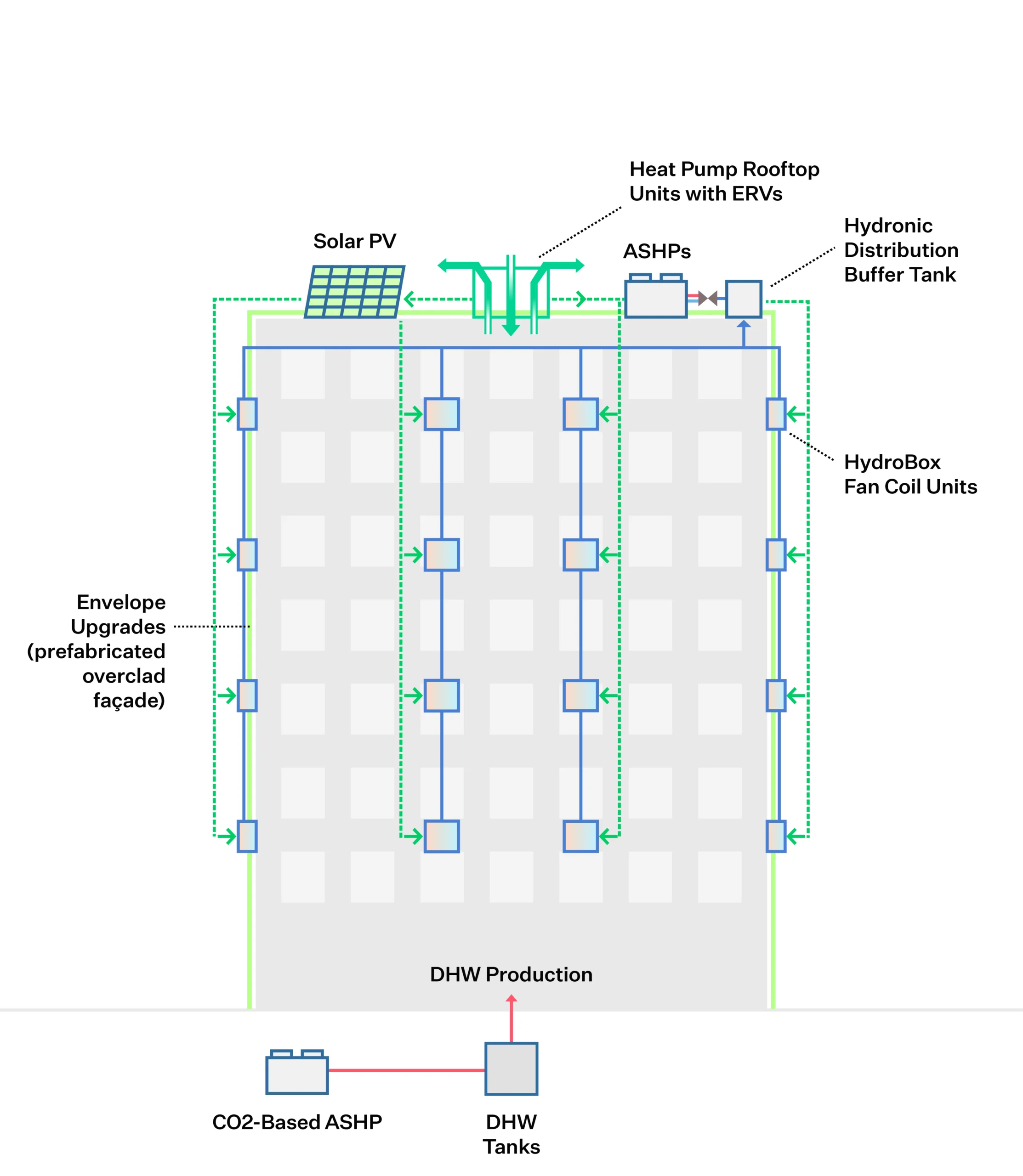
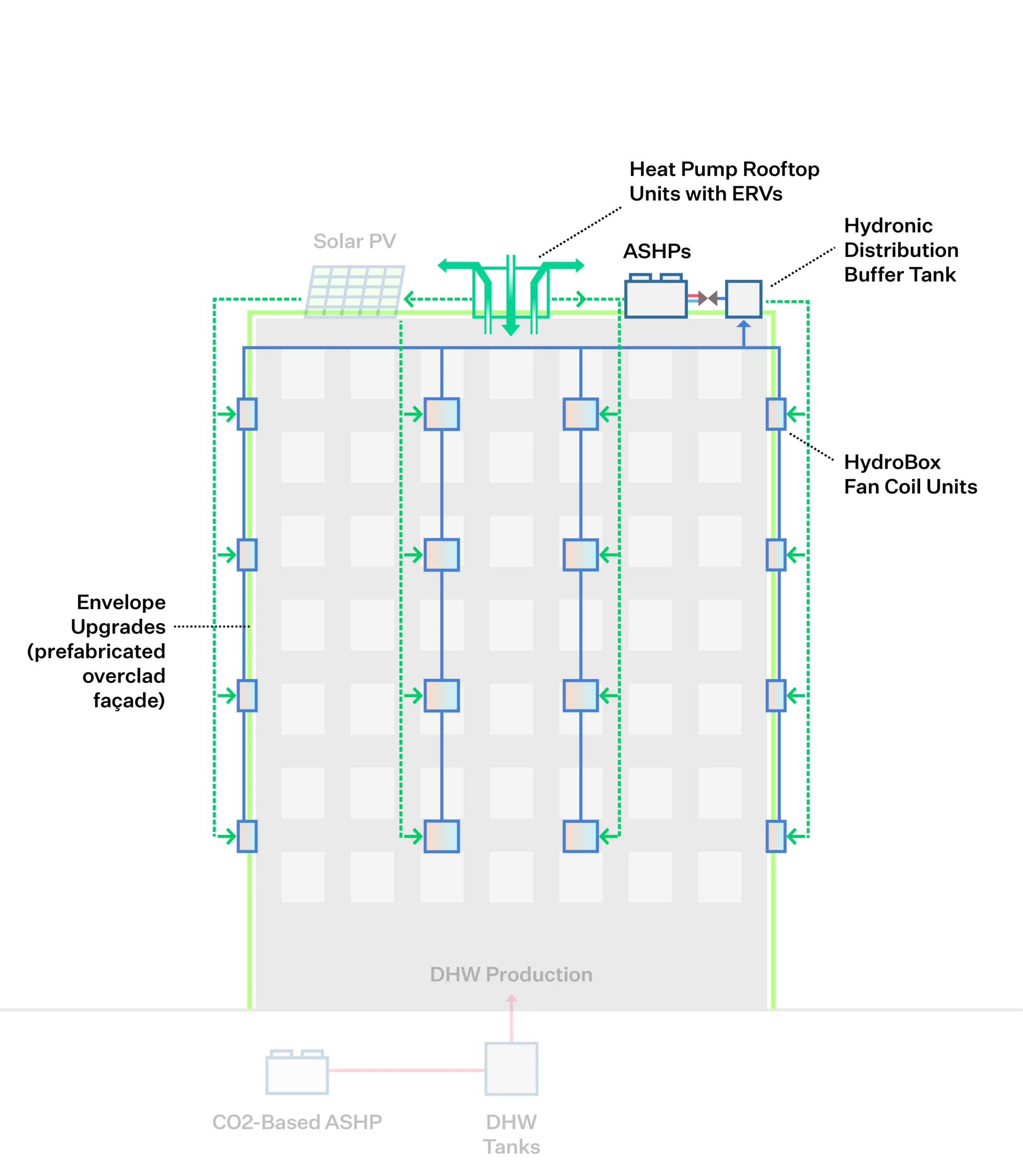
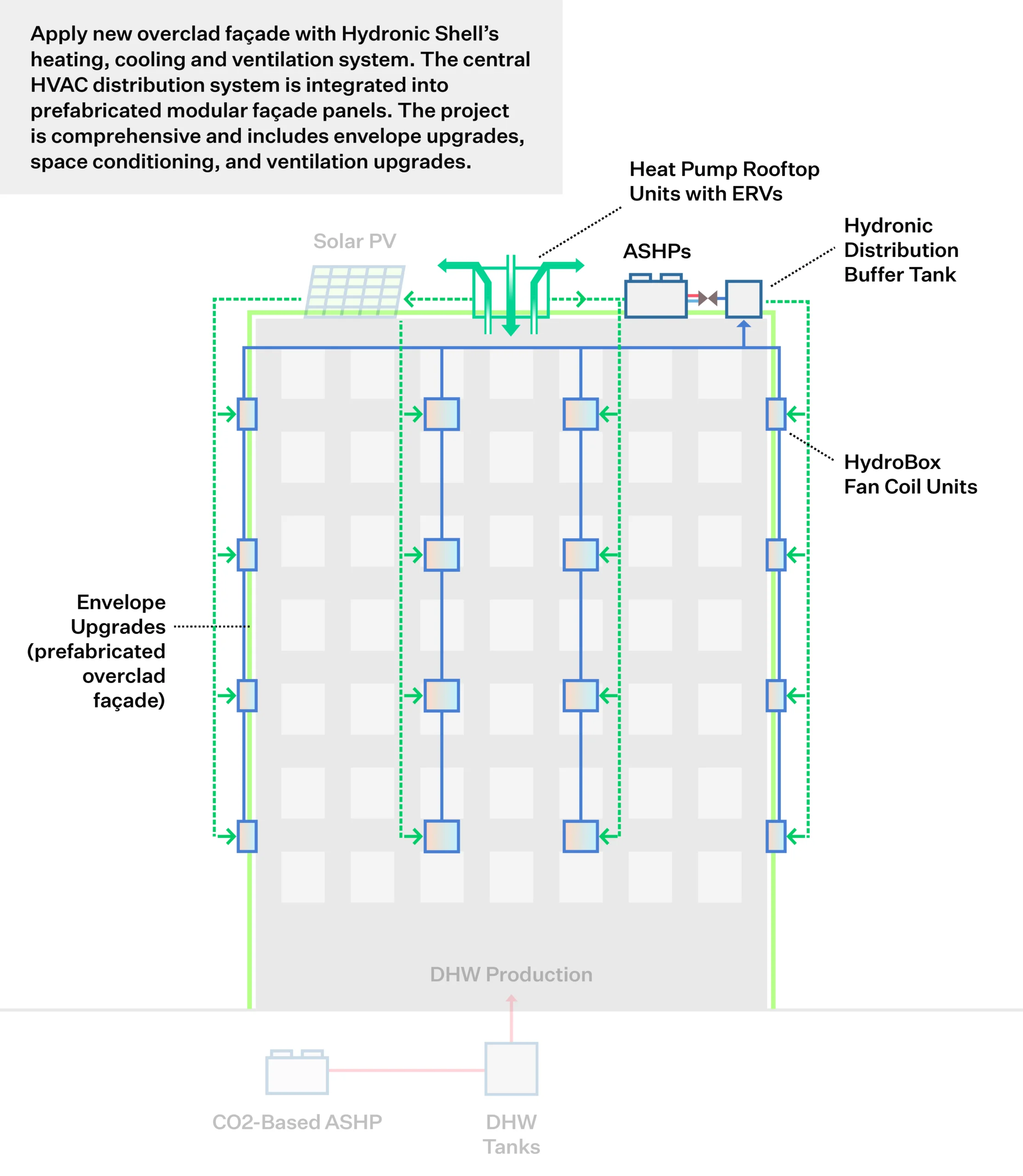
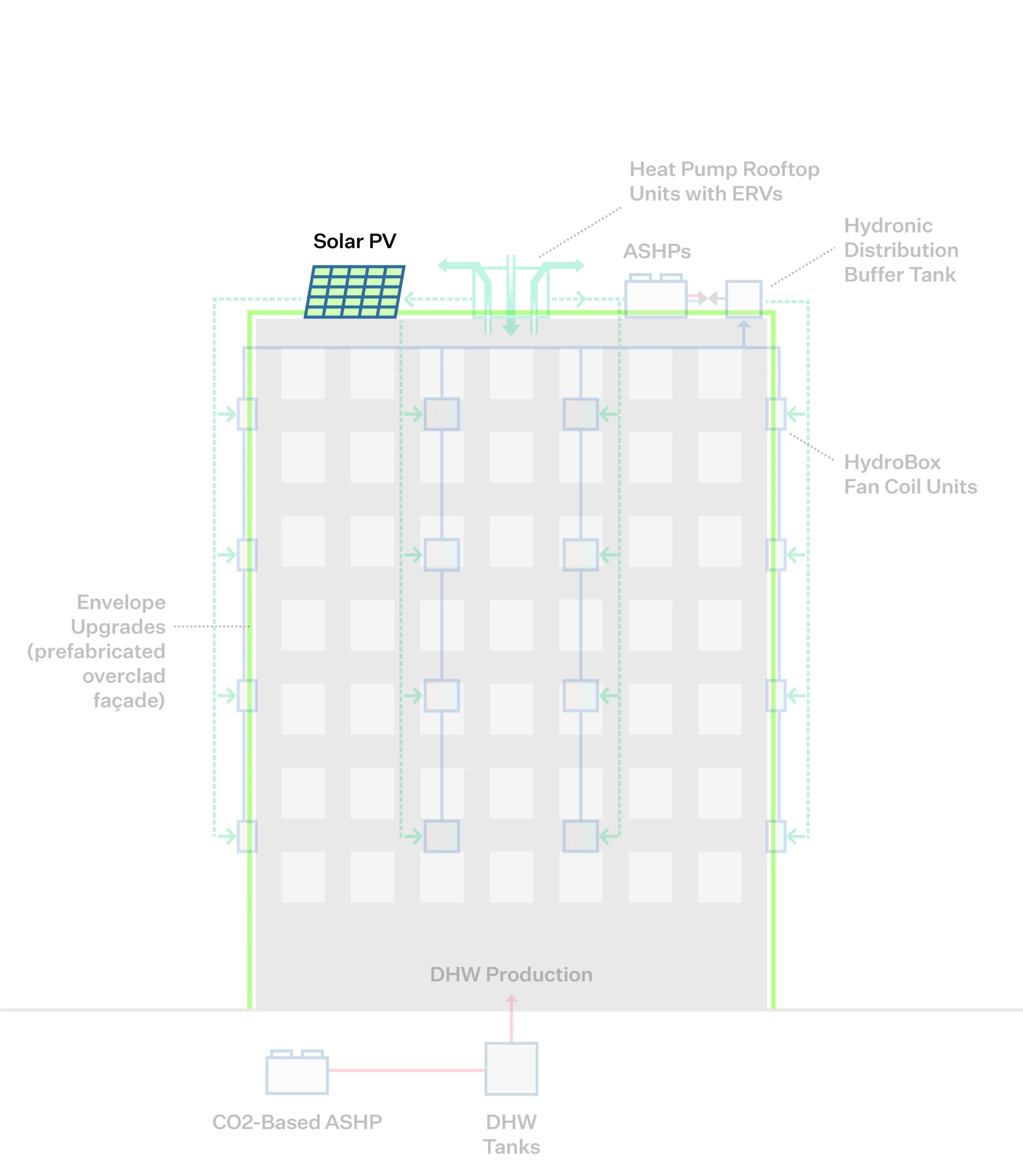
Click through the measures under “Building After” to understand the components of the building’s energy transition.
Sequence of Measures
2027
Building System Affected
heating
cooling
ventilation
Step 3
Step 3: Build the Business Case
Making a business case for strategic decarbonization requires thinking beyond a traditional energy audit approach or simple payback analysis. It assesses business-as-usual costs and risks against the costs and added value of phased decarbonization investments in the long-term.
Decarbonization Costs
$19.4M
Business-as-Usual Costs
$755,000 + $74,000 / YR
Energy cost savings: 74k / YR.
Repairs and maintenance savings: Minimal
BAU cost of system replacement/upgrades: 755k.
Business-as-Usual Risks
$0
Decarbonization Value
$7M
Incentives: ~7M (estimated).
Net Present Value
-$11.5M
The business case for decarbonization is centered around the buildings’ recapitalization cycles and a reduction in operating expenses.
The buildings currently face no potential penalties under Local Law 97 (since they are affordable housing covered under Article 321) and the operational savings are not commensurate with the cost of the Roadmap.
This is a typical situation in multifamily buildings, especially affordable housing, where the discounted cash flow analysis shows a negative present value compared to business as usual. High initial costs and the high cost per-unit of electricity compared to gas in New York City both push paybacks in an unattractive direction. A building will typically see only a handful of opportunities to fund capital projects. Incentives and tax credits are critical in making the business case for decarbonization.
Strategic Decarbonization Action Plan
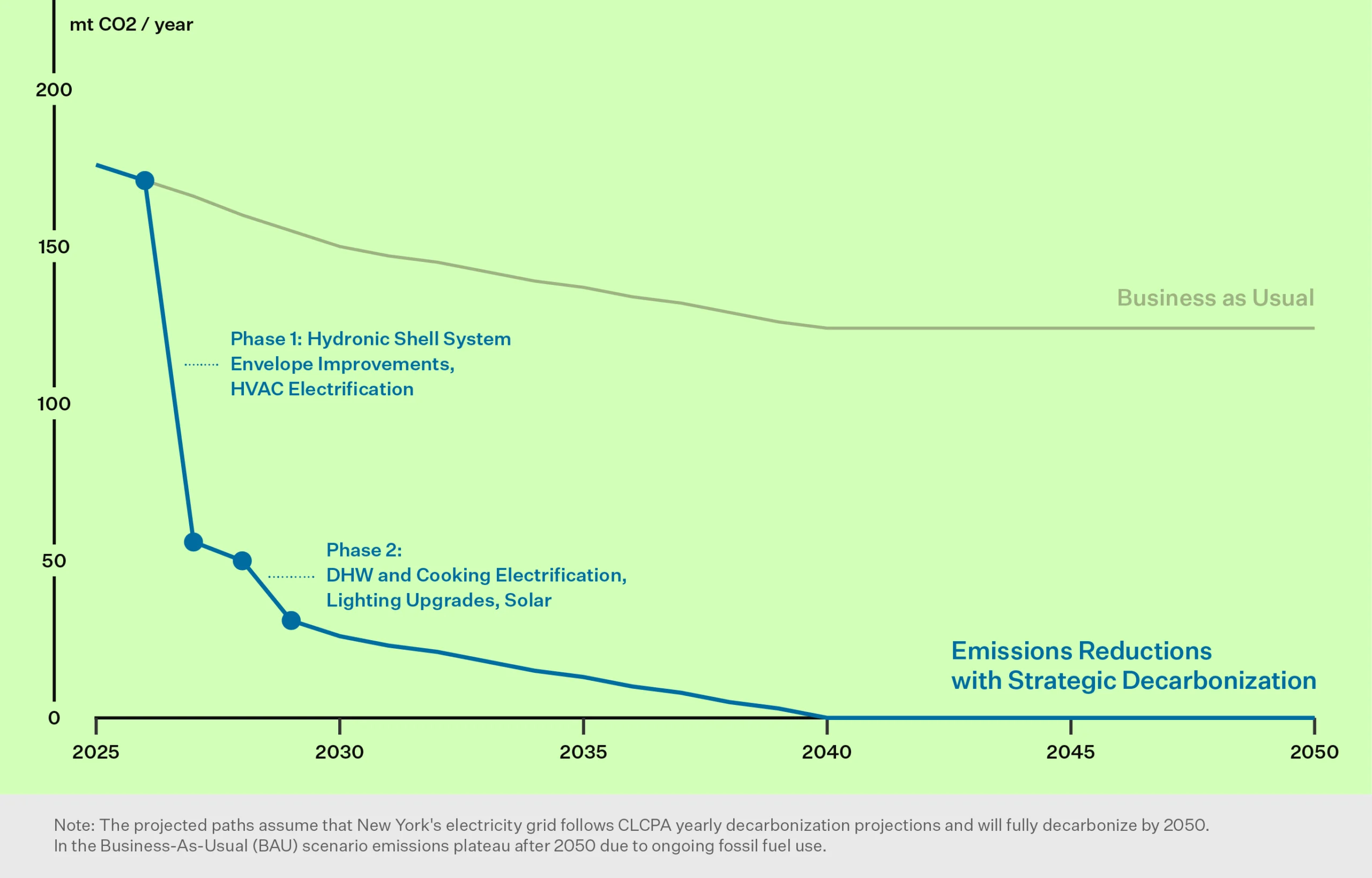
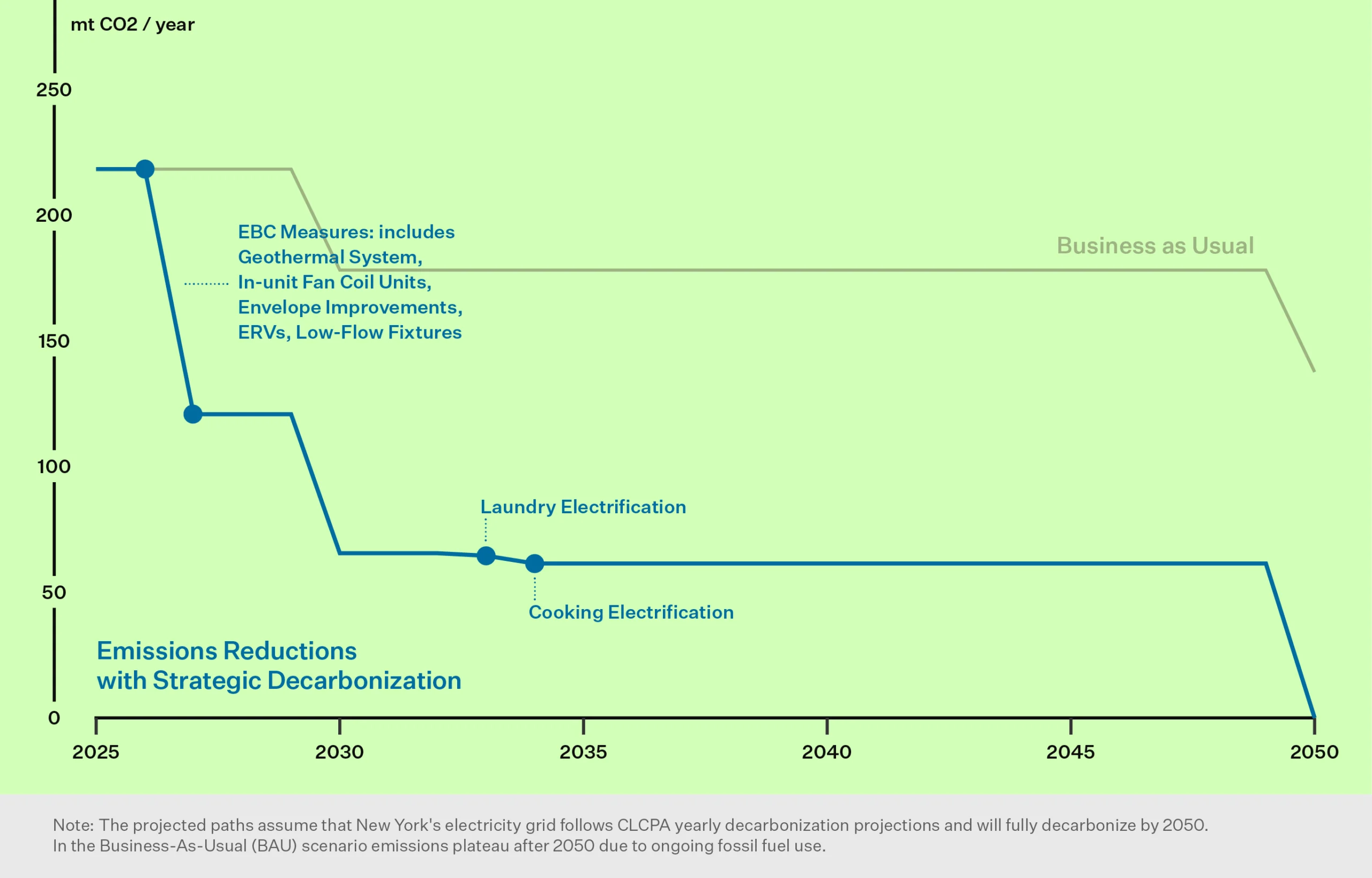
An emissions decarbonization roadmap helps building owners visualize their future emissions reductions by outlining the CO2 reductions from selected energy conservation measures. This roadmap is designed with a phased approach, considering a 20- or 30-year timeline, and incorporates the evolving benefits of grid decarbonization, ensuring a comprehensive view of long-term environmental impact.
A baseline assessment is key to understanding current systems and performance, then identifying conditions, requirements or events that will trigger a decarbonization effort. The assessment looks across technical systems, asset strategy and sectoral factors.
Building System Conditions
Asset Conditions
Market Conditions
Step 2
Step 2: Design Resource Efficient Solutions
Effective engineering integrates measures for reducing energy load, recovering wasted heat, and moving towards partial or full electrification. This increases operational efficiencies, optimizes energy peaks, and avoids oversized heating systems, thus alleviating space constraints and minimizing the cost of retrofits to decarbonize the building over time.
Step 3
Step 3: Build the Business Case
Making a business case for strategic decarbonization requires thinking beyond a traditional energy audit approach or simple payback analysis. It assesses business-as-usual costs and risks against the costs and added value of phased decarbonization investments in the long-term.
Decarbonization Costs
Business-as-Usual Costs
Business-as-Usual Risks
Decarbonization Value
Net Present Value
Strategic Decarbonization Action Plan
An emissions decarbonization roadmap helps building owners visualize their future emissions reductions by outlining the CO2 reductions from selected energy conservation measures. This roadmap is designed with a phased approach, considering a 20- or 30-year timeline, and incorporates the evolving benefits of grid decarbonization, ensuring a comprehensive view of long-term environmental impact.
Project Team
Additional Resources
Tags
This guide from The Clean Fight and RMI helps building owners and managers understand how high-temperature heat pumps can decarbonize steam and hot-water space heating systems. It outlines key benefits, technology basics, example products, and strategies for effective retrofit integration. High-temperature heat pumps offer a new, less disruptive path to electrification for buildings with steam or hot water distribution.
Strategic Decarbonization Planning Training Series
Tags
Project Highlights
Step 1
Step 1: Examine Current Conditions
A baseline assessment is key to understanding current systems and performance, then identifying conditions, requirements or events that will trigger a decarbonization effort. The assessment looks across technical systems, asset strategy and sectoral factors.
Building System Conditions
Asset Conditions
Market Conditions
Step 2
Step 2: Design Resource Efficient Solutions
Effective engineering integrates measures for reducing energy load, recovering wasted heat, and moving towards partial or full electrification. This increases operational efficiencies, optimizes energy peaks, and avoids oversized heating systems, thus alleviating space constraints and minimizing the cost of retrofits to decarbonize the building over time.
Step 3
Step 3: Build the Business Case
Making a business case for strategic decarbonization requires thinking beyond a traditional energy audit approach or simple payback analysis. It assesses business-as-usual costs and risks against the costs and added value of phased decarbonization investments in the long-term.
Decarbonization Costs
Business-as-Usual Costs
Business-as-Usual Risks
Decarbonization Value
Net Present Value
Strategic Decarbonization Action Plan
An emissions decarbonization roadmap helps building owners visualize their future emissions reductions by outlining the CO2 reductions from selected energy conservation measures. This roadmap is designed with a phased approach, considering a 20- or 30-year timeline, and incorporates the evolving benefits of grid decarbonization, ensuring a comprehensive view of long-term environmental impact.
Project Team
Additional Resources
Tags
About the Series
NYSERDA and Building Energy Exchange, in collaboration with RMI, University of Cincinnati, and Ember Strategies, are excited to offer a comprehensive three-part Strategic Decarbonization Planning training series designed to help industry professionals tackle complex retrofit projects with confidence. Tailored for professionals in engineering, real estate, and technology, this training series will equip participants with the tools and knowledge to drive practical, cost-effective low-carbon retrofits in large buildings. Grounded in lessons learned from NYSERDA’s Empire Building Challenge and their innovative retrofit demonstration projects, participants will learn how to:
Identify effective retrofit strategies by evaluating technical solutions and real estate conditions;
Make the case for low-carbon retrofits with compelling business narratives that resonate with decision-makers; and
Turn plans into action by creating clear, step-by-step decarbonization roadmaps for real-world projects.
Live training sessions for all three courses are coming this spring. Read more about our high-impact, solutions driven training series below:
Course 1
SDP: RED Framework and Technical Solutions (1.5 AIA LU)
This first course of the series will explore Resource Efficient Decarbonization (RED) as a replicable solutions framework used to develop carbon neutrality roadmaps for large buildings in cold climates. Using real-world examples from Empire Building Challenge retrofit projects, participants will learn how to apply the RED framework to create comprehensive, long-term decarbonization plans for their buildings. Additionally, the training will review a range of technical solutions for decarbonizing buildings, highlighting how prioritization of these technologies can optimize retrofits.
SDP: Building the Business Case for Better Decarbonization (1.5 AIA LU)
The second course will focus on the finance and asset planning components of strategic decarbonization. Participants will learn how to evaluate and align technical solutions with economic realities and long-term asset strategies to inform decision-making. This course will also provide guidance on crafting compelling business case narratives that build stakeholder support and unlock investment for retrofits. By the end of the training, participants will be equipped to develop persuasive business cases that advance building decarbonization projects.
Let’s Decarbonize! A Hands-on Building Decarbonization Workshop
The third course of the series will be a highly interactive session offering a hands-on introduction to building decarbonization planning – delivered in a dynamic, game-based format. The session begins with a brief review of key concepts from the first two courses, then, participants will break into small groups to create a mock decarbonization plan for a real-world building scenario. Teams will evaluate strategies to reduce greenhouse gas emissions while weighing factors such as costs, trigger events, and other site- specific considerations. Come prepared to collaborate, apply your skills, and dive into the decision- making process behind effective building decarbonization.
This material was developed at the University of Cincinnati by Amanda Webb, Barry Abramson, Katherine Castiello Jones, and Heather Cheng. It is based upon work supported by the National Science Foundation under Award No. 2339386.
A baseline assessment is key to understanding current systems and performance, then identifying conditions, requirements or events that will trigger a decarbonization effort. The assessment looks across technical systems, asset strategy and sectoral factors.
Building System Conditions
Asset Conditions
Market Conditions
Step 2
Step 2: Design Resource Efficient Solutions
Effective engineering integrates measures for reducing energy load, recovering wasted heat, and moving towards partial or full electrification. This increases operational efficiencies, optimizes energy peaks, and avoids oversized heating systems, thus alleviating space constraints and minimizing the cost of retrofits to decarbonize the building over time.
Step 3
Step 3: Build the Business Case
Making a business case for strategic decarbonization requires thinking beyond a traditional energy audit approach or simple payback analysis. It assesses business-as-usual costs and risks against the costs and added value of phased decarbonization investments in the long-term.
Decarbonization Costs
Business-as-Usual Costs
Business-as-Usual Risks
Decarbonization Value
Net Present Value
Strategic Decarbonization Action Plan
An emissions decarbonization roadmap helps building owners visualize their future emissions reductions by outlining the CO2 reductions from selected energy conservation measures. This roadmap is designed with a phased approach, considering a 20- or 30-year timeline, and incorporates the evolving benefits of grid decarbonization, ensuring a comprehensive view of long-term environmental impact.
Project Team
Additional Resources
Tags
A global survey of 14 high-rise multifamily retrofit profiles that achieved deep energy reductions.
Retrofit Playbook Event Series: New Decarbonization Tools from ASHRAE, USGBC, and The Retrofit Playbook
Tags
Project Highlights
Step 1
Step 1: Examine Current Conditions
A baseline assessment is key to understanding current systems and performance, then identifying conditions, requirements or events that will trigger a decarbonization effort. The assessment looks across technical systems, asset strategy and sectoral factors.
Building System Conditions
Asset Conditions
Market Conditions
Step 2
Step 2: Design Resource Efficient Solutions
Effective engineering integrates measures for reducing energy load, recovering wasted heat, and moving towards partial or full electrification. This increases operational efficiencies, optimizes energy peaks, and avoids oversized heating systems, thus alleviating space constraints and minimizing the cost of retrofits to decarbonize the building over time.
Step 3
Step 3: Build the Business Case
Making a business case for strategic decarbonization requires thinking beyond a traditional energy audit approach or simple payback analysis. It assesses business-as-usual costs and risks against the costs and added value of phased decarbonization investments in the long-term.
Decarbonization Costs
Business-as-Usual Costs
Business-as-Usual Risks
Decarbonization Value
Net Present Value
Strategic Decarbonization Action Plan
An emissions decarbonization roadmap helps building owners visualize their future emissions reductions by outlining the CO2 reductions from selected energy conservation measures. This roadmap is designed with a phased approach, considering a 20- or 30-year timeline, and incorporates the evolving benefits of grid decarbonization, ensuring a comprehensive view of long-term environmental impact.
Project Team
Additional Resources
Tags
As climate-forward policies have gained momentum and high-performance building technologies have continued to advance, building owners are feeling increasing pressure to decarbonize while navigating a growing array of retrofit options and requirements. How can project teams chart a course through this evolving and overwhelming landscape to confidently plan and implement decarbonization retrofits?
The newly released Guide to Strategic Decarbonization Planning, produced by ASHRAE, U.S. Green Building Council (USGBC), and supported by New York State Energy Research and Development Authority (NYSERDA), presents a comprehensive suite of best practices to operationalize deep decarbonization in buildings by following the strategic decarbonization planning (SDP) framework. SDP is a proven approach to decarbonization planning that integrates holistic technical solutions with pragmatic asset management strategies, enabling project teams to deliver cost-effective, flexible decarbonization projects.
Join ASHRAE, USGBC, and the Retrofit Playbook for Large Buildings team on September 23rd to learn more about the Guide to Strategic Decarbonization Planning and explore how it connects with the tools, case studies, and planning resources available on the RetrofitPlaybook.org. Whether you’re just getting started or refining a long-term roadmap, this session will help you learn how to apply the SDP framework and other practical resources to actualize low-carbon, future-ready building retrofits.
Opening Remarks
Sophie Cardona, Senior Project Manager, NYSERDA
Moderator
Molly Dee-Ramasamy, Director of Deep Carbon Reduction Group, JBB
Presenters
Laurie Kerr, Principal Climate Advisor, USGBC Phil Keuhn, Principal, RMI
Panelists
Adam Hinge, Managing Director, Sustainable Energy Partnerships Laurie Kerr, Principal Climate Advisor, USGBC Phil Keuhn, Principal, RMI Laura Humphrey, Senior Director of Energy & Sustainability, L+M Development Partners
A baseline assessment is key to understanding current systems and performance, then identifying conditions, requirements or events that will trigger a decarbonization effort. The assessment looks across technical systems, asset strategy and sectoral factors.
Building System Conditions
Asset Conditions
Market Conditions
Step 2
Step 2: Design Resource Efficient Solutions
Effective engineering integrates measures for reducing energy load, recovering wasted heat, and moving towards partial or full electrification. This increases operational efficiencies, optimizes energy peaks, and avoids oversized heating systems, thus alleviating space constraints and minimizing the cost of retrofits to decarbonize the building over time.
Step 3
Step 3: Build the Business Case
Making a business case for strategic decarbonization requires thinking beyond a traditional energy audit approach or simple payback analysis. It assesses business-as-usual costs and risks against the costs and added value of phased decarbonization investments in the long-term.
Decarbonization Costs
Business-as-Usual Costs
Business-as-Usual Risks
Decarbonization Value
Net Present Value
Strategic Decarbonization Action Plan
An emissions decarbonization roadmap helps building owners visualize their future emissions reductions by outlining the CO2 reductions from selected energy conservation measures. This roadmap is designed with a phased approach, considering a 20- or 30-year timeline, and incorporates the evolving benefits of grid decarbonization, ensuring a comprehensive view of long-term environmental impact.
Project Team
Additional Resources
Tags
This resource is available to aid design teams and building owners in navigating the complexities of rapidly shifting supply chains. It will provide up-to-date information on lead times and pricing for key equipment essential to the design and implementation of low-carbon building and retrofit projects in large commercial buildings. It will be updated semi-annually to reflect changes in the supply chain.
The Role of Design Charrettes in Building Decarbonization Planning
Tags
Project Highlights
Step 1
Step 1: Examine Current Conditions
A baseline assessment is key to understanding current systems and performance, then identifying conditions, requirements or events that will trigger a decarbonization effort. The assessment looks across technical systems, asset strategy and sectoral factors.
Building System Conditions
Asset Conditions
Market Conditions
Step 2
Step 2: Design Resource Efficient Solutions
Effective engineering integrates measures for reducing energy load, recovering wasted heat, and moving towards partial or full electrification. This increases operational efficiencies, optimizes energy peaks, and avoids oversized heating systems, thus alleviating space constraints and minimizing the cost of retrofits to decarbonize the building over time.
Step 3
Step 3: Build the Business Case
Making a business case for strategic decarbonization requires thinking beyond a traditional energy audit approach or simple payback analysis. It assesses business-as-usual costs and risks against the costs and added value of phased decarbonization investments in the long-term.
Decarbonization Costs
Business-as-Usual Costs
Business-as-Usual Risks
Decarbonization Value
Net Present Value
Strategic Decarbonization Action Plan
An emissions decarbonization roadmap helps building owners visualize their future emissions reductions by outlining the CO2 reductions from selected energy conservation measures. This roadmap is designed with a phased approach, considering a 20- or 30-year timeline, and incorporates the evolving benefits of grid decarbonization, ensuring a comprehensive view of long-term environmental impact.
Project Team
Additional Resources
Tags
As the world grapples with the urgent need to reduce greenhouse gas emissions, the built environment has become a critical focus area to deliver progress. Buildings are significant contributors to global carbon emissions, and transitioning to more sustainable, low-carbon operations is essential for meeting climate goals. Planning for that transition now, through a thoughtful and rational approach, is key to achieving success over time.
Design charrettes are an important tool project teams can use to support their decarbonization planning work. These collaborative design review workshops bring together diverse stakeholders to develop and refine strategies for reducing carbon emissions from buildings over time.
What is a Design Charrette?
A design charrette is an intensive, multi-disciplinary workshop aimed at finding and refining solutions to complex problems. The term originated in 19th century Paris and refers to the practice of design students working intensely on their projects until the last minute, when a cart or “charrette” would be wheeled around to collect their final designs. The term has evolved to describe collaborative sessions that bring together developers, designers, domain experts, community members, and an array of other stakeholders to reach mutually beneficial outcomes. In the context of building decarbonization, design charrettes facilitate the rapid development of actionable (and at times substantially more innovative) strategies to reduce emissions from buildings, with alignment among multiple interested parties.
Why Use Design Charrettes to Achieve Resource Efficient Decarbonization?
Collaborative Problem-Solving: Building decarbonization requires input from a wide range of experts, including architects, engineers, asset managers, environmental scientists, and community leaders. A design charrette brings these diverse voices together in a collaborative setting, ensuring that all perspectives are considered.
Intensive Focus: The concentrated nature of a charrette allows participants to delve deeply into the problem at hand. Over several hours (or days), stakeholders can explore various scenarios, analyze data, and develop detailed plans that might otherwise take months to create using traditional methods.
Iterative Process: Charrettes are designed to be iterative, with multiple rounds of feedback and refinement as needed. This approach ensures that the final outcomes are well-vetted and robust, with broad support from all stakeholders.
Creative Solutions: The collaborative and open nature of charrettes fosters creativity and challenges deeply held assumptions about how to approach a problem by the charrette participants. Participants are encouraged to think outside the box and develop innovative solutions that might not emerge in a more conventional planning process.
Achieving Resource Efficient Decarbonization (RED): Charrettes enable stakeholders to develop highly strategic plans to transition a building away from on-site fossil fuel over time in a way that does not diminish high-performance operations, contains operating and capital expenses, and maintains a complex urban systems perspective including considerations relating to infrastructure and natural resources.
The Design Charrette Process
Charrettes are conducted just after a decarbonization concept plan is created and initial decarbonization measures are framed. A successful charrette requires being prepared to discuss the existing conditions of the building in detail, various decarbonization measures and approaches considered, and an understanding of the social and market conditions influencing the building owner’s decision making. The charrette process includes:
Preparation: Successful charrettes require careful preparation. This includes identifying key stakeholders and inviting them to join, gathering relevant data, and setting clear objectives for the workshop.
Workshop Session: During the charrette, the project team presents their building existing conditions and decarbonization approaches and engage in brainstorming, design review, and business discussions with a team of technical experts and industry leaders.
Iteration and Feedback: Ideas generated during the sessions can be reviewed and refined through multiple rounds of feedback and additional charrettes as needed. This iterative process helps to improve and perfect the proposed solutions.
Implementation and Follow-Up: The final step is to translate the charrette outcomes into a formal strategic decarbonization plan and business case that leads to real-world actions. This may involve further planning, securing funding, and ongoing community engagement.
Design charrettes are a powerful tool for addressing complex decarbonization challenges, especially in the planning and early implementation phase. With collaboration, creativity, and iteration, charrettes enable the development of effective and sustainable strategies to reduce carbon emissions from buildings.
Want to review your decarbonization plan with our team of experts?
A baseline assessment is key to understanding current systems and performance, then identifying conditions, requirements or events that will trigger a decarbonization effort. The assessment looks across technical systems, asset strategy and sectoral factors.
Building System Conditions
Asset Conditions
Market Conditions
Step 2
Step 2: Design Resource Efficient Solutions
Effective engineering integrates measures for reducing energy load, recovering wasted heat, and moving towards partial or full electrification. This increases operational efficiencies, optimizes energy peaks, and avoids oversized heating systems, thus alleviating space constraints and minimizing the cost of retrofits to decarbonize the building over time.
Step 3
Step 3: Build the Business Case
Making a business case for strategic decarbonization requires thinking beyond a traditional energy audit approach or simple payback analysis. It assesses business-as-usual costs and risks against the costs and added value of phased decarbonization investments in the long-term.
Decarbonization Costs
Business-as-Usual Costs
Business-as-Usual Risks
Decarbonization Value
Net Present Value
Strategic Decarbonization Action Plan
An emissions decarbonization roadmap helps building owners visualize their future emissions reductions by outlining the CO2 reductions from selected energy conservation measures. This roadmap is designed with a phased approach, considering a 20- or 30-year timeline, and incorporates the evolving benefits of grid decarbonization, ensuring a comprehensive view of long-term environmental impact.
Project Team
Additional Resources
Tags
Through the Empire Building Challenge (EBC), NYSERDA is supporting forward-thinking leaders in the real estate and engineering industries, in the quest to find workable and scalable, cost-effective approaches to retrofit tall, complex, and hard-to-decarbonize buildings in New York. Partners and projects funded through the flagship $50 million demonstration program are working to reach a zero-emissions future. The groundbreaking work of these leaders is presented in this Playbook, which showcases a novel, compelling framework that can unlock opportunities for decarbonizing most buildings in a cost-effective manner, over time. We call the framework Resource Efficient Decarbonization.
To date, NYSERDA has partnered with 27 commercial and multifamily real estate owners who have committed to eliminate carbon emissions from some of New York State’s tallest and most iconic buildings. These partners have pledged to decarbonize over 128 million square feet of space, and more than 3,500 units of affordable housing. The scale of these partner commitments and the early success of EBC demonstration projects sends a clear signal that New York’s real estate industry is ready to accelerate investment in the buildings of the future.
Beyond these commitments, EBC partners collectively control and manage over 400 million square feet of real estate in New York. This amounts to over 20% of commercial office space in New York City, and more than 200,000 housing units throughout the State, representing a potential for impact much greater than the sum of its parts. The lessons learned during the planning, design, and implementation of EBC projects pave the way for the most viable solutions to gain traction and scale throughout the State, reinforcing progress toward the Climate Leadership and Community Protection Act’s goal to reduce greenhouse gas emissions 85% by 2050.
Understand the real-world implications and successes of the Empire Building Challenge through this in-depth article, “How to get New York City’s biggest buildings to zero carbon,” by Canary Media. This piece highlights the practical steps and measures being taken to reduce carbon footprints across New York’s architectural landscape, showcasing the challenge as a beacon for carbon-neutral aspirations worldwide.
A baseline assessment is key to understanding current systems and performance, then identifying conditions, requirements or events that will trigger a decarbonization effort. The assessment looks across technical systems, asset strategy and sectoral factors.
Building System Conditions
Asset Conditions
Market Conditions
Step 2
Step 2: Design Resource Efficient Solutions
Effective engineering integrates measures for reducing energy load, recovering wasted heat, and moving towards partial or full electrification. This increases operational efficiencies, optimizes energy peaks, and avoids oversized heating systems, thus alleviating space constraints and minimizing the cost of retrofits to decarbonize the building over time.
Step 3
Step 3: Build the Business Case
Making a business case for strategic decarbonization requires thinking beyond a traditional energy audit approach or simple payback analysis. It assesses business-as-usual costs and risks against the costs and added value of phased decarbonization investments in the long-term.
Decarbonization Costs
Business-as-Usual Costs
Business-as-Usual Risks
Decarbonization Value
Net Present Value
Strategic Decarbonization Action Plan
An emissions decarbonization roadmap helps building owners visualize their future emissions reductions by outlining the CO2 reductions from selected energy conservation measures. This roadmap is designed with a phased approach, considering a 20- or 30-year timeline, and incorporates the evolving benefits of grid decarbonization, ensuring a comprehensive view of long-term environmental impact.
Project Team
Additional Resources
Tags
Insights from Empire Building Challenge
The discovery phase is intended to provide an initial understanding of the building’s existing conditions, current challenges, and potential opportunities. The data and insights gathered during this phase will be used to create the building’s calibrated energy model. Key activities in this workstream include:
Collecting and reviewing relevant building information
Observing building operations under different conditions
Testing subsystems and their interactions
Creating the Business-as-Usual (BAU) base case
This workstream is critical because it grounds the project team in the reality of the building’s current performance. It also helps build a jointly owned process for uncovering early energy or carbon reduction opportunities that can increase trust and enthusiasm to identify more complex measures as the project progresses.
At the end of this phase, the team should have a clear understanding of the building energy systems, its historical energy and carbon profile, the potential impact of local laws or other building requirements, opportunities for additional metering, and preliminary energy and carbon reduction opportunities.
This workstream provides vital information on current challenges, near and longer-term carbon reduction opportunities, and the accuracy of the energy model. It also creates early wins that build momentum and trust. Getting the most out of this work requires trust-based collaboration between multiple stakeholders, including facilities managers, operations staff, the energy modeler, external contractors, and design engineers. Engaging with tenants to get insight into what drives their loads can also add value and inform this process. Data and insights on the building’s existing condition typically arise from four sources:
Design documents
Data from metered systems
Direct observation and testing
Building operations team feedback
Each source is important, but it is the integration across these four categories of data that leads to deep operational insights and identification of major areas of opportunity.
Inputs
Cross-disciplinary, trust-based collaboration
Tenant insights
Activities
Gather Information: In this phase, project teams should work with the building management and operations teams to collect key information using the sample checklist shown below.
Architectural drawings will be used to build the energy model geometry and assign performance characteristics to exterior wall assemblies.
Mechanical, Electrical and Plumbing Drawings: · Mechanical Schedules · Mechanical Riser Diagrams · M-Drawings (Schedules) of Retrofit/Upgraded Equipment or a Description of Changes · Electrical Schedules · Electrical Riser Diagrams · Lighting Schedules and Detail Sheets · Plumbing Schedules · Plumbing Riser Diagrams
MEP drawings will be used to build the energy-consuming systems in the energy model. These documents will also inform opportunities for equipment replacements based on end of useful life and can be referenced when evaluating equipment locations and available space.
Utility Data: · Minimum 12 months of data for all incoming utilities including electricity, natural gas, district steam, fuel oil · Data from tenant electrical sub-meters (if available) · Data from central plant BTU meters (if available)
Building utility bills showing annual energy consumption and tariffs are required to create an initial energy model. Utility bills allow the energy modeler to calibrate the total energy consumption and the breakdown by fuel type, which is important to track as different fuel sources have different greenhouse gas emissions and associated energy costs.
BMS Operational Information: · Fan run hours · Damper and valve positions · Air and water flow rates · Air handling unit supply air set points · Space temperature set points · Air, water and space temperatures · Chiller/cooling tower/boiler entering and leaving water temperatures · Pump flows during peak and off-peak times · Fan and pump electrical consumption and demand data from VFDs
Relevant BMS parameters include: · Meter data · Equipment hours of operation · Temperature setpoints · Data trends · Fault detection · System mode (manual versus override)
Historical data from the BMS can help align modeled energy use breakdowns with actual operation. Collating and reviewing this data can provide insights into building operations. Sometimes building operation differs from the document design, standards, and even the facilities team’s own understanding as system modifications are made incrementally over the years. Live data can be used to verify system schedules, turndown, and setpoints and drive even more accurate modeling of building operations. Building management systems provide insight into how the building is performing in real-time.
Operator Interviews
Information gathered from building operators can provide deep operation insights, serve to develop trust, and identify areas of opportunity for improvement.
Existing Capital Plans
It is also important to gather data on the “business as usual” (BAU) plan for future capital and operational expenditures. Doing so allows the team to compare ECMs against already planned expenditures and to begin to understand the sequence and timing of ECMs within the context of already-planned building upgrades.
Lease Turnover Schedules
Having insight into lease turnover schedules can help define opportunities for engaging tenants in the low carbon retrofit process and identifying proper phasing of decarbonization solutions in tenant spaces.
Survey the Building: Understanding a building’s existing conditions requires time on-site. Design drawings, operator interviews, and utility data all provide valuable insight, but do not capture the nuances of how the building runs day-in and day-out. Project teams should plan to conduct an initial site walkthrough to confirm high-level information about the building equipment, systems, and operations strategies shortly after project kickoff. As the study unfolds, additional site visits to verify information, gain additional clarity on certain conditions, or evaluate the feasibility of implementing ECMs will be necessary. The more time the project team spends in the building, the easier it will be to capture the building’s existing conditions in the building energy model and to develop ECMs that are feasible. When completing the building walkthrough, the project team should evaluate the following:
Space temperatures: does the space temperature feel too low or too high?
Infiltration conditions: are there noticeable drafts within the space?
Pipe trim and valving: is there proper instrumentation within the system?
Unoccupied space conditions: is equipment running when it should be off?
Central plant operations: is equipment running more often than it needs to be?
Piping/duct conditions: are there noticeable leaks or inefficiencies within the distribution?
Multiple controls for different equipment within a single space or physically grouped thermostats: is it possible that the controls are causing conflicting operation?
Deploy Additional Metering (if required): Collecting documentation and surveying the building will highlight gaps in data or information needed to build a calibrated energy model. To fill these gaps, the project team may elect to deploy additional metering to capture the missing information. Metering ultimately reduces speculation and provides real-time insight into the building’s operations. Project teams should execute the following steps when developing a metering strategy:
Identify and create an inventory of existing meters, submeters and instrumentation.
Verify the accuracy of existing meters and ensure they are properly connected and integrated in the building management system (BMS).
Gain direct access to view the BMS data. Ideally, the team will have viewing access to real-time building operations during the entire duration of the project.
Identify areas where additional meters will be required.
Develop a deployment program for additional metering needs including preferred vendors, meter types, meter quantities, locations for placement, and an installation schedule.
Observe and Test Systems: Building system assessments and functional tests are great ways to capture operating parameters, evaluate performance, and identify issues that can be resolved with retro-commissioning. Project teams should conduct some or all the following building tests to further inform the study:
Test/Assessment
Goals
Reference/Procedure
Building envelope performance and infiltration
Understand the conduction losses/gains through the envelope. This will inform potential envelope opportunities and the baseline energy model.
Refer to ASTM E1186 – 17 for standard practices for air leakage site detection in building envelopes and air barrier systems.
Tenant electric load disaggregation, i.e. plug loads, lighting, IT
Identify high consumption loads within tenant spaces to target critical loads and opportunities.
Select one or two tenants and install submeters on their floor (can be temporary), separating out loads by lighting, IT, plug loads. Analyze consumption and data trends to develop energy conservation measures.
Setpoints and setbacks in all spaces (tenant areas, common area, IT rooms, MEP) during winter and summer seasons
Determine the most energy efficient setpoint/setback while maintaining a comfortable space. Evaluate what is possible within each space. Evaluate the ability of the system to recover from the setback without causing excessive utility demand.
Test potential setpoint and setback temperatures within each space type to determine the optimal energy efficient condition.
Airside controls
Verify that airside controls are configured to optimize energy and indoor air quality. Identify easy-to-implement and inexpensive controls ECMs.
Test procedures will vary based upon the type of airside equipment in use; however, the following assessments are applicable to many airside configurations and can act as a starting point: Step 1: Verify that static pressure setpoint controls are correct per the sequence of operations or current facility requirements. Step 2: Verify that supply air temperature resets are programmed and operating within the correct range. Step 3: Verify that terminal box minimum and maximum setpoint are appropriately set per the latest balancing report. Step 5: Confirm if outdoor airflow stations are installed, and if so, verify that the appropriate amount of outside air is being delivered per the design documents or current facility requirements. Step 6: Verify if a demand control ventilation (DCV) program is in place. If so, confirm that outside airflows are reduced as occupancy is reduced. Step 7: Verify that turndown controls are appropriately reducing equipment temperatures or flows in low load conditions.
Waterside controls
Verify that waterside controls are configured to optimize energy and are load-dependent.
Identify easy-to-implement and inexpensive controls ECMs.
Test procedures will vary based upon the type of waterside equipment in use; however, the following assessments are applicable to many waterside configurations and can act as a starting point: Step 1: Verify that static pressure setpoint controls are correct per the sequence of operations or current facility requirements. Step 2: Verify that supply or return temperature resets are programmed and operating within the correct range. Step 3: Confirm if an economizer mode is available, and if so, verify that the system appropriately enables this mode in certain weather conditions. Step 4: Verify that turndown controls are appropriately reducing equipment temperatures or flows in low load conditions.
BMS anomalies and faults
Identify discrepancies in what the BMS is outputting on the front-end versus the actual observed conditions. Identify easy-to-implement and inexpensive controls ECMs.
For each tested system, compare the BMS outputs to the actual measured data or observed condition. Identify the root cause of the discrepancy and resolve.
Outputs
An additional metering strategy with a timeline for installation and a plan for measurement & verification of new meters.
A preliminary list of operational adjustments and retro-commissioning issues based upon building surveys and building system assessment/tests.
A plan for implementing operational opportunities like setbacks and setpoint adjustments.
Lessons Learned and Key Considerations
Investigation and discovery are an iterative process: — Information from all avenues including reviewing design drawings, walking the building, talking to the facilities team, and performing building tests will be required to create a full picture of the building’s existing condition. Consistent feedback is the key to success.
Organization should be a top priority: — The amount of information collected on the building will be significant. To ease the burden of developing an energy model for the building, information should be verified and organized so that it can be easily referenced throughout the project.
Business operations are as important as facility operations: Energy studies tend to focus only on the architectural and MEP operations within the building. Project teams spend a lot of time understanding how equipment and systems operate and perform, but often don’t spend enough time considering the building’s existing lease turnover schedules, existing capital plans, or hold strategy. These business considerations are critical to understanding the types of decarbonization strategies that building ownership are likely to invest in.
2. Build the “Business-as-Usual” Base Case
Building the business-as-usual (BAU) base case occurs between the Discovery and Energy Modeling phases and includes an analysis of the building’s utility data to gain insight into how the building uses energy at a high level and how that consumption translates to carbon emissions. From this analysis, the project team will be able to evaluate the building’s exposure to mandates such as Local Law 97.
Inputs
Building the BAU base case requires obtaining one full year of utility data, at a minimum.
Activities
Utility Analysis (Baseline Condition): As the project team learns the building, one full year of utility data (at a minimum) will be collected. The project team should visualize this data monthly to further develop its understanding of how and when the building uses energy. The following list of questions can be used to guide the analysis:
What fuel types are consumed by the building?
When are fuel types used the most or the least and why?
Are there unexpected usage peaks for certain fuel types?
What is the building Energy Use Intensity (EUI) and how does it compare to peer buildings?
What is the building Energy Cost Intensity (ECI) and how does it compare to buildings?
What service class is the building in and what is the tariff structure for that service class?
How does demand correlate with cost?
Based on the results of this activity, the project team will begin to form hypotheses about how building systems interact, which end uses are the most energy intensive, and where deeper energy and carbon reduction strategies may be pursued.
Building Performance Standard Impact Analysis: Depending on the jurisdiction in which the deep energy retrofit study is taking place, it may be beneficial for the project team to evaluate the building’s current performance against mandates or building performance standards (BPS) that are in effect. In New York City, for example, Local Law 97 is a BPS that many building owners are focused on. Other jurisdictions may have energy use intensity (EUI) targets or other metrics for performance. The outcome of the impact analysis may help to inform the overall decarbonization approach for the building. Project teams should execute the following steps to conduct a BPS impact analysis:
Step 1: Aggregate annual utility data by fuel type.
Step 2: Convert raw data into the appropriate BPS metric. In the example of LL97, annual fuel consumption is converted to annual carbon emissions with carbon coefficients that are published in the law.
Step 3: Compare the building’s annual performance against the BPS performance criteria.
Step 4: Consider how the building’s performance might change over time as the electric grid decarbonizes. In the example of LL97, a building’s carbon emissions associated with electricity consumption will naturally decline over time as the grid decarbonizes.
Step 5: Calculate impacts of compliance or non-compliance with the BPS. For LL97, building emissions in excess of the allowable carbon limit results in an annual financial penalty.
Step 6: Share results with the building management and ownership teams to further inform that building decarbonization approach.
During the energy retrofit process, the team will discover simple ways to reduce energy consumption that can be implemented almost immediately. With real-time data, the BMS allows the team to analyze how effective the changes to the system are.
Outputs
Deliverables for this task include the following:
Energy, carbon & cost end use breakdowns (monthly)
Demand and tariff structure analysis
Mandate or Building Performance Standard impact analysis
Lessons Learned and Key Considerations
Visualize the data: — Data visualizations can bring insights to light and help project teams explain these insights to non-technical audiences. Making complex energy analysis accessible to all members of the project team, including those without technical backgrounds, will lead to a more engaging and actionable process for all.
BPS impact assessments can alter the deep energy retrofit approach: — Mandates and building performance standards are often successful in getting building owners to think more critically about existing building energy and carbon performance; however, the anticipated impact of a BPS can alter how the project team approaches a deep retrofit project. For example, if an Owner discovers that their building is not subject to non-compliance penalties until 2030 or 2035, they may elect to wait on larger retrofit projects than they would have if penalties were imminent in 2024. It’s important that project teams review BPS exposure with the Owner before settling on a particular decarbonization strategy or timeline.
Consider the grid: — When evaluating a building’s anticipated performance over time in the BAU base case, the project team must take grid decarbonization into account. The overall outlook for the building can change drastically with and without grid decarbonization. Both scenarios must be explored and discussed with the building owner and management team.
3. Identify Preliminary ECMs and Carbon Reduction Strategies
Inputs
Based on the work completed during the “Learn the Building” and “Build the BAU Base Case” tasks, the project team should already have a sense of the ECMs that are a good fit for the building. The project team should review the outcomes of the work done up to this point and develop a list of preliminary strategies so the team can level set on an approach as the project enters the Energy & Carbon Modeling phase.
Activities
• Develop a Tiered List of ECMs: Through the document collection and building system assessments, the project team likely identified low or no-cost operational items that can be implemented immediately. These simple items should be grouped and presented as Tier 1 measures. Deeper measures that require more upfront capital and/or have a longer lead time should be separated out into Tier 2 items. Tiers can be based upon cost or timeframe for implementation. Categorizing measures in this way will support building owner decision-making.
• Conduct a Qualitative Assessment of ECMs: Once the measures are appropriately categorized into tiers, the project team should generate a qualitative assessment of each measure, based on metrics that are important to the building management team. For example, one building team may identify disruption to tenants as their primary go/no-go metric when deciding which strategies deserve deeper analysis. Metrics will vary from project to project.
• Present and Solicit Feedback: Present the tiered list of ECMs, along with the qualitative assessment, and solicit feedback from the building management team. Eliminate ideas that don’t meet the team’s decarbonization approach and welcome new items that the building team may want to pursue that were not originally considered. This process will bolster team engagement and ensure that time spent in the energy model is dedicated to measures that will be considered seriously by the building team for implementation.
Outputs
The output of this task will be a finalized list of energy reduction strategies to study the next phase: the Energy & Carbon Modeling Phase.
Lessons Learned and Key Considerations
Solicit feedback early and often: — In any deep energy retrofit study, there will be several opportunities for the building to reduce energy and carbon. Some of these strategies will be reasonable to the building management and ownership teams, and others will not. To avoid going down the wrong road and analyzing a set of solutions that don’t align with the building team’s vision, the project team should present potential strategies early on and gain consensus on the decarbonization approach before analyzing measures in the building energy model.
The Heritage, preserved by L+M, showcases a multifamily retrofit project that eliminates fossil fuel usage, improves resident comfort, and minimizes occupant disruption through the use of innovative retrofit methods, materials, and technology. The 34-story, three-building complex , which was built in 1974 next to Central Park in New York City, contains 600 housing units, of which 402 are affordable, with 134 set aside for the formerly unhoused.
The Heritage is an affordable housing development with poor insulation and high utility costs due to outdated heating and water heating systems. This project dramatically cuts heating and cooling needs thanks to major building envelope improvements. Packaged terminal heat pumps for heating and cooling will reduce energy use and costs from the current electric resistance heating system. The retrofit project also pilot-tests state of the art heat pump water heaters and electric laundry dryers.
L+M is a pioneer in mixed-income, market-rate, and mixed-use developments that revive and transform neighborhoods. The company has acquired, built, or preserved nearly 46,000 residential units and more than 1.2 million square feet of retail and community facility space, representing approximately $16.5 billion in development and investment.
Project Highlights
Investment
19 million
to accomplish Strategic Decarbonization retrofits.
Testimonial
“The funding from NYSERDA’s Empire Building Challenge program will help L+M pilot and scale new retrofit technologies that will drastically reduce or eliminate carbon emissions in our affordable housing portfolio. Large-scale investment in such technology is crucial to addressing the challenge of climate change.”
Joseph Weishaar
Senior Vice President
L+M Fund Management
Scale
The package of measures offers a pathway to decarbonization for LMI properties across New York State.
Testimonial
“We integrated a newer prefabricated system with EIFS to significantly upgrade the performance and aesthetics of The Heritage, while minimizing project costs.”
David Ash
Director of Construction
L+M Development Partners
Step 1
Step 1: Examine Current Conditions
A baseline assessment is key to understanding current systems and performance, then identifying conditions, requirements or events that will trigger a decarbonization effort. The assessment looks across technical systems, asset strategy and sectoral factors.
Building System Conditions
Equipment nearing end-of-life
Comfort improvements
Indoor air quality improvements
Facade maintenance
Efficiency improvements
Asset Conditions
Repositioning
Recapitalization
Capital event cycles
Carbon emissions limits
Owner sustainability goals
Market Conditions
Technology improves
L+M takes advantage of the recapitalization cycle of The Heritage to upgrade its infrastructure and include decarbonization measures to meet its climate goals while improving tenant comfort. The property’s age and outdated design made it an ideal candidate for a deep carbon reduction project, focused on envelope improvements, high efficiency heat pumps, and an integrated design approach to minimize tenant disruption. One element of this project is improving views through larger windows.
Step 2
Step 2: Design Resource Efficient Solutions
Effective engineering integrates measures for reducing energy load, recovering wasted heat, and moving towards partial or full electrification. This increases operational efficiencies, optimizes energy peaks, and avoids oversized heating systems, thus alleviating space constraints and minimizing the cost of retrofits to decarbonize the building over time.
Existing Conditions
This diagram illustrates the building prior to the initiation of Strategic Decarbonization planning by the owners and their teams.
Click through the measures under “Building After” to understand the components of the building’s energy transition.
Sequence of Measures
2022
2023
2024
Building System Affected
heating
cooling
ventilation
Reduce Energy Load
Re-cladding of the 3 buildings is estimated to avoid $10 million of LL11 compliance costs between now and 2046. One portion of the project is using prefabricated external wall panels from Dextall to minimize installation time and therefore tenant disruption.
Envelope Improvement: Install exterior wall and roof insulation (EIFS overclad and panelized wall system with integrated high performance windows, dependent on location, and commercial window replacement)
Submetering
Recover Wasted Heat
Energy Recovery Ventilator (ERV): install ERV unit into exhaust risers to recapture exhaust heat and preheat fresh air
Partial Electrification
Replacing apartment electric resistance heating baseboards and sleeve air conditioning units with modular Packaged Terminal Heat Pumps (PTHP), and installing CO2-based heat pumps for Domestic Hot Water (DHW) production will significantly increase system efficiency and reduce energy use
and costs. The PTHP installation work is coordinated with the panelized exterior wall system to integrate necessary electrical upgrades and condensate lines and minimize installation time as a result.
Heat Pumps: Replace electric baseboard heating with Package Terminal Heat Pumps (PTHPs) for apartments and install VRF system for common areas
Domestic Hot Water: CO 2 Air Source Heat Pump (ASHP) for DHW production
Laundry appliance
Step 3
Step 3: Build the Business Case
Making a business case for strategic decarbonization requires thinking beyond a traditional energy audit approach or simple payback analysis. It assesses business-as-usual costs and risks against the costs and added value of phased decarbonization investments in the long-term.
Decarbonization Costs
$18M
Capital costs of decarbonization measures.
Business-as-Usual Costs
$11M + $535k / YR
BAU cost of system replacement/upgrades and LL11 compliance cost for facades + yearly energy cost, repairs, and maintenance savings.
Business-as-Usual Risks
$34k / YR
Avoided LL97 fines starting in 2030.
Decarbonization Value
$6M
Incentives from Empire Building Challenge and Clean Heat from ConEd.
Net Present Value
TBD
Net difference between the present value of cash inflows and outflows over a period of time.
Built in 1974, the buildings have little-to-no remaining insulation, costly and inefficient baseboard electric resistance heat systems, and central natural gas-fired domestic hot water (DHW) plants. The outdated design and building age make the Heritage an ideal candidate for a carbon-neutral deep retrofit.
At the time of its acquisition in late 2019, L+M planned to open up the façade at 1660 Madison to increase the size of some of the bedroom windows and replace the roof. Previous ownership had already completed this scope of work on the two high-rise towers. Since 1660 Madison was already targeted for these more intrusive upgrades, the building presented the greatest opportunity for a deep retrofit scope of work. This 11-story building’s scale and layout is representative of L+M’s portfolio and LMI (low and moderate housing) buildings in New York State.
The package cost exceeds that of standard business-as-usual practice at the property. Every element of the buildings’ envelope, HVAC systems, DHW systems, and controls are proposed for upgrades to modernize the building to meet necessary resiliency and low-carbon needs.
Standard operating practice at the building would entail maintenance and replacement of mechanical systems in-kind at end of useful life (e.g., baseboard heaters, central DHW, and exhaust equipment), and code-minimum glazing replacement at end of useful life.
The building’s heating system consists of mainly baseboard electric resistance heaters in apartments and some common areas. It is estimated that roughly 50% of the heaters date to the building’s construction and as such are past the end of useful life and in need of replacement. Cooling in apartments is provided by sleeve ACs provided by residents. PTHP installation will provide controllable, efficient heating, as well as cooling to all residents within the 1660 Madison building. The higher cost for this upgrade provides a better functioning system and benefit to residents.
The three gas-fired water heaters are near the end of their useful life, making for an ideal time to invest in a new approach to DHW. The electrification of the load at 1660 will inform the approach used at the towers later in the decarbonization period.
Facade maintenance requires continual investment. In particular, recladding of the three properties is estimated to avoid $10 million of LL11 compliance costs between now and 2046.The new façade approach will nearly eliminate these costs throughout the life of the product as it will not require the same upkeep as the existing materials.
The 1660 Madisonbuilding is an 11-story Concrete Superstructure with a masonry cavity wall façade with no insulation. The master bedrooms have one full height window and one narrow ribbon window at the top of the wall. All other bedrooms have a narrow ribbon window at the top of the wall. All the windows were replaced over 20 years ago and are in poor condition. Only the living rooms and master bedrooms are cooled, with conventional AC Units installed in through-wall sleeves.
The initial approach to updating the façade was to enlarge ribbon windows, install AC units/through-wall sleeves in all rooms without cooling, replace all residential windows, and then clad masonry with an EIFS system.
After review, it was determined that masonry columns around windows and modified openings would require a significant amount of reinforcement and likely not survive demolition and need to be removed and replaced. Construction time frames would take roughly 8 weeks per apartment with a temporary interior wall shrinking apartment spaces.
Instead L+M identified a solution that would address both the engineering and tenant challenges and found that a window-wall or panelized system would solve both. This solution eliminates the need for added masonry reinforcing and/or the rebuilding of masonry which significantly reduces installation time from (8) to (2) weeks. This allows residents to remain in their units during construction and substantially reduces the impact on their daily lives.
This approach would also give added access to upgrade the existing baseboard heating and through-wall AC cooling to combined BMS-controlled PTHPs. The façade work also permits running the necessary electrical conduit and drainage for the PTHPs. L+M identified the Dextall Dwall product which combines UPVC components resulting in superior thermal values. This prefabricated product addresses insulation and air-sealing requirements, while also including window replacements in one package. L+M verified with the manufacturer that it can be customized to include necessary sleeve penetrations for PTHPs.
Financial feasibility for decarbonization projects depends on numerous factors including the availability of project financing, incentive funding, and allocation of low-income housing tax credits (LIHTC). Exterior over-cladding projects that enhance curb appeal and improvements to resident comfort may also increase market rents and/or Section 8 rents. L+M evaluates potential reductions to long-term capital spending in addition to operating expense savings in determining which projects to pursue. In addition to financial feasibility, L+M may elect to pursue decarbonization measures in order to evaluate new materials and technologies, meet internal ESG goals, or comply with mandated or anticipated regulatory changes.
Strategic Decarbonization Action Plan
An emissions decarbonization roadmap helps building owners visualize their future emissions reductions by outlining the CO2 reductions from selected energy conservation measures. This roadmap is designed with a phased approach, considering a 20- or 30-year timeline, and incorporates the evolving benefits of grid decarbonization, ensuring a comprehensive view of long-term environmental impact.
In 2020, L+M envisioned a deep retrofit plan for the Heritage and formed its consulting team including Inglese and Cosentini. L+M and SWA discussed the possibility of applying to the Empire Building Challenge initial round to further study possibilities for the building and to support the retrofit plan. In 2021 the L+M was awarded the next round of funding to execute the vision. The process encouraged the team to think holistically about the project and identify as many opportunities as possible to eliminate fossil fuel usage, reuse waste heat, and reduce loads on the building.
Throughout 2022 to the present, the team has met regularly to review each aspect of the design, review submittals and recommend improvements, and review construction schedules and decision-making deadlines to ensure all elements of the project are completed as needed.
As a socially responsible developer, sustainability is central to L+M’s mission to create green, high-quality affordable housing. Since many of our projects are income-restricted, L+M is focused on reducing operating costs to allow for greater affordability.
Partnering with NYSERDA on developing a roadmap to carbon neutrality will benefit our investors, residents, our communities, and our environment, both now and in the future
L+M hopes to use the Empire Building Challenge as a chance to pilot new technologies and create a scalable approach to reducing emissions throughout its portfolio.
Furthermore, L+M is committed to transparency and sharing retrofit project economics and case studies with the broader industry. L+M’s pre-construction, engineering, and development teams actively share best practices with industry peers through the New York State Association for Affordable Housing (NYSAFAH), The Urban Land Institute (ULI) and other industry organizations.
L+M is also an active participant in conferences and stakeholder sessions with NYSERDA and is committed to working with state and local governments, equipment suppliers, contractors, and the broader real estate industry to decarbonize the built environment.