



































































Case Study

St. Elizabeth Manor

Renewing multifamily senior housing with sustainable electrification

This case study was chosen as part of the Empire Building Challenge competition. Click here to learn more about the Empire Building Challenge competition.

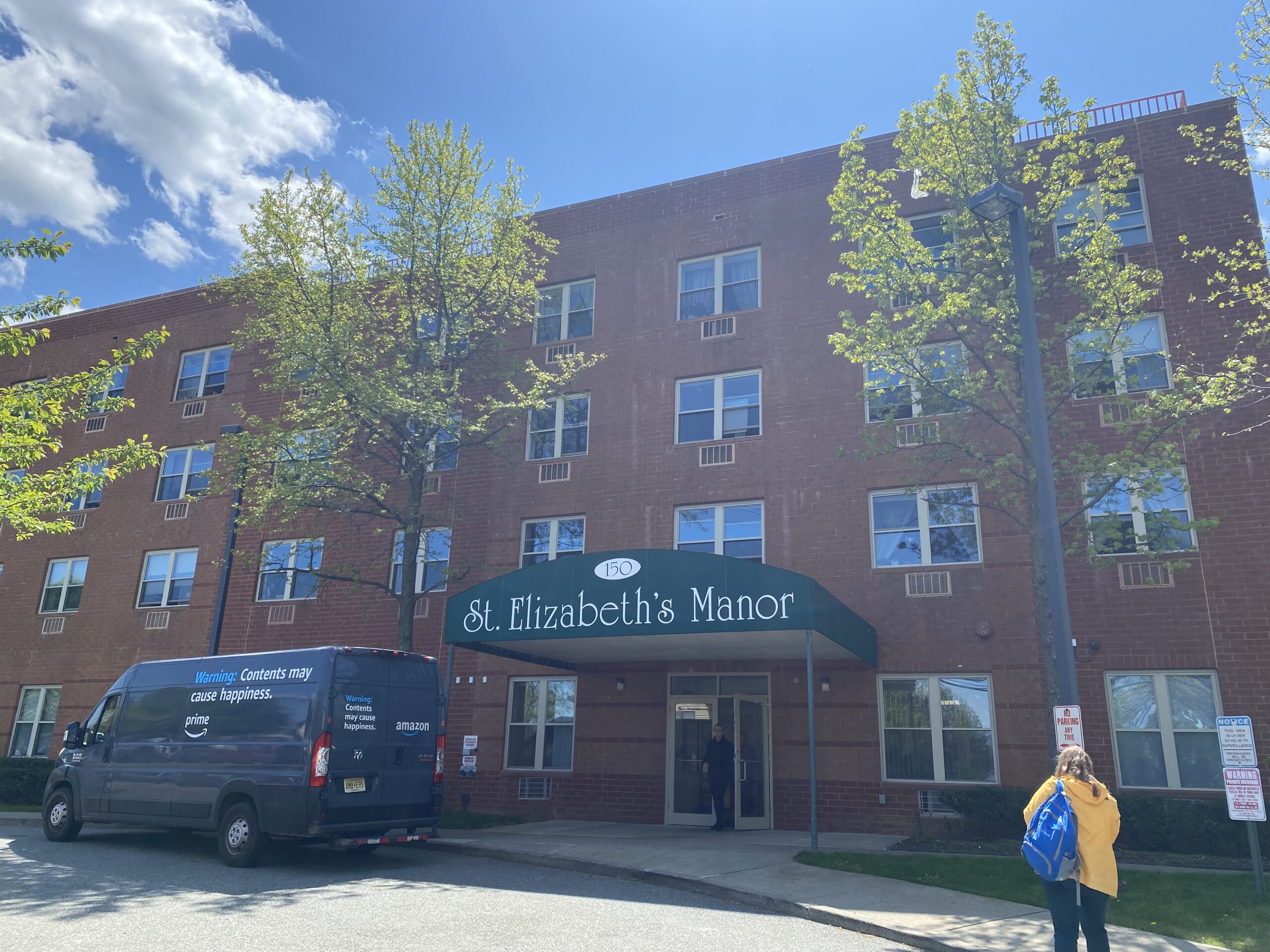
St. Elizabeth Manor is a 4-story, 80-unit multifamily senior-housing building located at 150 Brielle Avenue in Staten Island, New York. The 61,320 GSF building was constructed in 1994 and has not undergone any major renovations since. Besides utilizing natural gas for space heating and domestic hot water production in the cellar, the rest of the building and all apartments run on electricity. Existing systems and infrastructure are mostly original to the building and nearing the end of their useful lives. The goal is to revive the building by improving the envelope, electrifying heating and hot water systems, installing heat recovery systems for ventilation, and installing wastewater heat recovery systems. Sisters of Charity Housing Development has 17 total buildings in their portfolio which includes 1272 total dwelling units. The owner’s goal is to replicate the above measures in all the buildings that have similar existing conditions, which will impact 804 dwelling units.
St. Elizabeth Manor
Conditions Assessment

High gas consumption and deteriorating existing conditions are driving the decision to decarbonize St. Elizabeth Manor.

Project Planning

Added wall insulation, weather stripping, and ventilation improvements, will significantly reduce heating loads at the site.

Project Planning

Space heating and water heaters will be electrified using cold climate packaged terminal heat pumps and high performance blackwater source heat pumps.

A baseline assessment is key to understanding current systems and performance, then identifying conditions, requirements or events that will trigger a decarbonization effort. The assessment looks across technical systems, asset strategy and sectoral factors.

Building System Conditions

  • Equipment nearing end-of-life
  • Comfort improvements
  • Indoor air quality improvements
  • Efficiency improvements
Asset Conditions

  • Recapitalization
  • Carbon emissions limits
  • Owner sustainability goals
Market Conditions

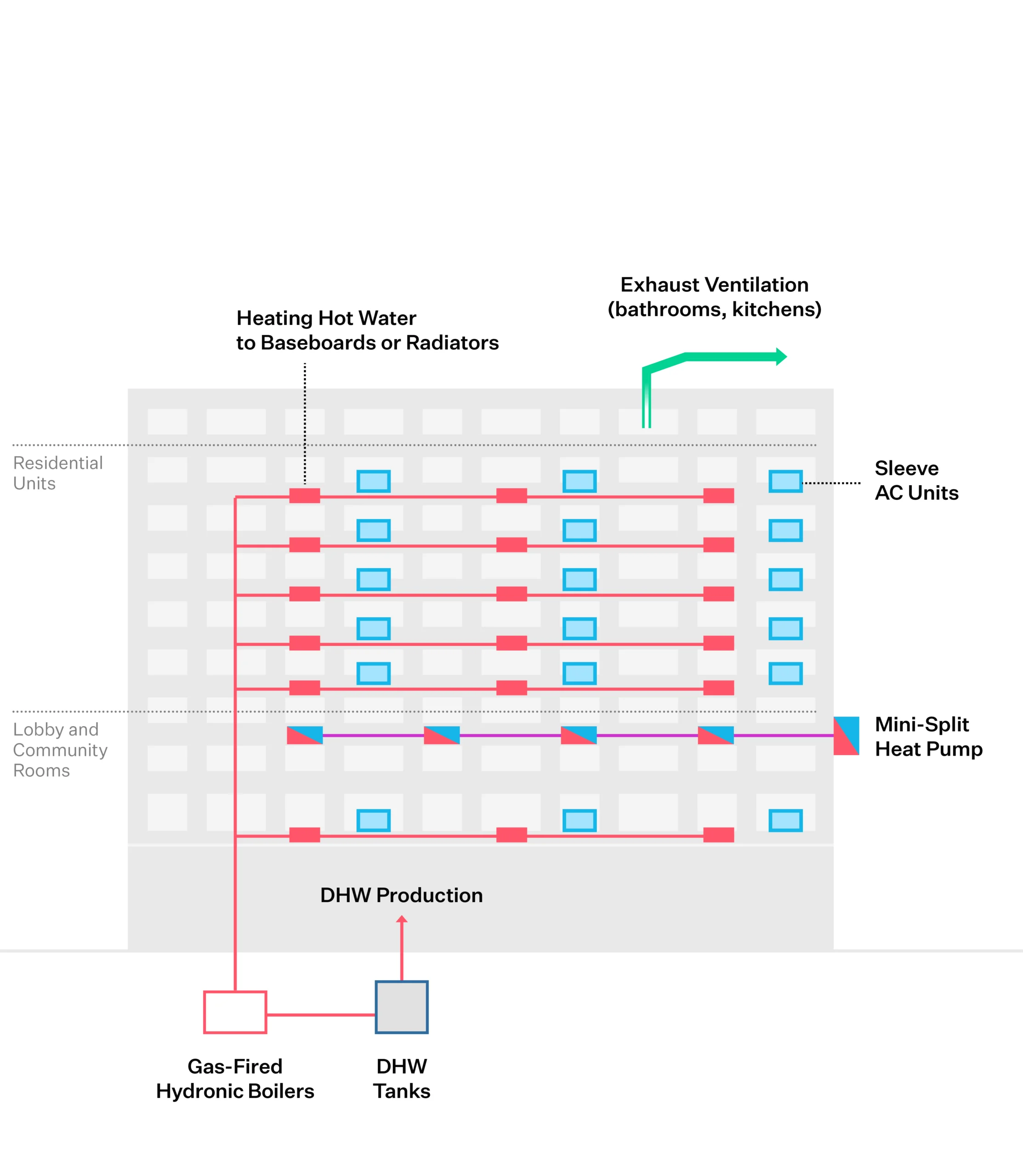
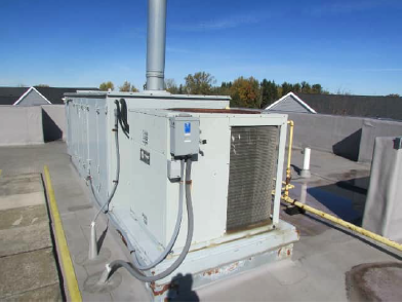
    Considering the age of all original systems, the building is operating fairly but structurally failing with repairs needed to the face brick façade and roof which continue to experience water infiltration issues, particularly around the windows, roof flashing and bulkheads. Energy consumption associated with space heating and domestic hot water is high. The reasons for high space heating include high ventilation/infiltration, conductive heat losses through building envelope, and ageing boiler. The high infiltration is caused due to unbalanced ventilation, high exhaust rates, lack of energy recovery system, and weakening infrastructure. Domestic hot water consumption is high due to high flow rates from faucets/shower heads and ageing non-condensing water heaters.

    Effective engineering integrates measures for reducing energy load, recovering wasted heat, and moving towards partial or full electrification. This increases operational efficiencies, optimizes energy peaks, and avoids oversized heating systems, thus alleviating space constraints and minimizing the cost of retrofits to decarbonize the building over time.

    Existing Conditions

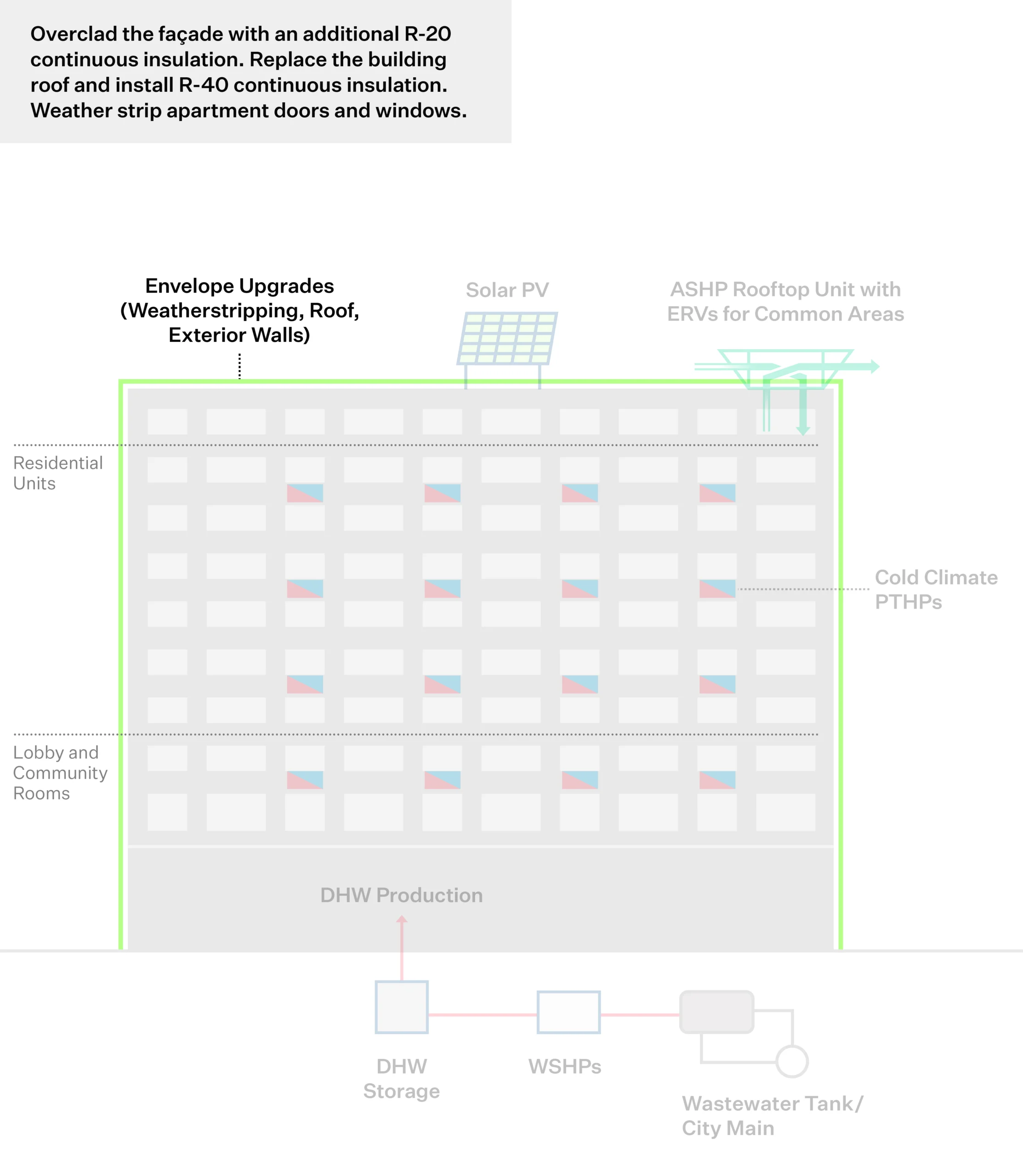
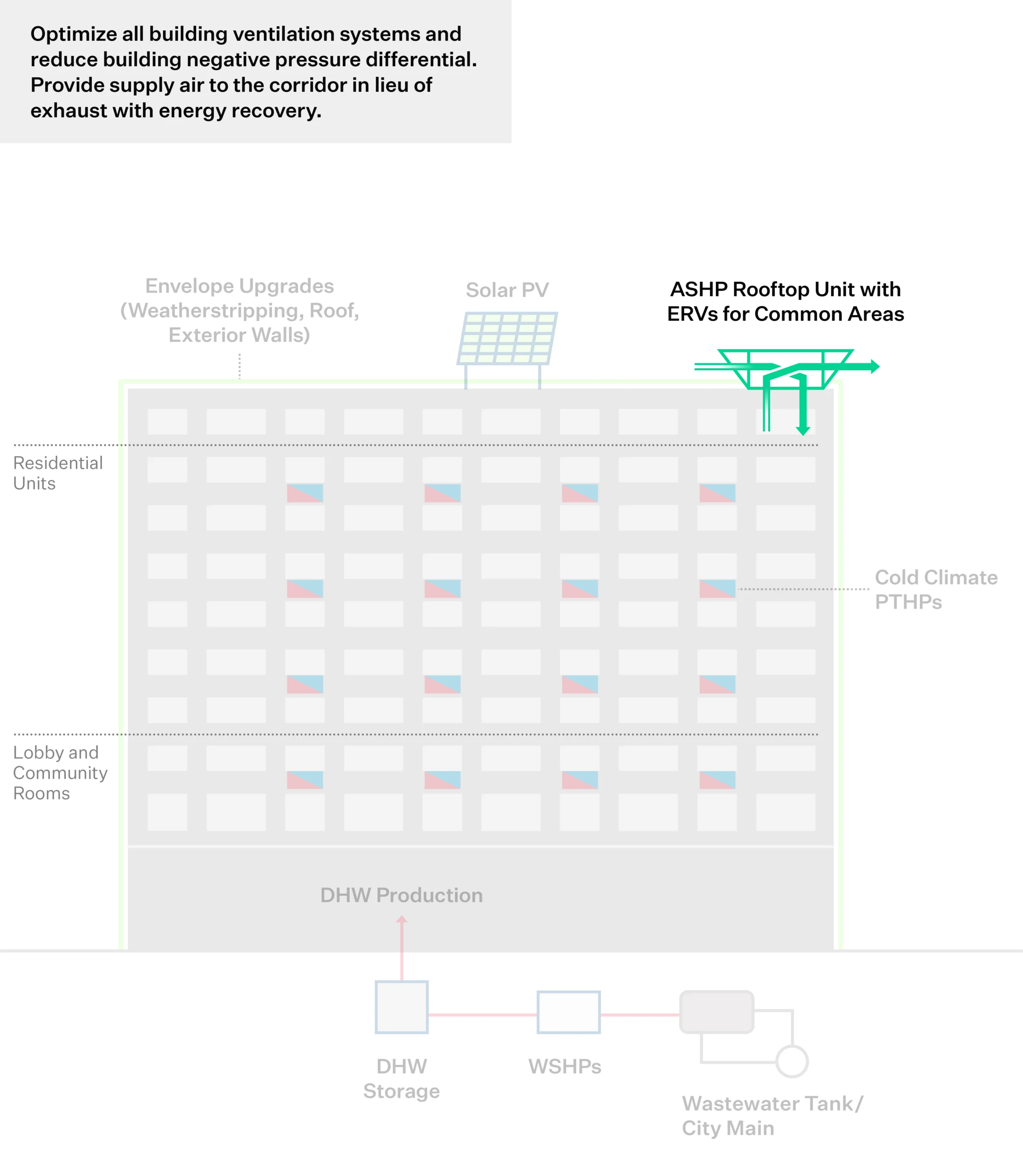
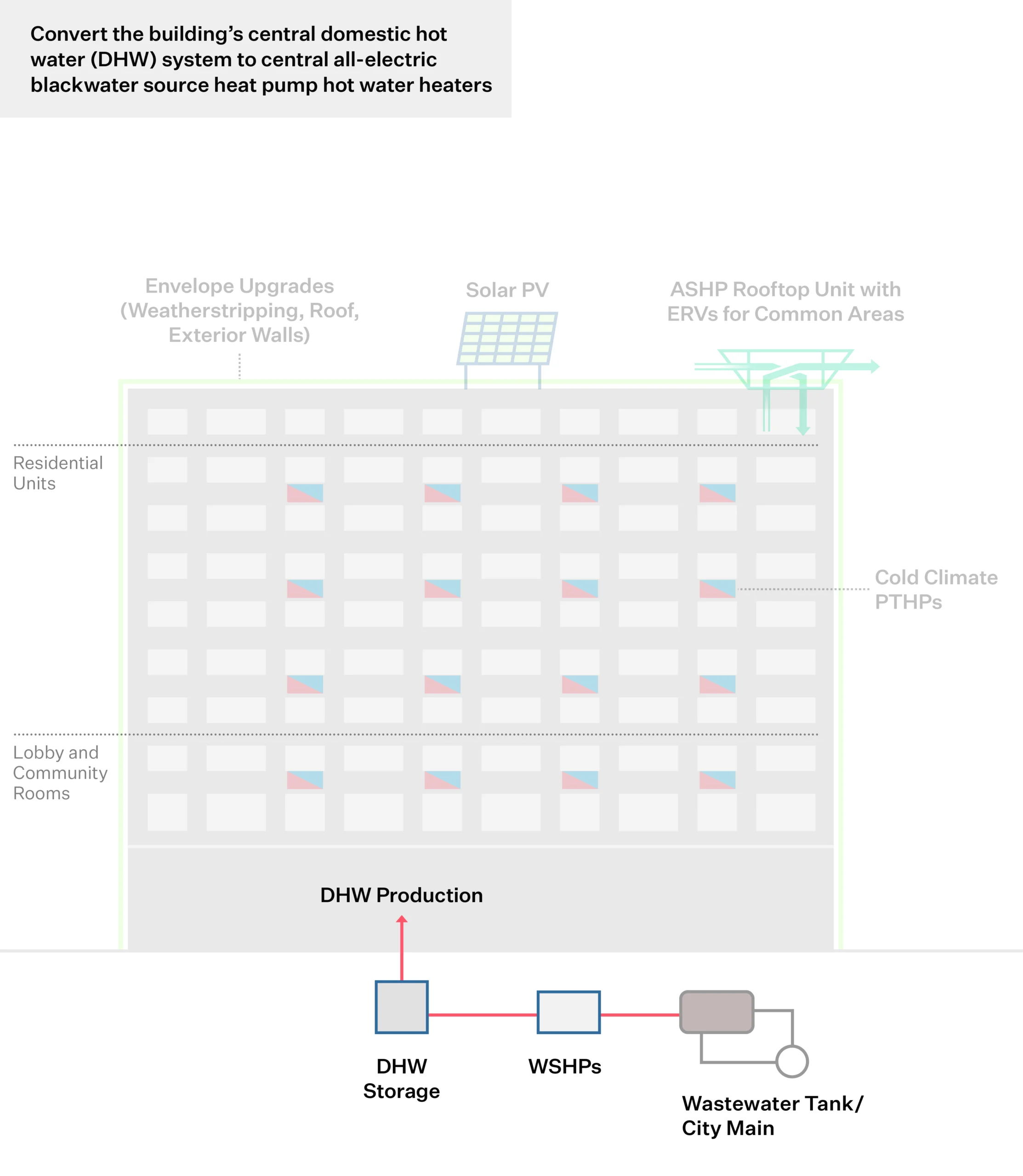
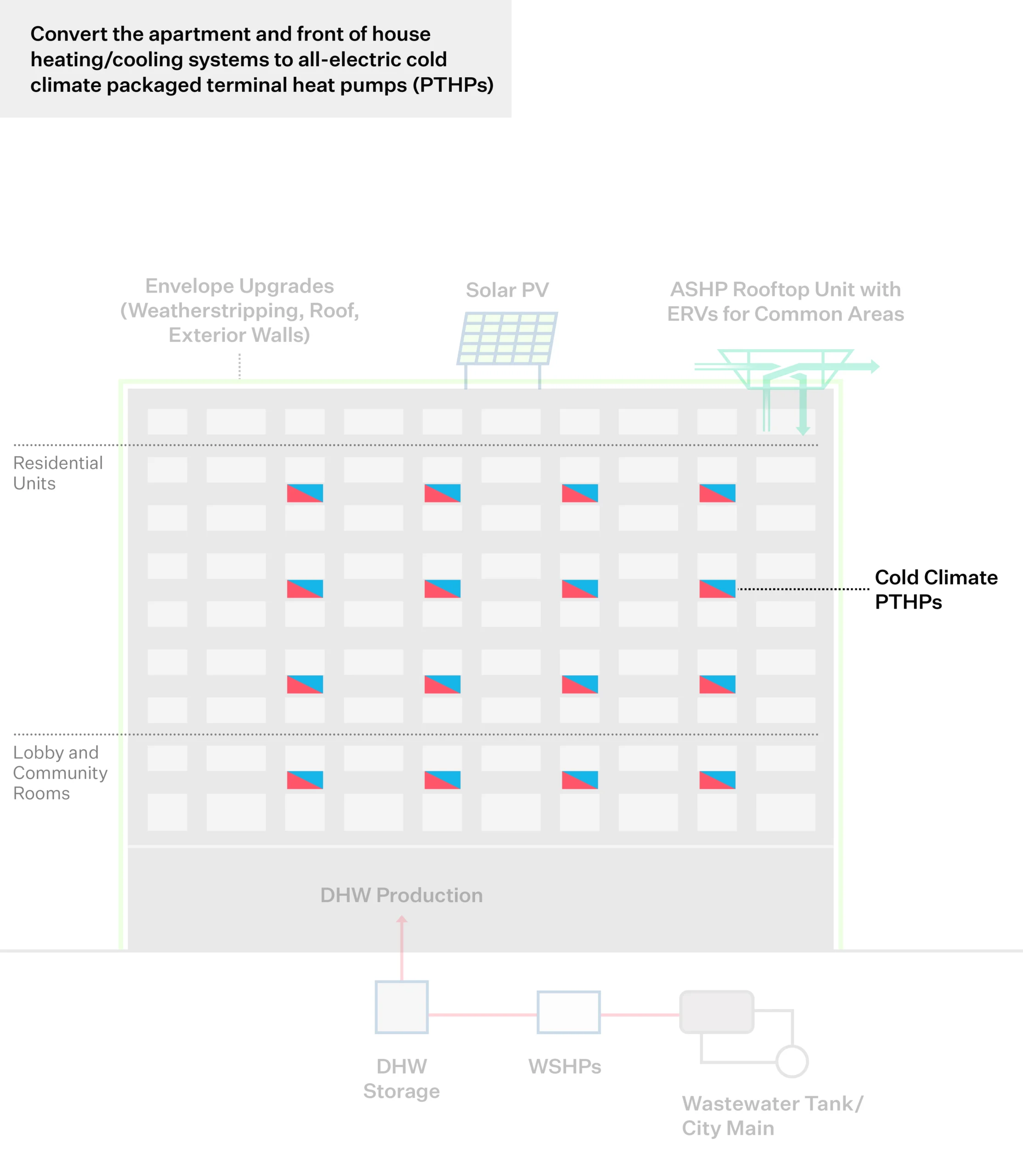
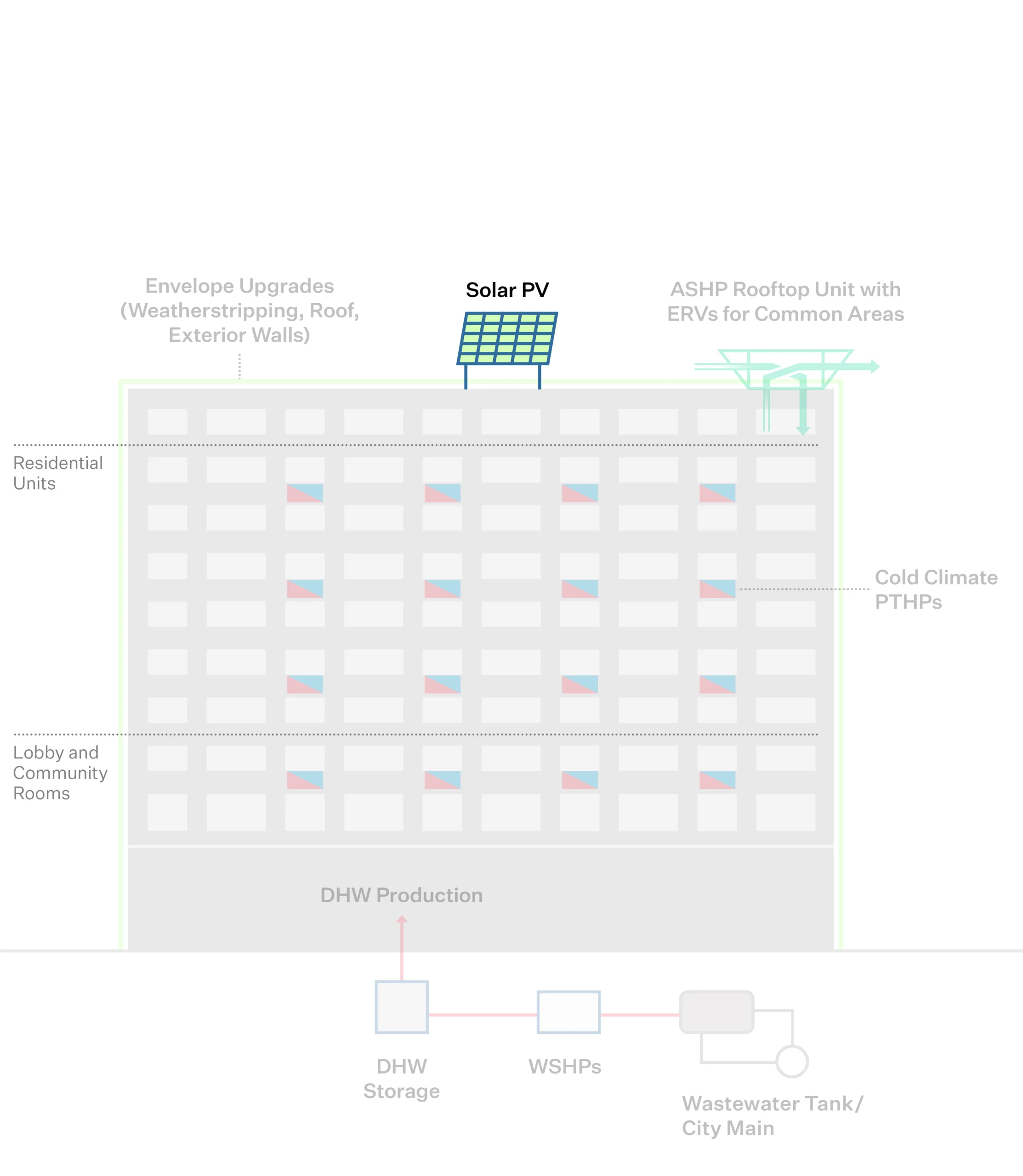
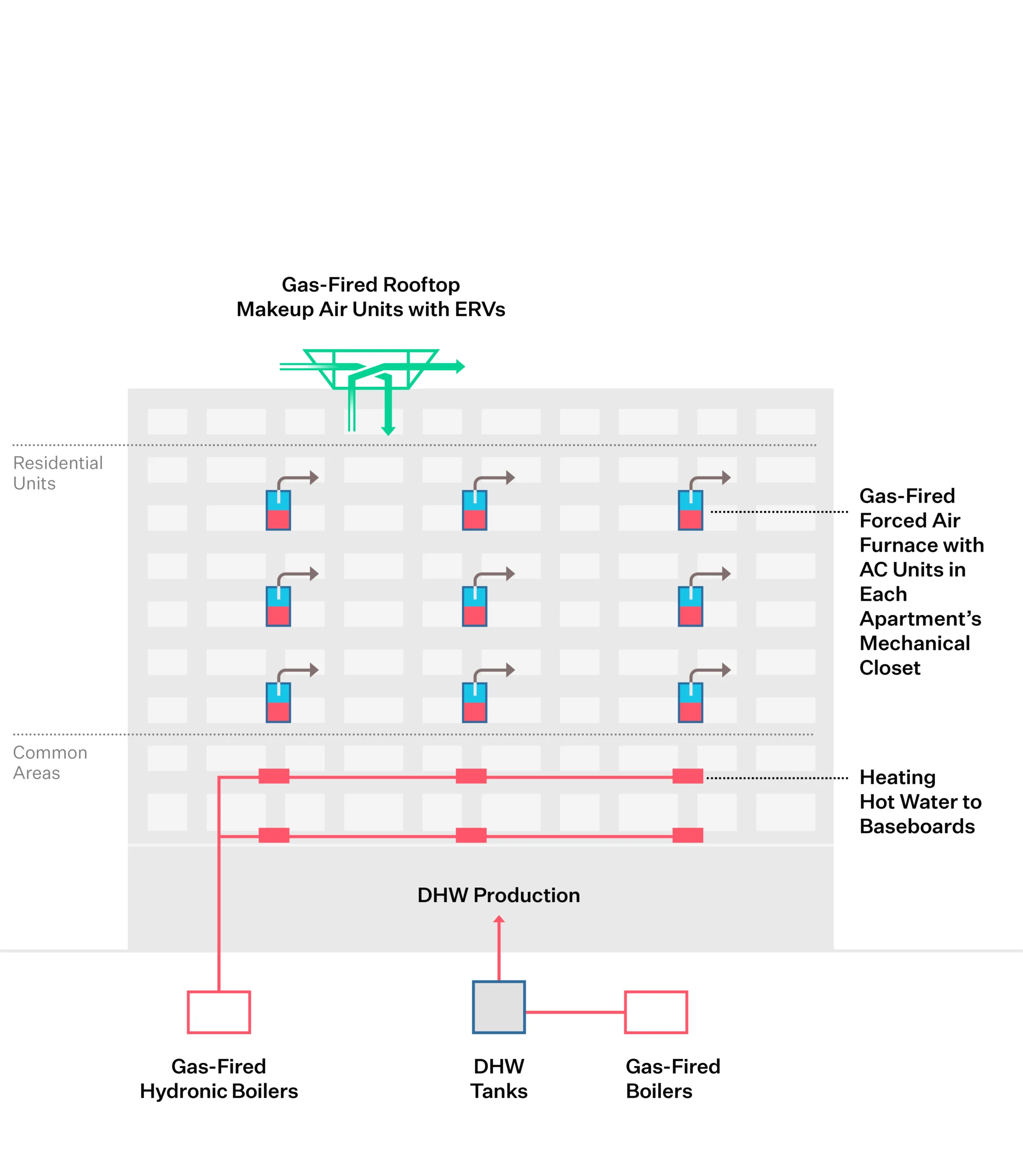
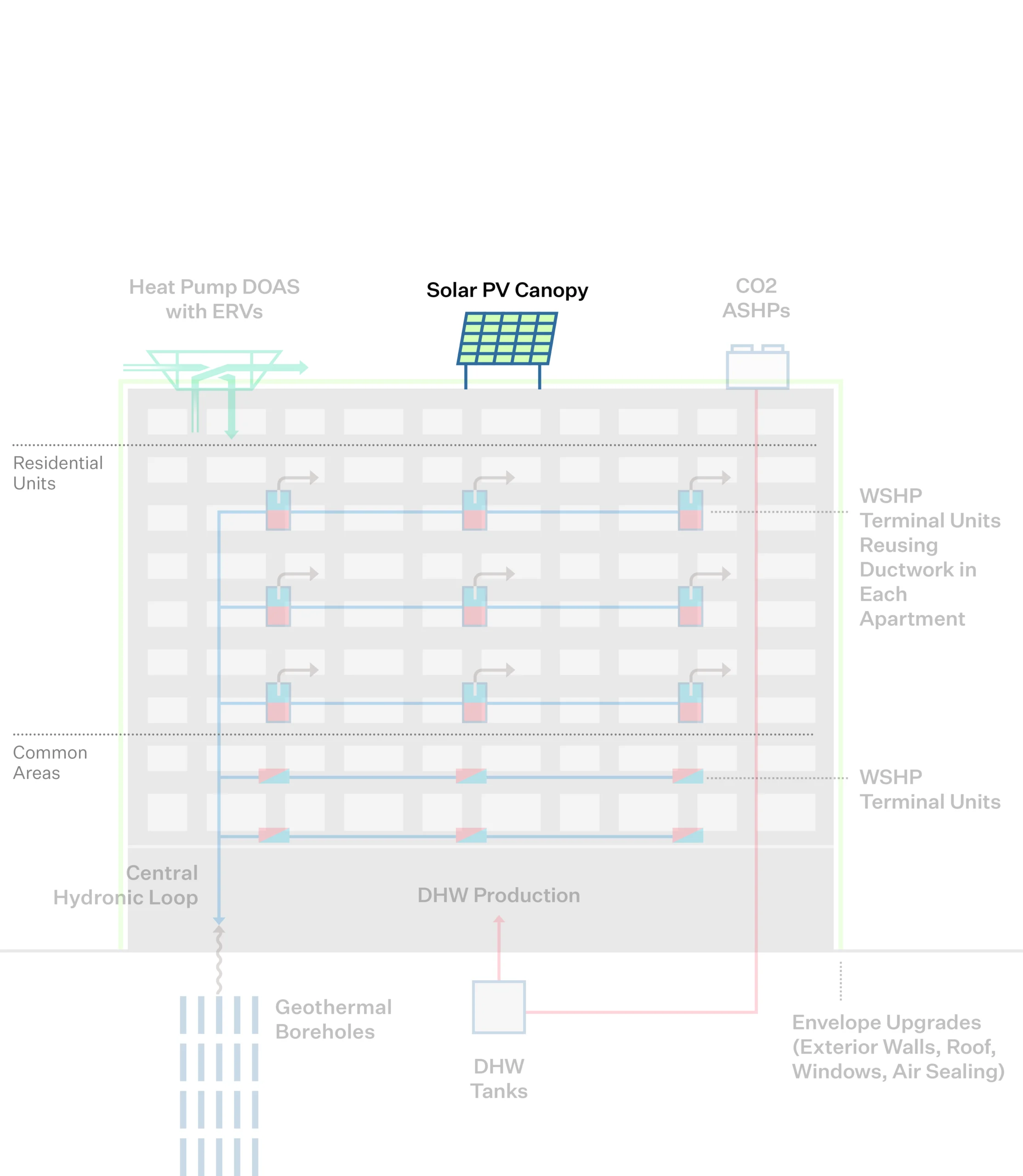
    This diagram illustrates the building prior to the initiation of Strategic Decarbonization planning by the owners and their teams.

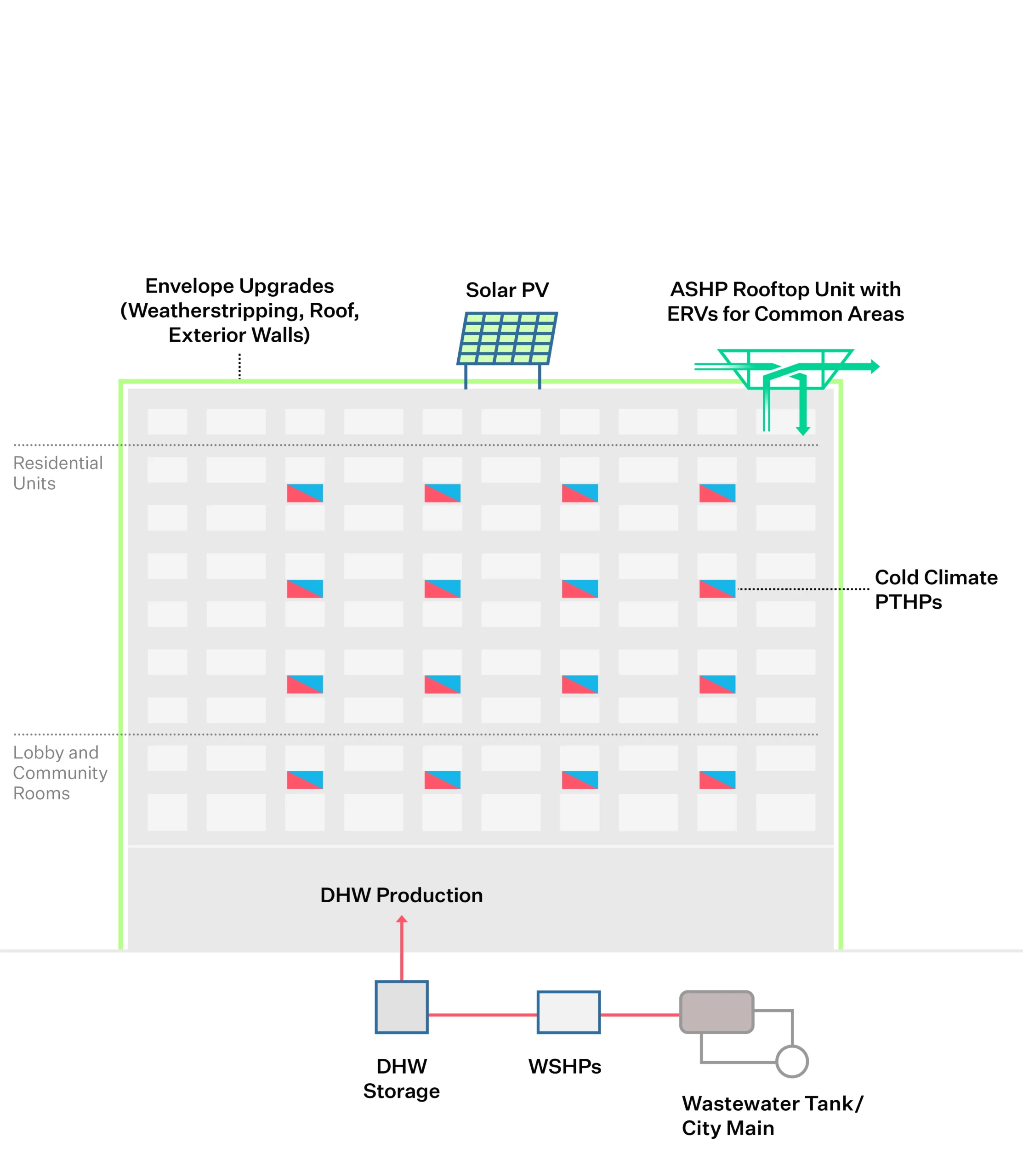
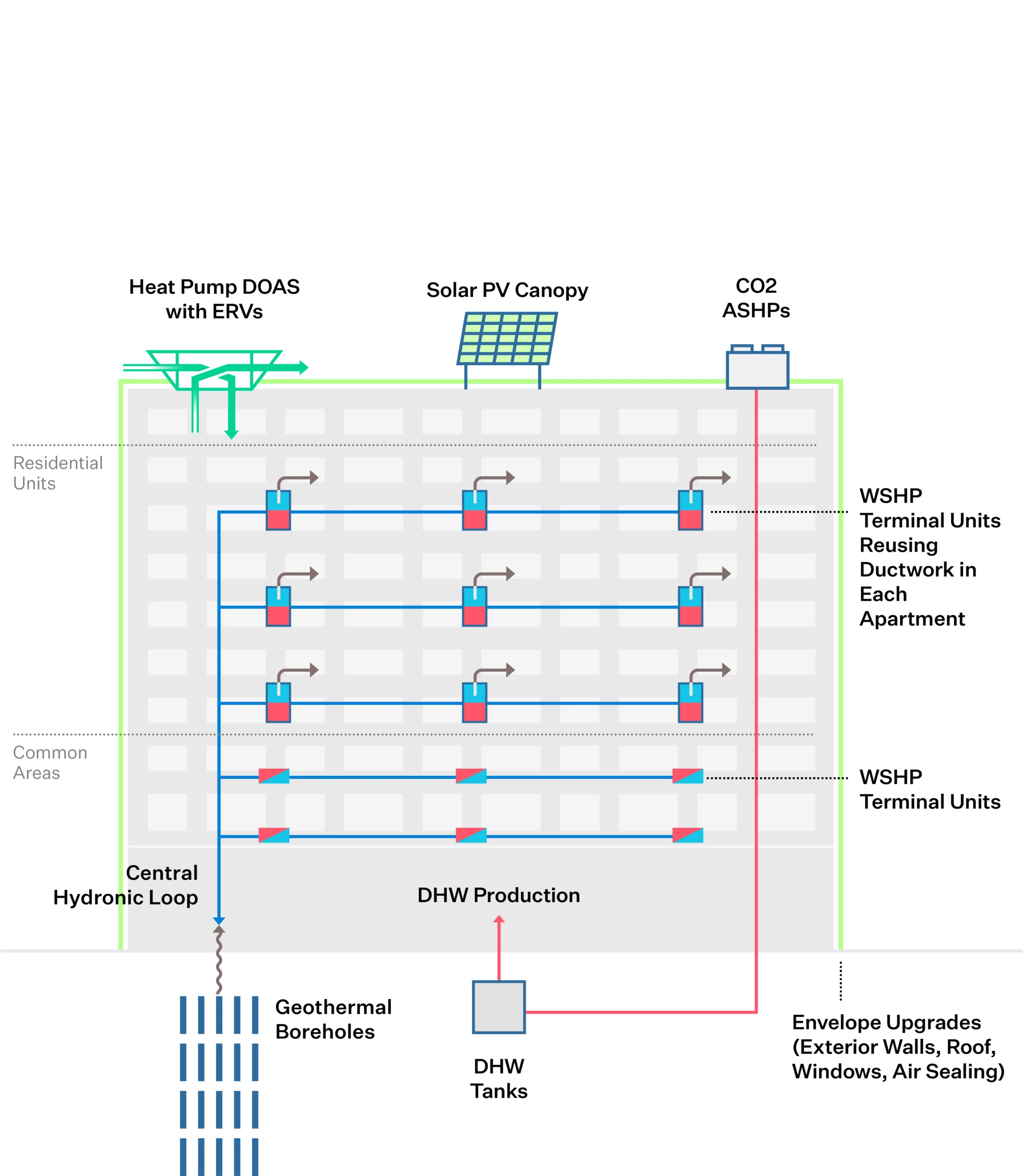
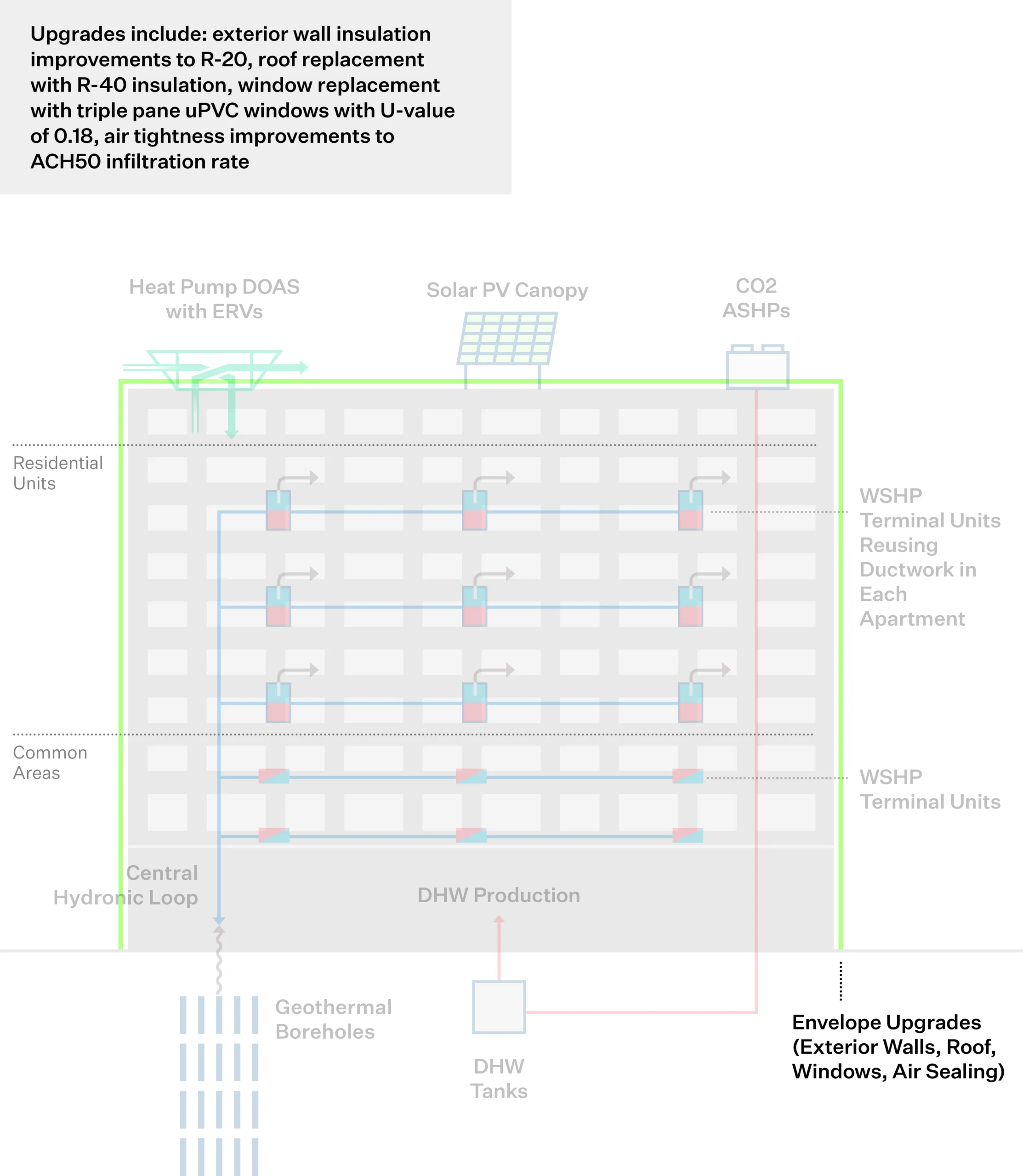
    Click through the measures under “Building After” to understand the components of the building’s energy transition.

    Sequence of Measures

    2026

    2027

    Building System Affected

    • heating
    • cooling
    • ventilation
    St. Elizabeth Manor before
    St. Elizabeth Manor after
    Low Flow Fixtures
    Laundry Electrification
    Envelope Upgrades
    Ventilation Upgrades
    Wastewater Heat Recovery for DHW
    Packaged Terminal Heat Pumps (PTHP)
    Solar PV

    Making a business case for strategic decarbonization requires thinking beyond a traditional energy audit approach or simple payback analysis. It assesses business-as-usual costs and risks against the costs and added value of phased decarbonization investments in the long-term.

    Retrofit Costs

    Decarbonization Costs

    $5.6M

    Cost of ECM #1: 1.7M.

    Cost of ECM #2: 875k.

    Cost of ECM #3: 679k.

    Cost of ECM #4: 210k.

    Cost of ECM #5: 86k.

    Non-EBC ECMs: 1.8M.

    Avoided Risks

    Business-as-Usual Costs

    $51,242

    Energy cost savings

    Avoided Risks

    Business-as-Usual Risks

    $0

    Added Value

    Decarbonization Value

    $2.6M

    Incentives

    Net Present Value

    $638,589

    The implementation of the Decarbonization Roadmap for Sisters of Charity’s Affordable Multifamily portfolio represents a strategic investment in both the environmental sustainability and long-term financial viability of the properties. By leveraging HUD’s Rental Assistance Demonstration (RAD) for Project Rental Assistance Contracts (PRAC) program to secure a 20-year Housing Assistance Payment (HAP) contract for St. Elizabeth’s Manor, Sisters of Charity ensures a stable revenue stream that will significantly enhance the financial health of the property. This stable income will support the necessary debt service payments on a mortgage, enabling the funding of $13.2 million in capital improvements. These capital improvements are critical not only for the immediate physical needs of the property but also for achieving the long-term decarbonization goals outlined in the Roadmap. The integration of Energy Conservation Measures (ECMs) as part of this comprehensive renovation plan will reduce operational expenses by decreasing energy consumption and fossil fuel dependency. The Roadmap’s capital plan, which combines mortgage proceeds, existing reserves, and subsidy financing from New York State’s Housing Finance Agency, is designed to minimize the financial burden on Sisters of Charity while maximizing the long-term return on investment. The use of this diversified funding strategy allows Sisters of Charity to undertake the necessary decarbonization measures without imposing additional financial strain on residents, as tenants will continue to pay only 30% of their income towards rent. Furthermore, the enhanced energy efficiency of the buildings will likely reduce long-term maintenance costs and improve the overall asset value, creating a more resilient financial model.

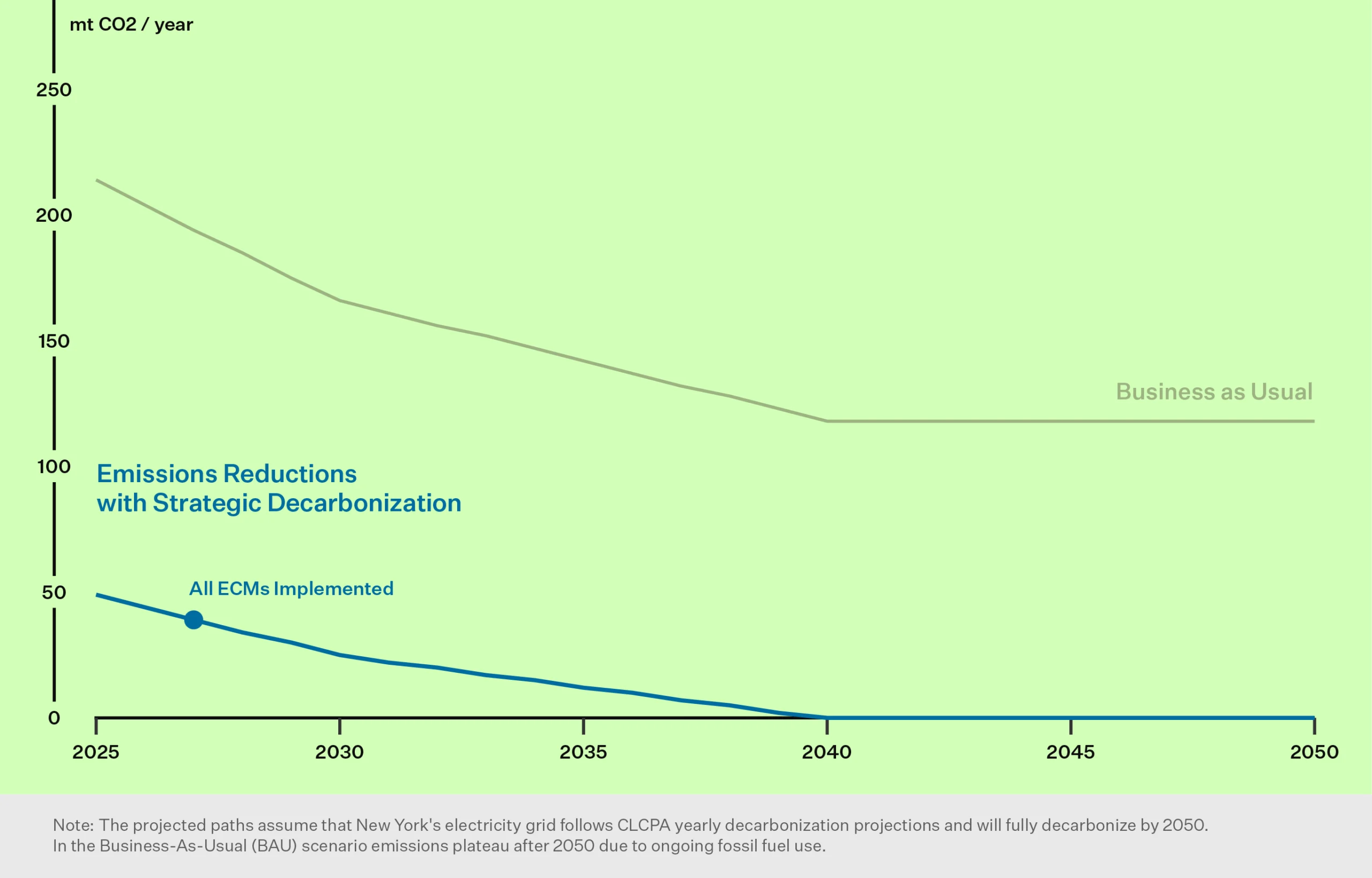
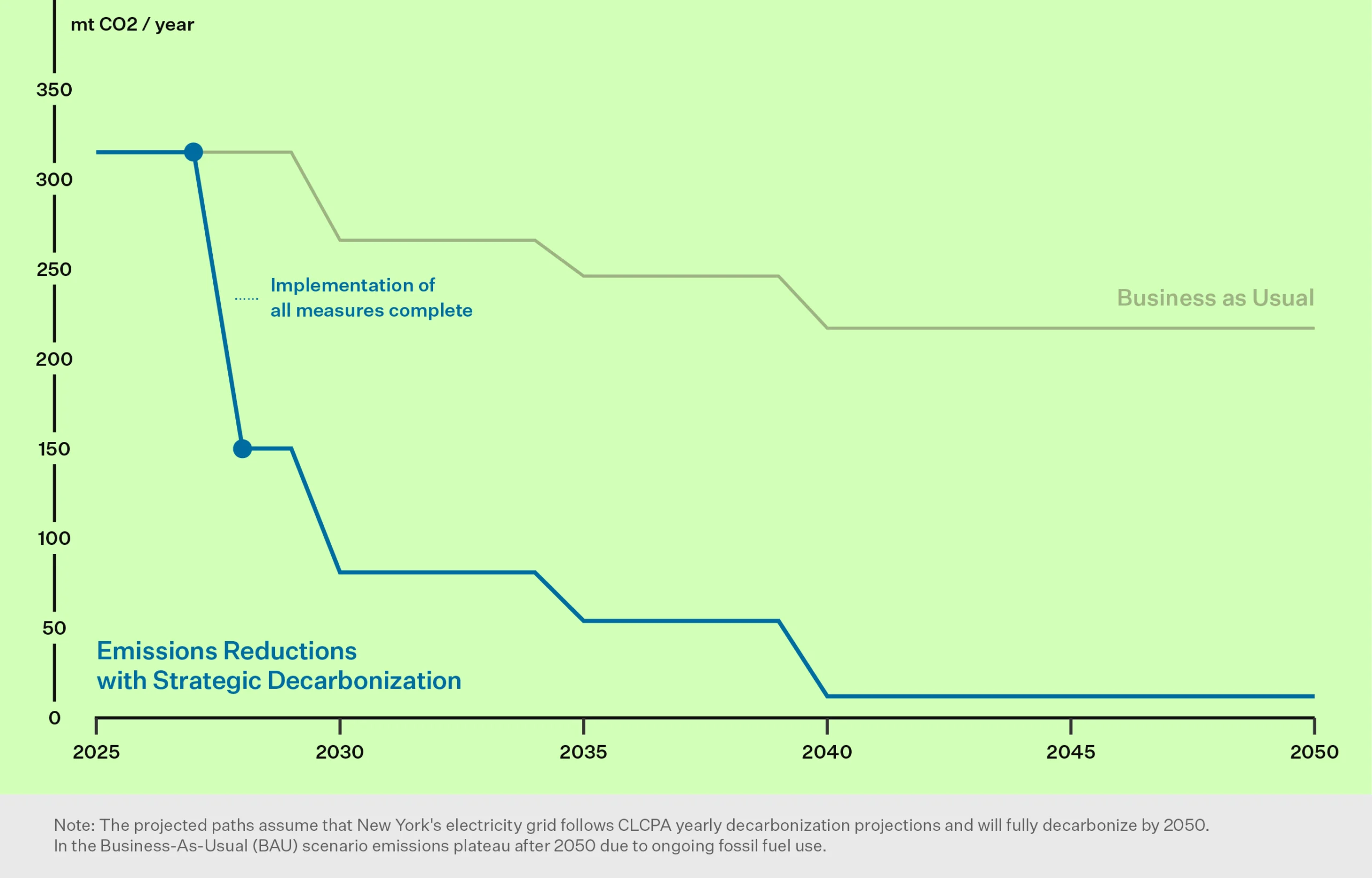
    An emissions decarbonization roadmap helps building owners visualize their future emissions reductions by outlining the CO2 reductions from selected energy conservation measures. This roadmap is designed with a phased approach, considering a 20- or 30-year timeline, and incorporates the evolving benefits of grid decarbonization, ensuring a comprehensive view of long-term environmental impact.
    Strategic Decarbonization Roadmap

    More Like This

    Case Study
    NYSERDA supported
    Case Study

    The Victory

    Energy conservation analysis at midtown tower

    Energy conservation analysis at midtown tower

    The Victory Case Study
    Case Study
    Case Study

    The Towers

    Oldest US multifamily co-op transforms wastewater into clean energy
    The Towers Case Study

    Case Study

    215 East 68th Street

    Electric heat recovery chiller implementation at Upper East Side high-rise

    This case study was chosen as part of the Empire Building Challenge competition. Click here to learn more about the Empire Building Challenge competition.

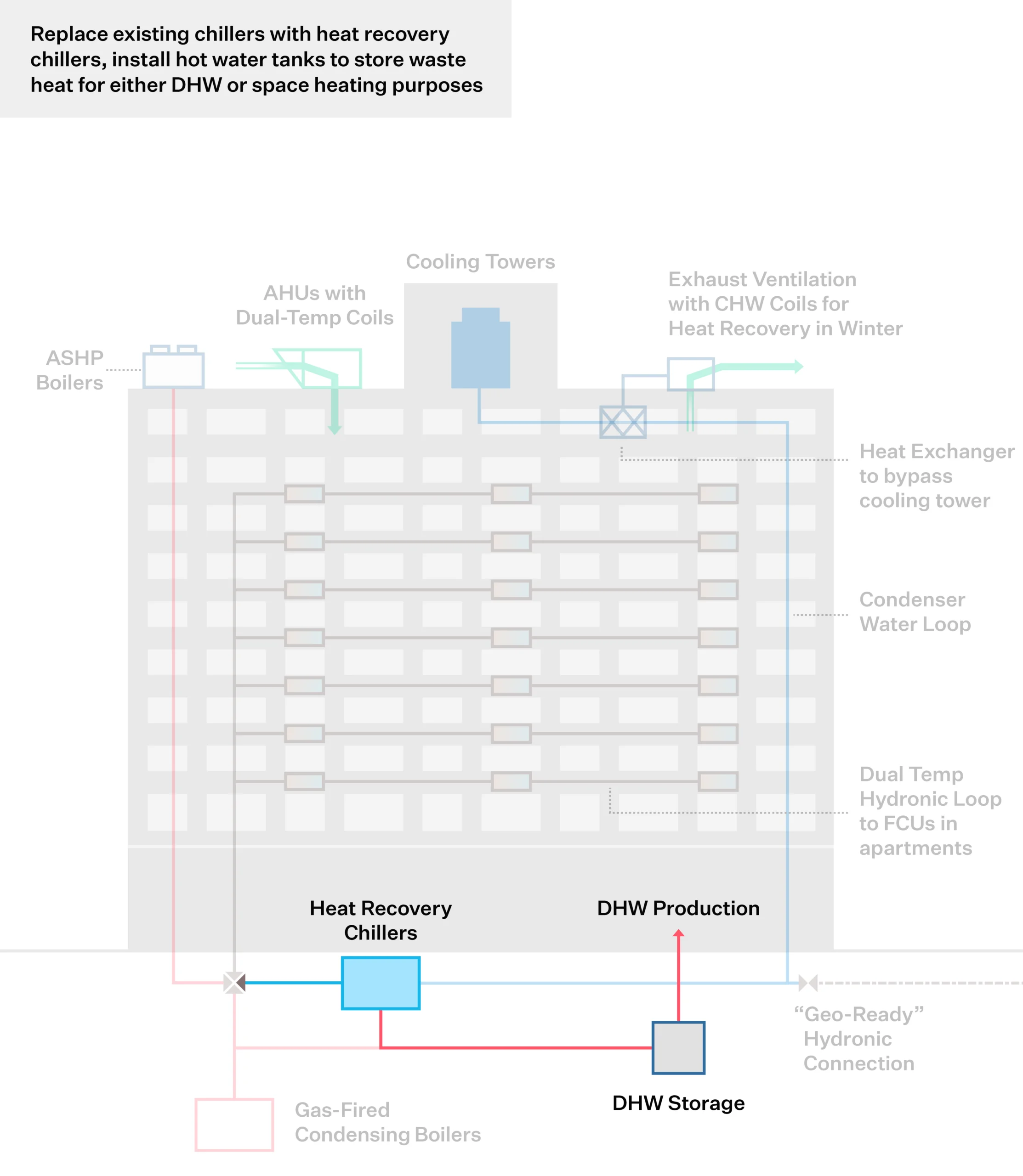
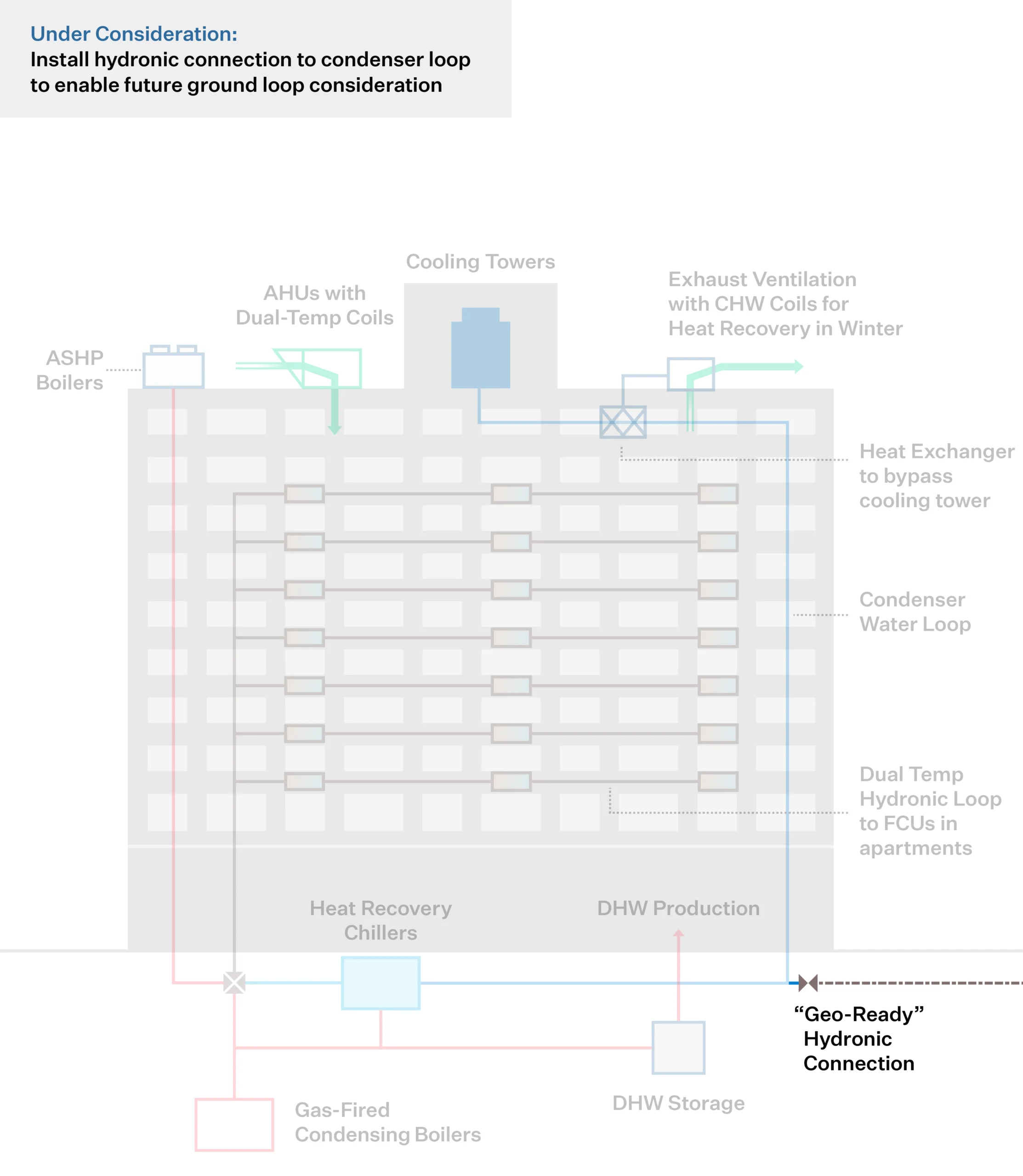
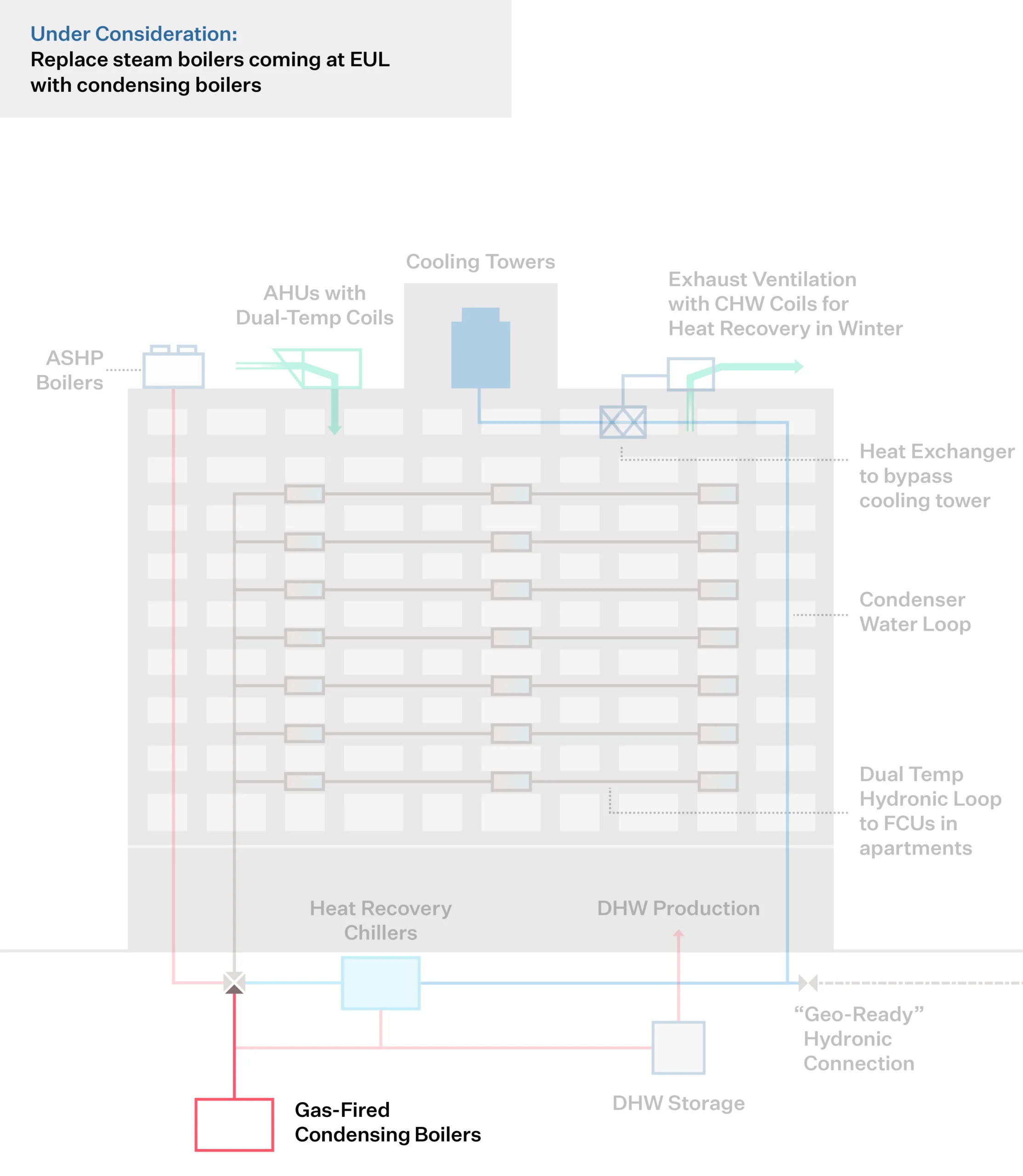
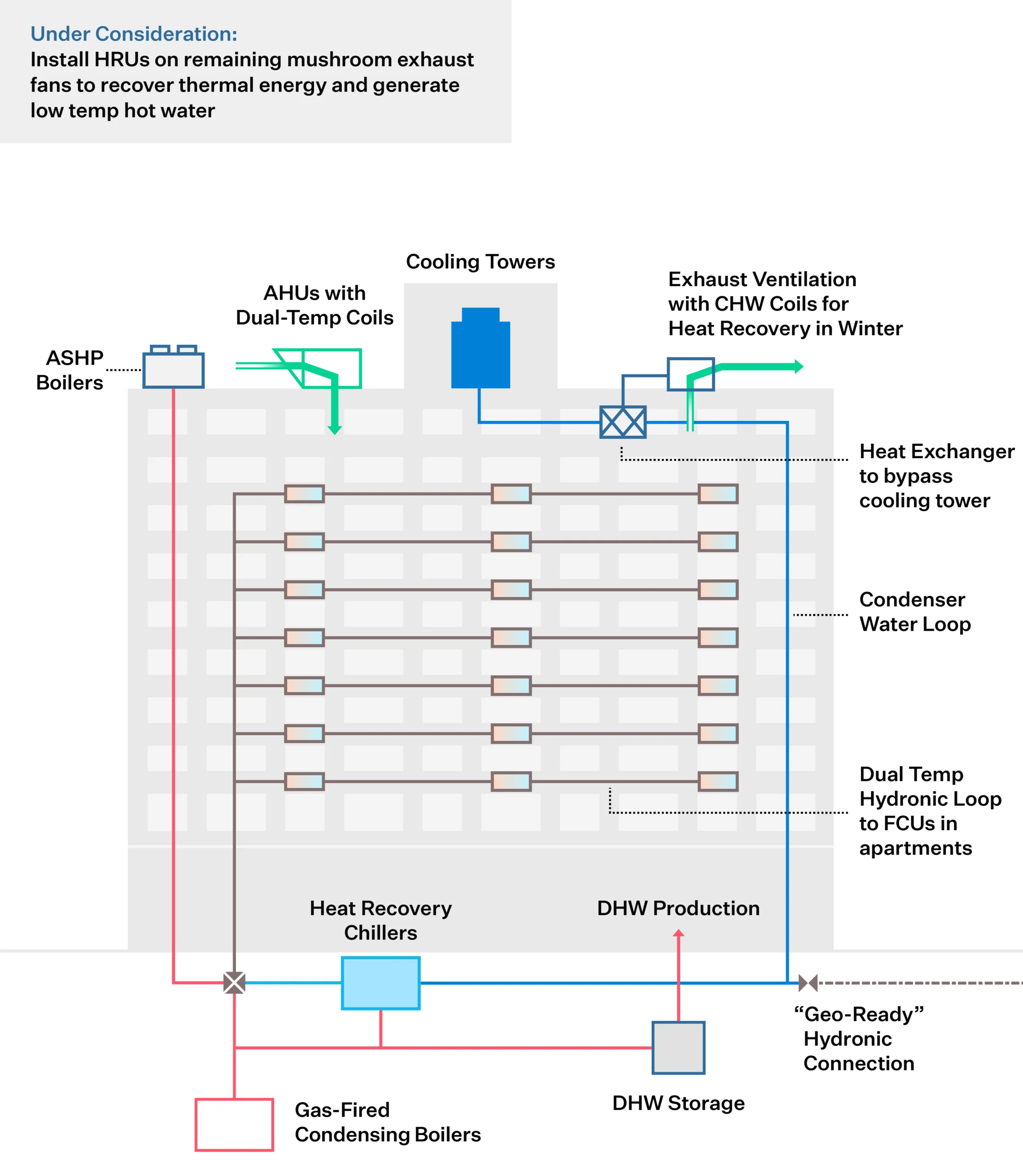
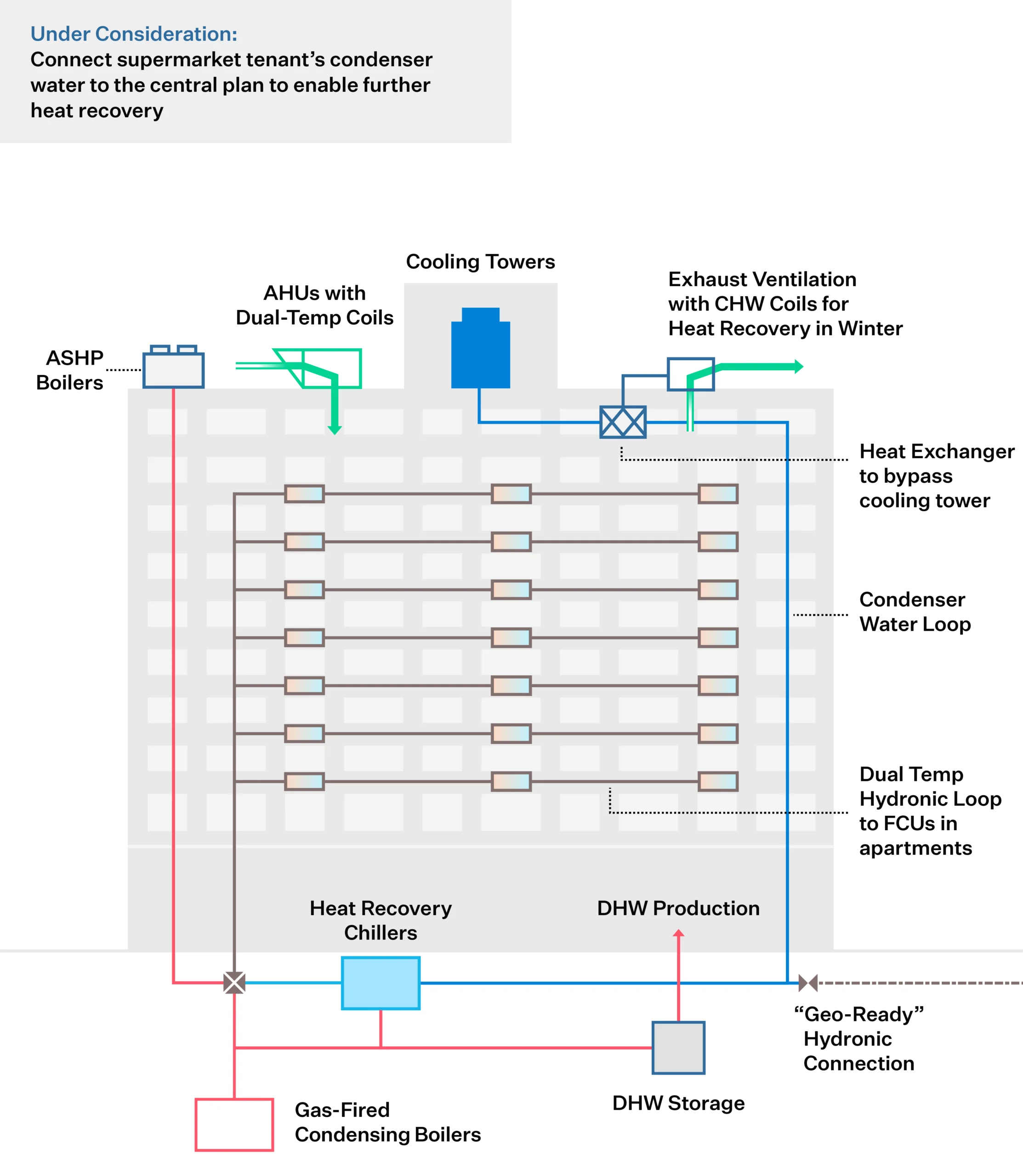
    215 East 68th Street is an approximately 1M+ square foot multifamily building in the Upper East Side of Manhattan. Built in 1962 and spanning 32 floors, the building supports tenant heating, cooling, and domestic hot water needs through natural gas boilers and absorption chillers. As a result, the building burns fossil fuels for the entire year, putting the building in Local Law 97 penalty range starting in 2030. Rudin Management plans to retrofit the outdated system with new electric heat recovery chillers to offset natural gas usage and align with New York City’s electrification efforts. The new system eliminates the need for fossil fuel boilers to create cooling and domestic hot water in the summer. The building also intends to install “geo-ready” thermal taps to prepare for a potential future ground loop under the existing parking lot and heat recovery from the 24/7 building exhaust system. The project largely decarbonizes building operations and aligns the building with company-wide sustainability goals.

    215 East 68th Street, Manhattan NY 10065
    Lessons Learned

    Heat pump technology is rapidly developing, creating cost-effective opportunities to decarbonize and electrify buildings without sacrificing operating costs.

    Emissions Reductions

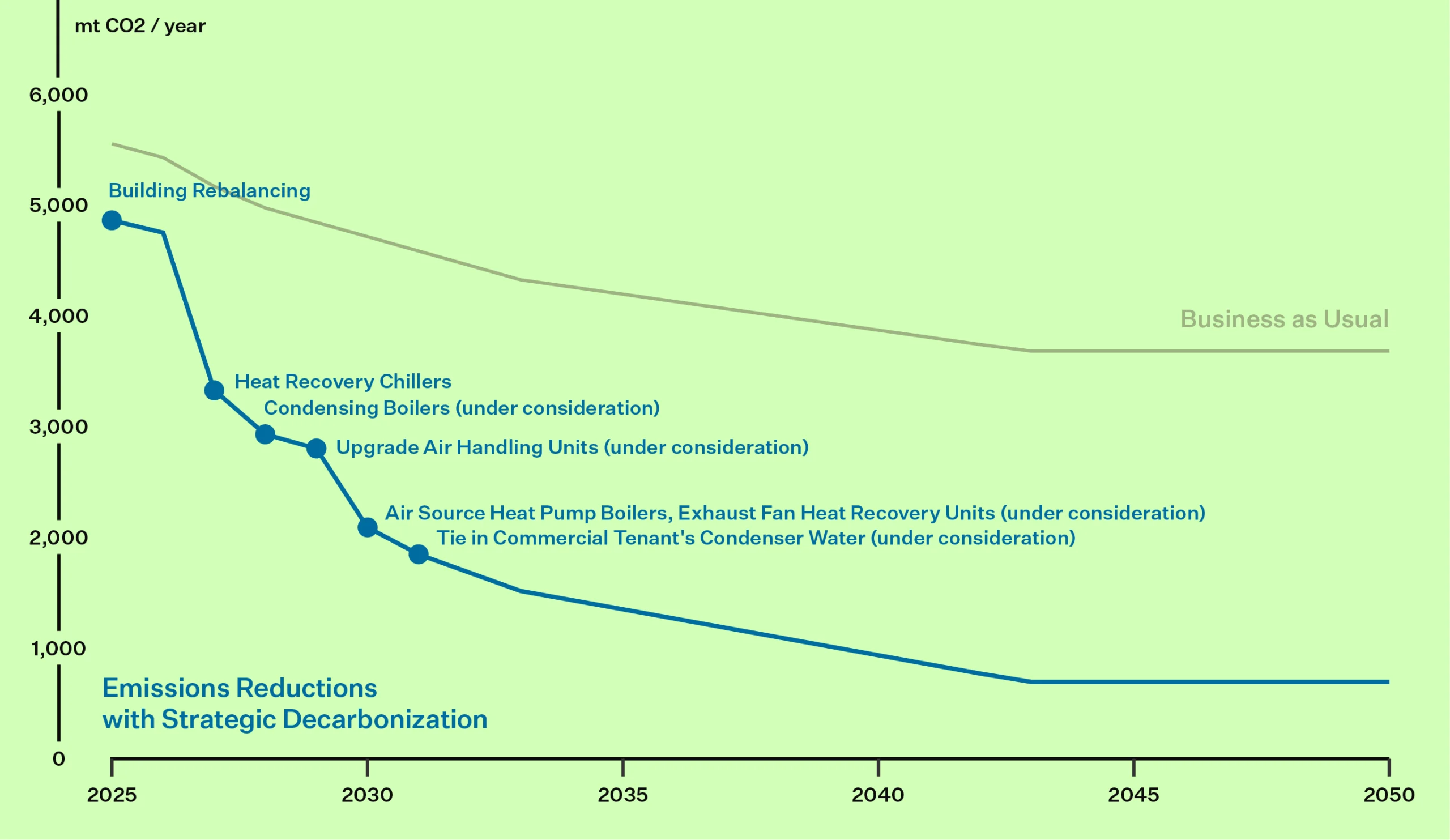
     The proposed retrofit avoids penalties associated with Local Law 97 entirely, while also significantly reducing building energy use intensity.

    A baseline assessment is key to understanding current systems and performance, then identifying conditions, requirements or events that will trigger a decarbonization effort. The assessment looks across technical systems, asset strategy and sectoral factors.

    Building System Conditions
    • Equipment nearing end-of-life
    • Efficiency improvements
    Asset Conditions
    • Capital event cycles
    • Carbon emissions limits
    Market Conditions
    • Technology improves
    • Policy changes
    • Infrastructure transitions
    • Fuels phase out

    The last major cooling plant upgrade at 215 East 68th Street was in 2001 when three, low pressure steam absorption chillers were installed. Since then, NYC introduced new carbon emission limits as part of LL97. The new laws push for the electrification of buildings to mitigate significant financial penalties associated with burning fossil fuels. In the case of 215 East 68th Street, building ownership is facing annual penalties exceeding $250,000 per year starting in 2030. As a result, Rudin sees an opportunity to replace the fossil-fuel cooling plant with an electric plant that generates domestic hot water and recovers building waste heat. The new system eliminates the 2030 penalty entirely and significantly reduces the building energy use intensity (EUI).

    Effective engineering integrates measures for reducing energy load, recovering wasted heat, and moving towards partial or full electrification. This increases operational efficiencies, optimizes energy peaks, and avoids oversized heating systems, thus alleviating space constraints and minimizing the cost of retrofits to decarbonize the building over time.

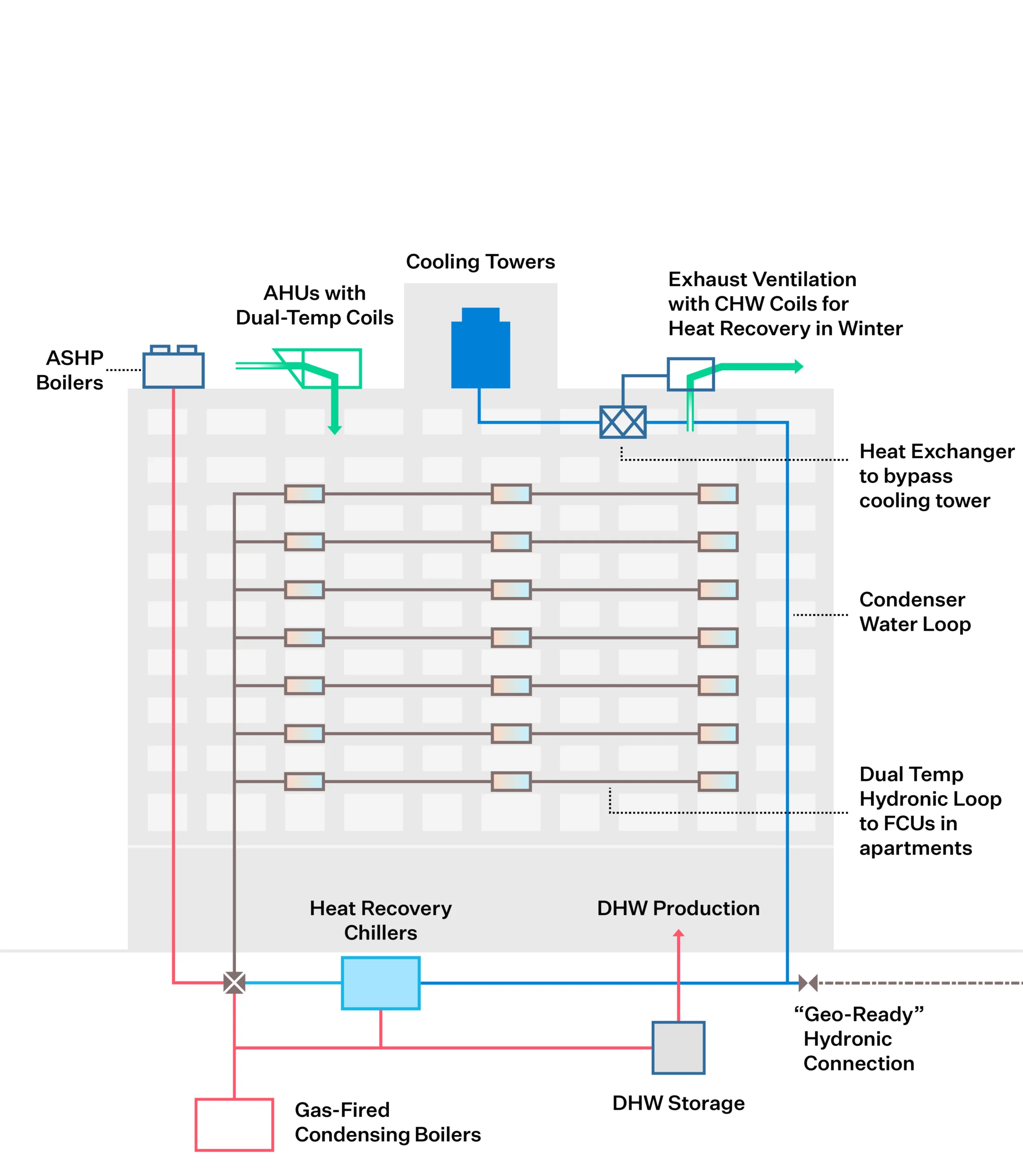
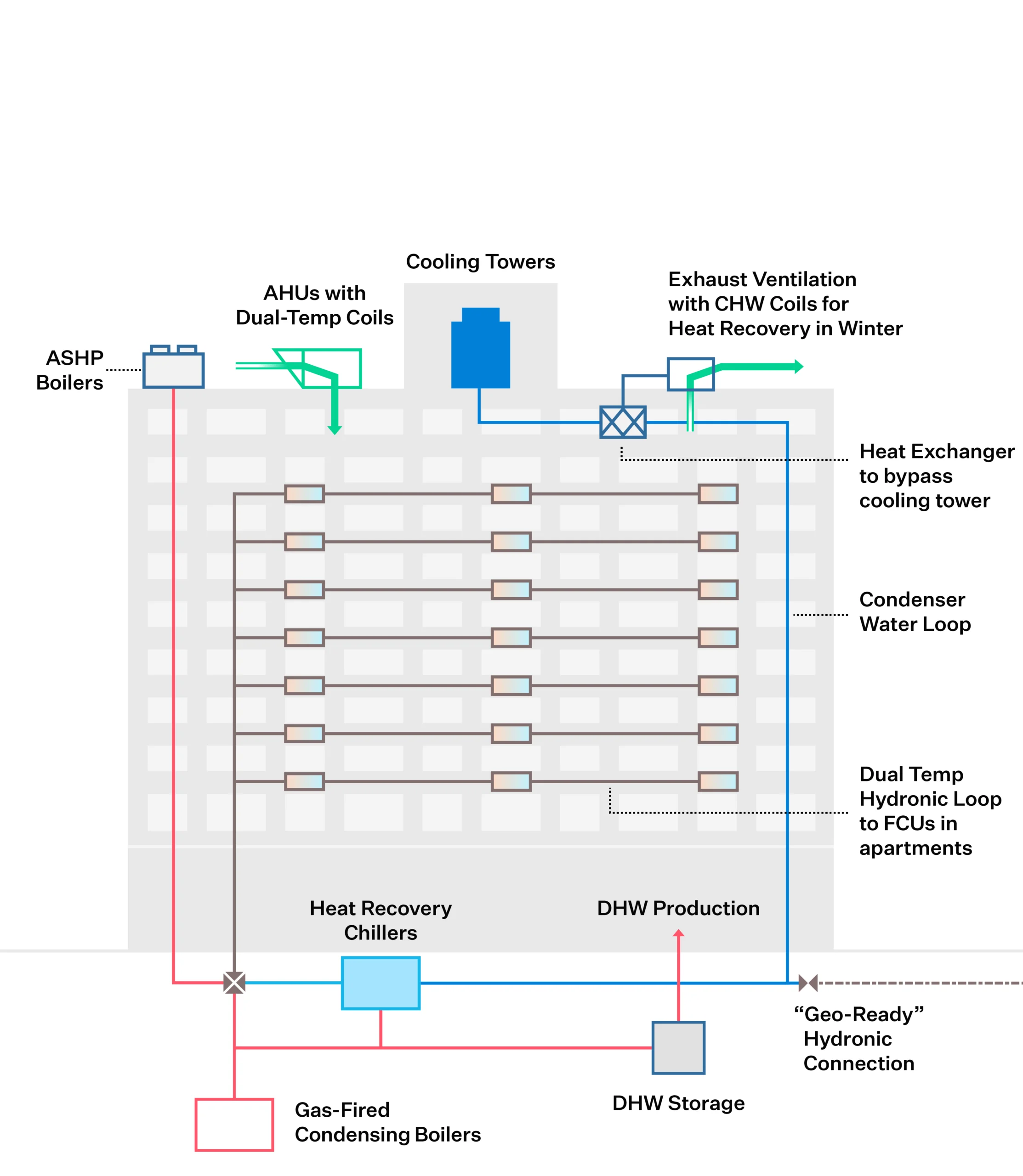
    Existing Conditions

    This diagram illustrates the building prior to the initiation of Strategic Decarbonization planning by the owners and their teams.

    Click through the measures under “Building After” to understand the components of the building’s energy transition.

    Sequence of Measures

    2025

    2026

    2027

    2028

    2029

    2030

    Building System Affected

    • heating
    • cooling
    • ventilation
    215 East 68th Street before
    215 East 68th Street after
    Heat Recovery Chillers
    Under Consideration: "Geo-Ready" Hydronic Connection
    Under Consideration: Condensing Boilers
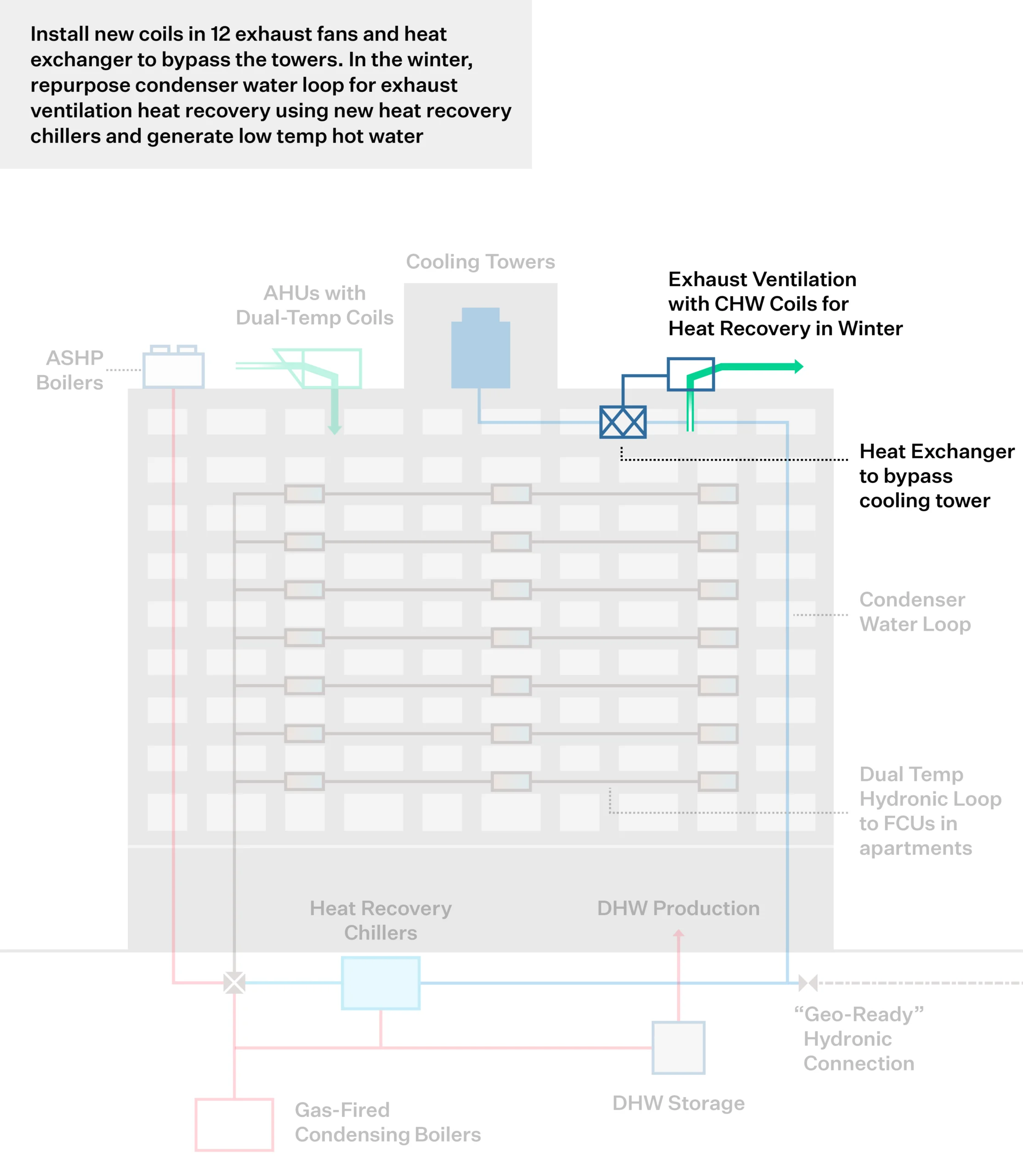
    Exhaust Ventilation Heat recovery
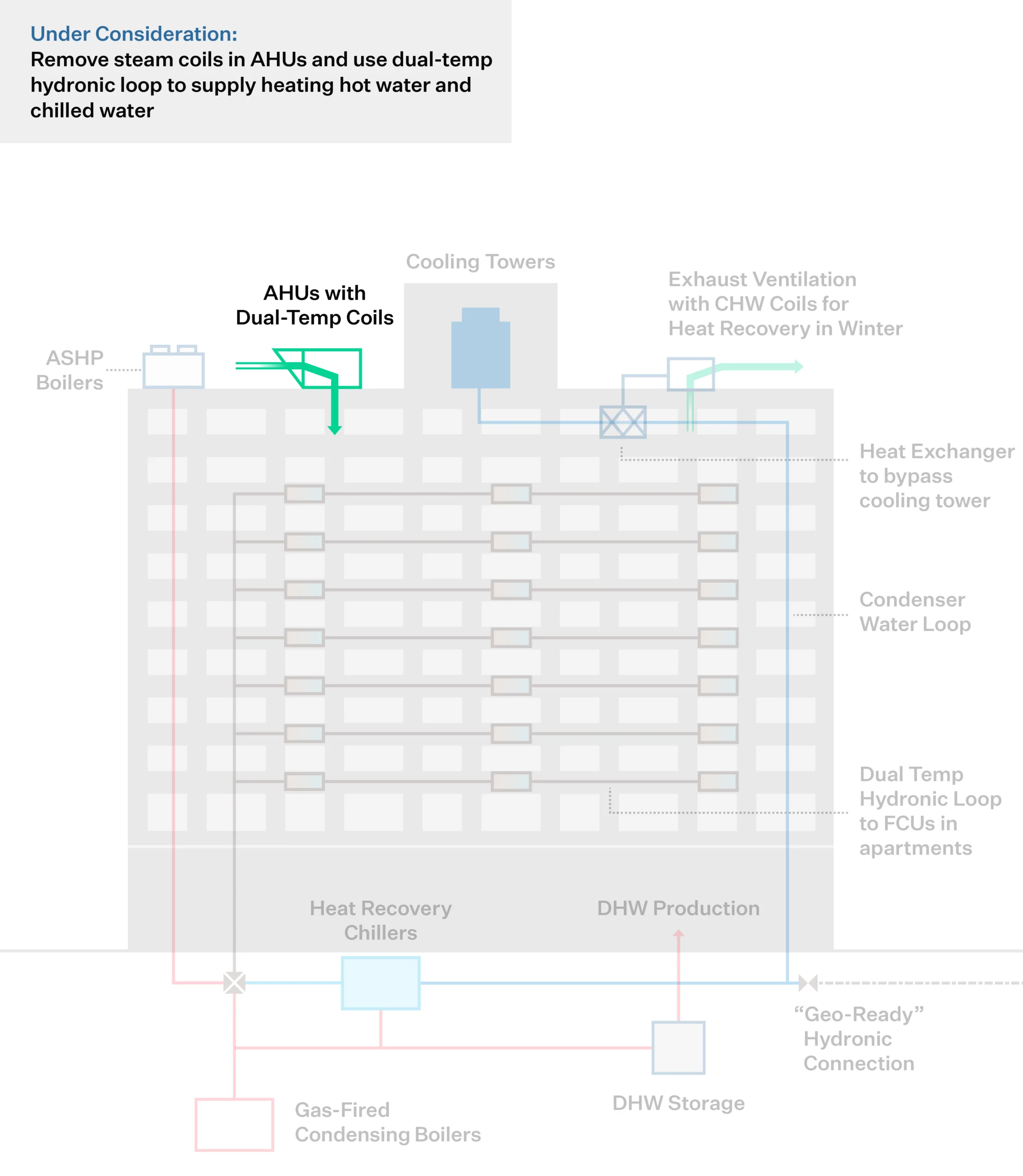
    Under Consideration: Upgrade Air Handling Units (AHU)
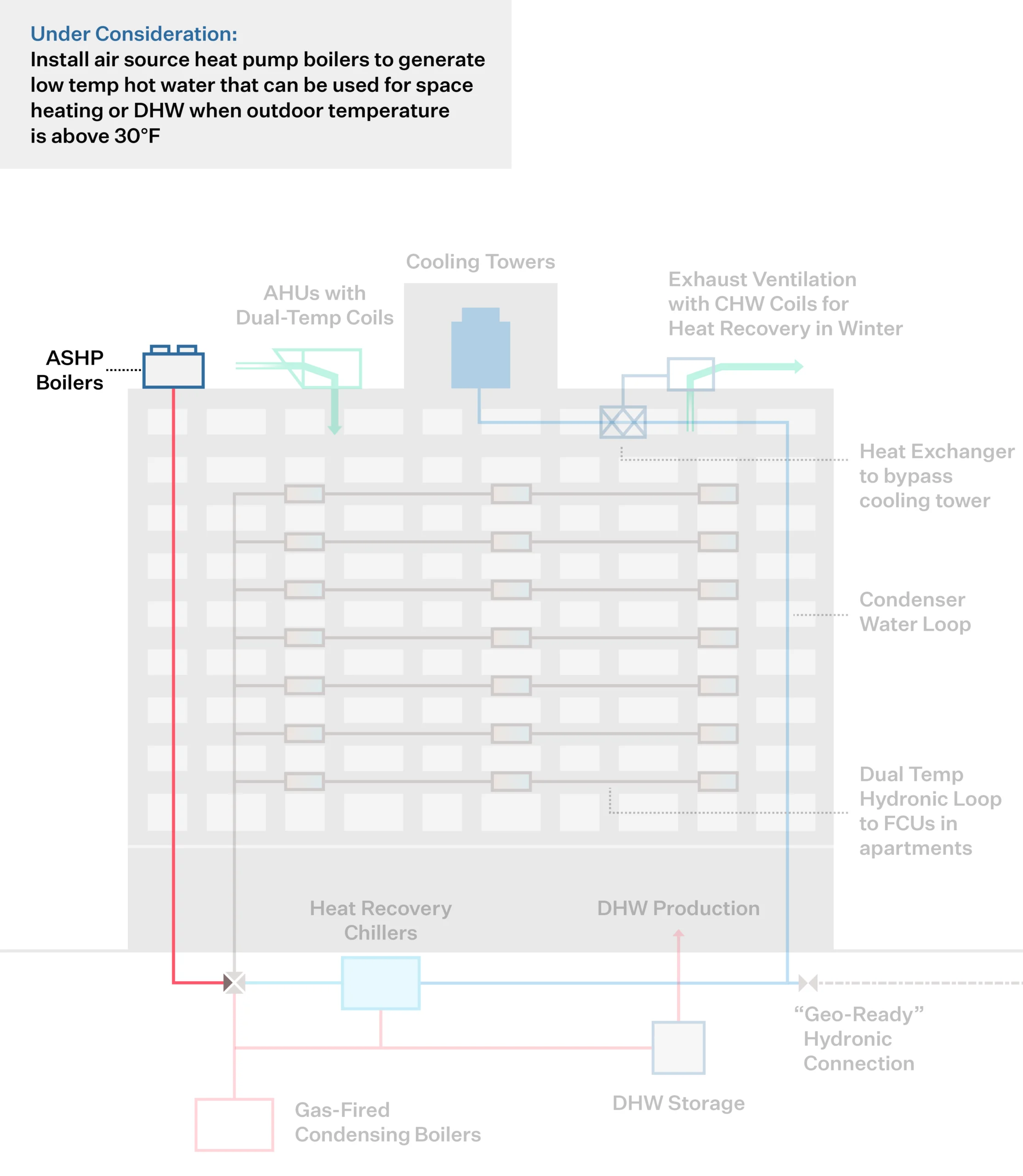
    Under Consideration: Air Source Heat Pump Boilers
    Under Consideration: Exhaust Fan Heat Recovery Units (HRU)
    Under Consideration: Tie in Commercial Tenant's Condenser Water

    Making a business case for strategic decarbonization requires thinking beyond a traditional energy audit approach or simple payback analysis. It assesses business-as-usual costs and risks against the costs and added value of phased decarbonization investments in the long-term.

    Retrofit Costs

    Decarbonization Costs

    $16M

    Cost of ECM #1: 1.2M.

    Cost of ECM #2: 14M.

    Avoided Risks

    Business-as-Usual Costs

    $4.4M

    Energy cost savings: 477k.

    Repairs and maintenance savings: -150k.

    BAU  cost of system replacement/upgrades: 4.1M.

    Avoided Risks

    Business-as-Usual Risks

    $2.7M

    Local Law 97 or other regulatory fines:

    2030-2034: 294k.

    2035-2039: 483k.

    2040-2049: 668k.

    2050+: 1.2M.


    Added Value

    Decarbonization Value

    $3M

    Incentives: 3M.

    Net Present Value

    $3.7M

    The central cooling plant at 215 East 68th Street is nearing the end of its useful life, prompting Rudin Management to consider the best plan for the buildings plant. The cheapest and simplest approach would be to replace existing low pressure steam absorbers in kind. Weighing the LL97 penalties starting in 2030, the building saw an opportunity to implement a new and electric heat recovery system to eliminate fines and decarbonize the building’s operations. While the electric heat recovery chillers carry a larger upfront cost, the cost of ownership over 30 years is lower than that of a fossil fuel system with a lower upfront cost but significant annual emissions penalties.

    An emissions decarbonization roadmap helps building owners visualize their future emissions reductions by outlining the CO2 reductions from selected energy conservation measures. This roadmap is designed with a phased approach, considering a 20- or 30-year timeline, and incorporates the evolving benefits of grid decarbonization, ensuring a comprehensive view of long-term environmental impact.

    Strategic Decarbonization Roadmap

    More Like This

    Case Study
    NYSERDA supported
    Case Study

    The Victory

    Energy conservation analysis at midtown tower

    Energy conservation analysis at midtown tower

    The Victory Case Study
    Case Study
    Case Study

    The Towers

    Oldest US multifamily co-op transforms wastewater into clean energy
    The Towers Case Study

    Case Study

    Stovroff Towers

    Deep energy retrofit creates new affordable housing

    This case study was chosen as part of the Empire Building Challenge competition. Click here to learn more about the Empire Building Challenge competition.

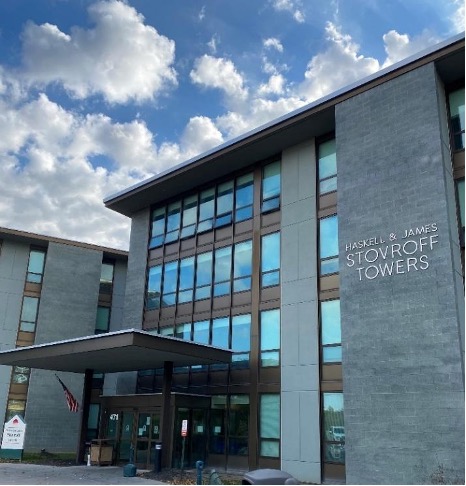
    Originally built in 2003, Stovroff Towers is a four-story, 74,000 square-foot senior living facility located in Amherst, NY. WinnDevelopment (Winn) plans to acquire the Property and implement a comprehensive renovation, converting the 120 single occupancy units into eight (8) studio apartments and fifty-eight (58) one-bedroom apartments, while investing in high-efficiency, low-carbon upgrades. The retrofit project prioritizes high-performance envelope upgrades and efficient electrification to transform Stovroff Towers and reduce site energy use intensity (EUI) by 78.30%. The project will be financed in part with low-income housing tax credit (LIHTC) equity, allowing the decarbonization strategies to be implemented in a single, holistic renovation slated for completion by 2027.

    Over the past decade, Winn has become an industry leader, and partner, in sustainable development, renewable energy, and building science. Winn is a long-term owner committed to tackling housing shortages and insecurity while also addressing climate change, energy equity, and resiliency for our communities. Winn is a leader in decarbonization, with several deep energy retrofit, and all-electric, high-performance projects completed or in development. 

    Winn has a pipeline of acquisition rehabilitation projects planned throughout the Northeast and the Mid-Atlantic. In New York State alone, Winn manages over 11,000 units of housing and owns eight (8) properties scheduled for capital improvements and/or comprehensive renovations between 2030-2040. Winn is committed to deploying elements of our Stovroff Towers scope at these other buildings as they reach recapitalization and/or at the time of equipment failure.

    Stovroff Towers
    Energy Savings

    78%

    The LIHTC-renovation will enhance the naturally occurring affordable housing at Stovroff Towers and preserve the property’s long-term affordability. The redevelopment project will invest in energy reduction measures that reduce site energy use intensity over 78%, transforming Stovroff Towers into a vibrant community for vulnerable populations.

    Testimonial

    “NYSERDA’s Empire Building Challenge (EBC) inspired a creative and efficient pre-development phase that will make the renovation of Stovroff Towers truly transformative. This Project will serve as an inspiring demonstration for similar buildings committed to reducing their carbon footprint in a meaningful way.”

    Christina McPike
    Vice President, Energy & Sustainability
    WinnCompanies

    Energy Savings

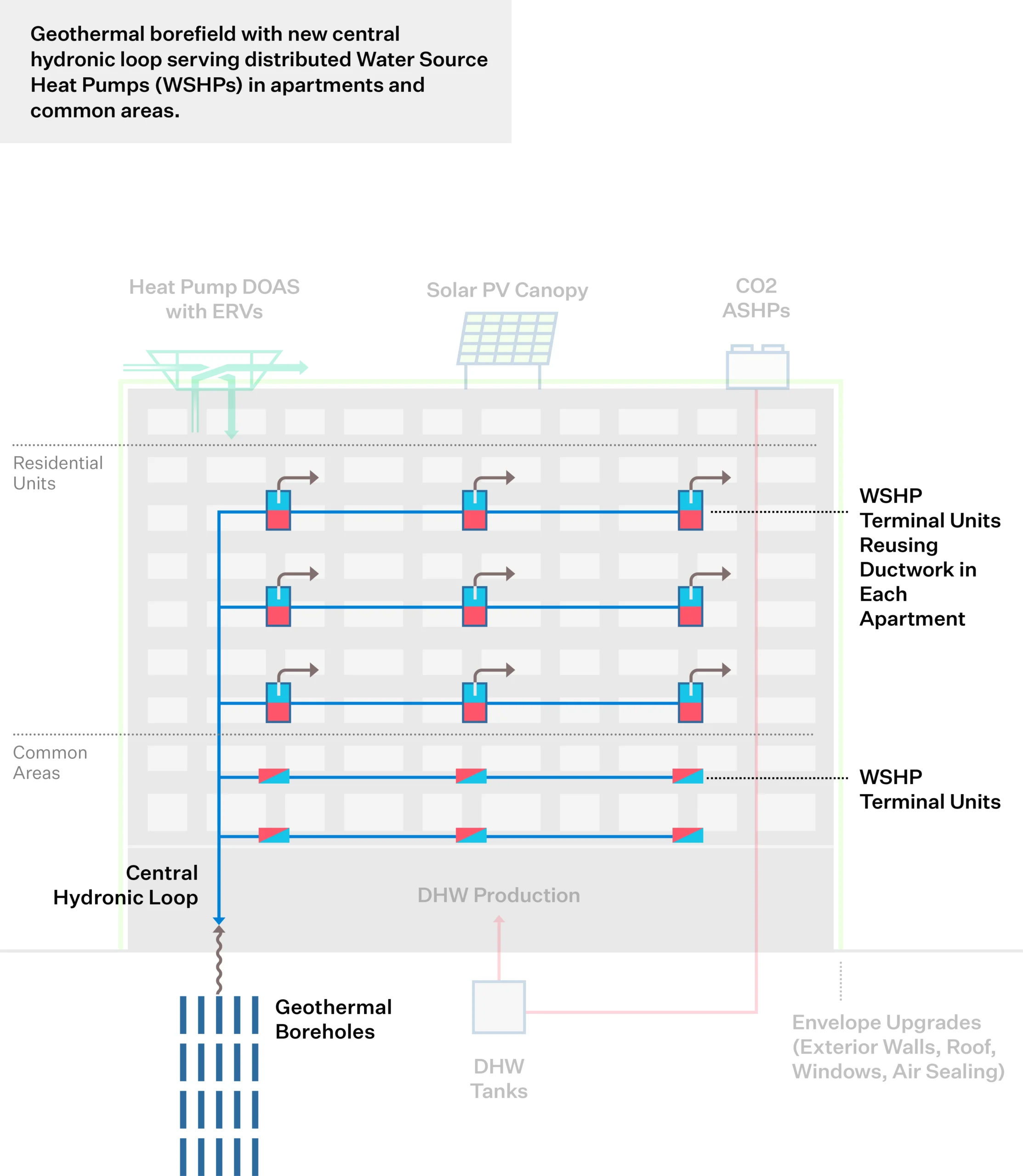
    The EBC Project demonstrates geothermal and distributed hydronic systems as a replicable retrofit technology in cold climates. Stable ground temperatures will enable design of a geothermal borefield that includes 12 bores drilled to 500 ft depth, providing 34 tons of heating and cooling, which will meet 100% of the annual heating and cooling load.

    A baseline assessment is key to understanding current systems and performance, then identifying conditions, requirements or events that will trigger a decarbonization effort. The assessment looks across technical systems, asset strategy and sectoral factors.

    Building System Conditions
    • System Failure
    • Equipment nearing end-of-life
    • New heat source potential
    • Comfort improvements
    • Indoor air quality improvements
    • Facade maintenance
    • Resilience upgrades
    • Efficiency improvements
    Asset Conditions
    • Repositioning
    • Recapitalization
    • Capital event cycles
    • Tenant turnover/vacancy
    • Building codes
    • Owner sustainability goals
    Market Conditions
    • Technology improves
    • Policy changes

    Since its completion, Stovroff Towers has suffered long-term programmatic issues due to single-occupancy efficiency units without full-service kitchens and limited on-site resident services. Vacancy rates have averaged 75-80%, leading to a severe operational deficit and extensive capital needs. These circumstances catalyzed Winn’s involvement at the site, which will utilize LIHTC financing from New York State’s Homes and Community Renewal (HCR) to fund a major recapitalization and comprehensive renovation that addresses capital and operational needs. Winn has a successful track record developing and preserving housing in the upstate region, where the relative cost of construction and energy is low and need for high quality affordable housing is high. The property’s existing needs informed the decarbonization scope, which will not only result in significant energy reduction and carbon emissions, but will improve the building’s passive resiliency, durability, and indoor living environment. The high efficiency all-electric equipment and building envelope upgrades will also reduce operating costs for the building owner and future residents and contribute to New York State’s building-sector decarbonization goals. The decarbonization retrofit scope is well-aligned with the Climate Leadership & Community Protection Act (CLCPA) and NYS HCR’s Existing Buildings Sustainability Guidelines and provides replicable, cost-efficient solutions that can be applied to future renovations and recapitalization events.

    Effective engineering integrates measures for reducing energy load, recovering wasted heat, and moving towards partial or full electrification. This increases operational efficiencies, optimizes energy peaks, and avoids oversized heating systems, thus alleviating space constraints and minimizing the cost of retrofits to decarbonize the building over time.

    Existing Conditions

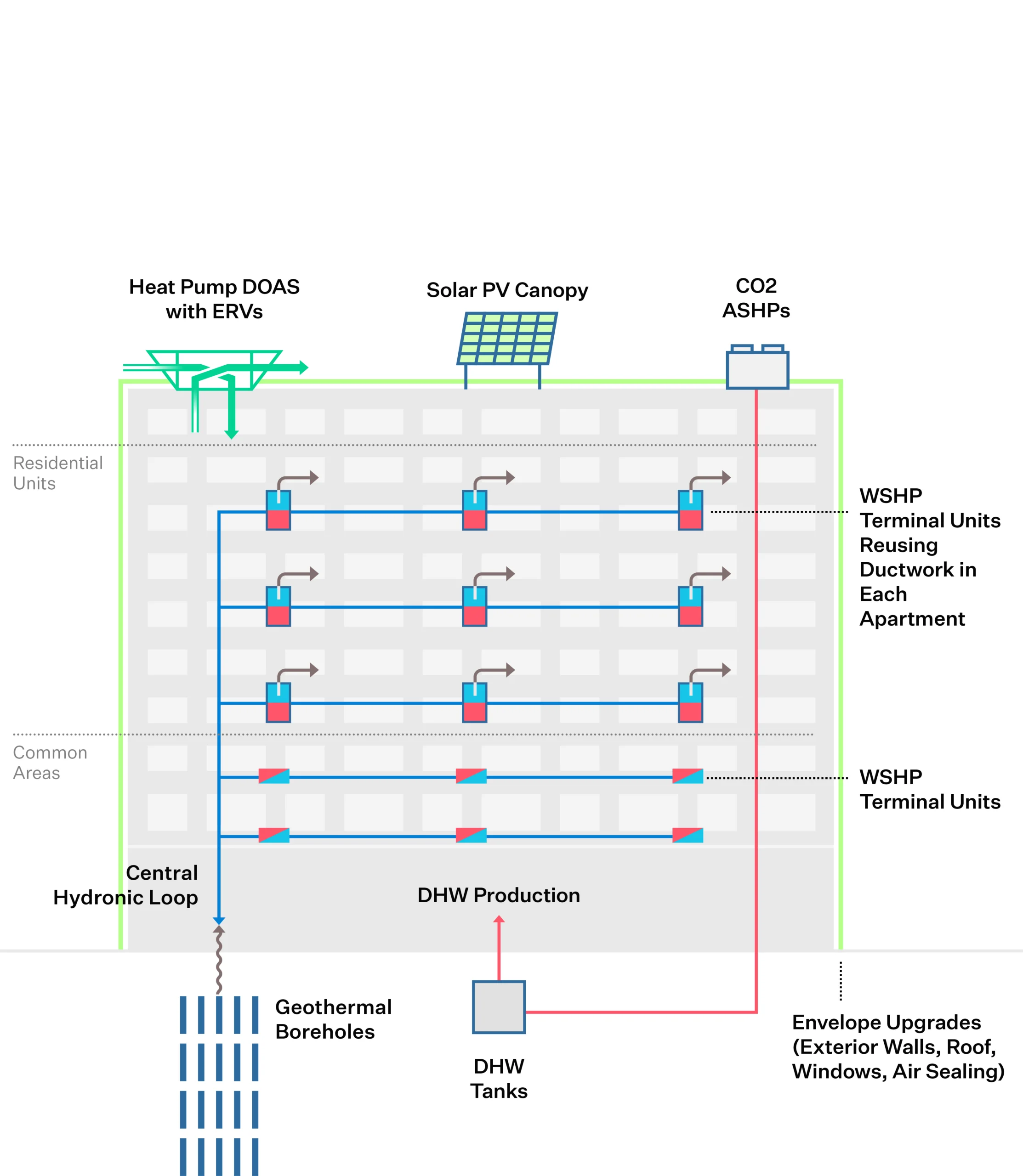
    This diagram illustrates the building prior to the initiation of Strategic Decarbonization planning by the owners and their teams.

    Click through the measures under “Building After” to understand the components of the building’s energy transition.

    Sequence of Measures

    2025

    Building System Affected

    • heating
    • cooling
    • ventilation
    Stovroff Towers before
    Stovroff Towers after
    Envelope Upgrades
    Geothermal System and Terminal WSHPs
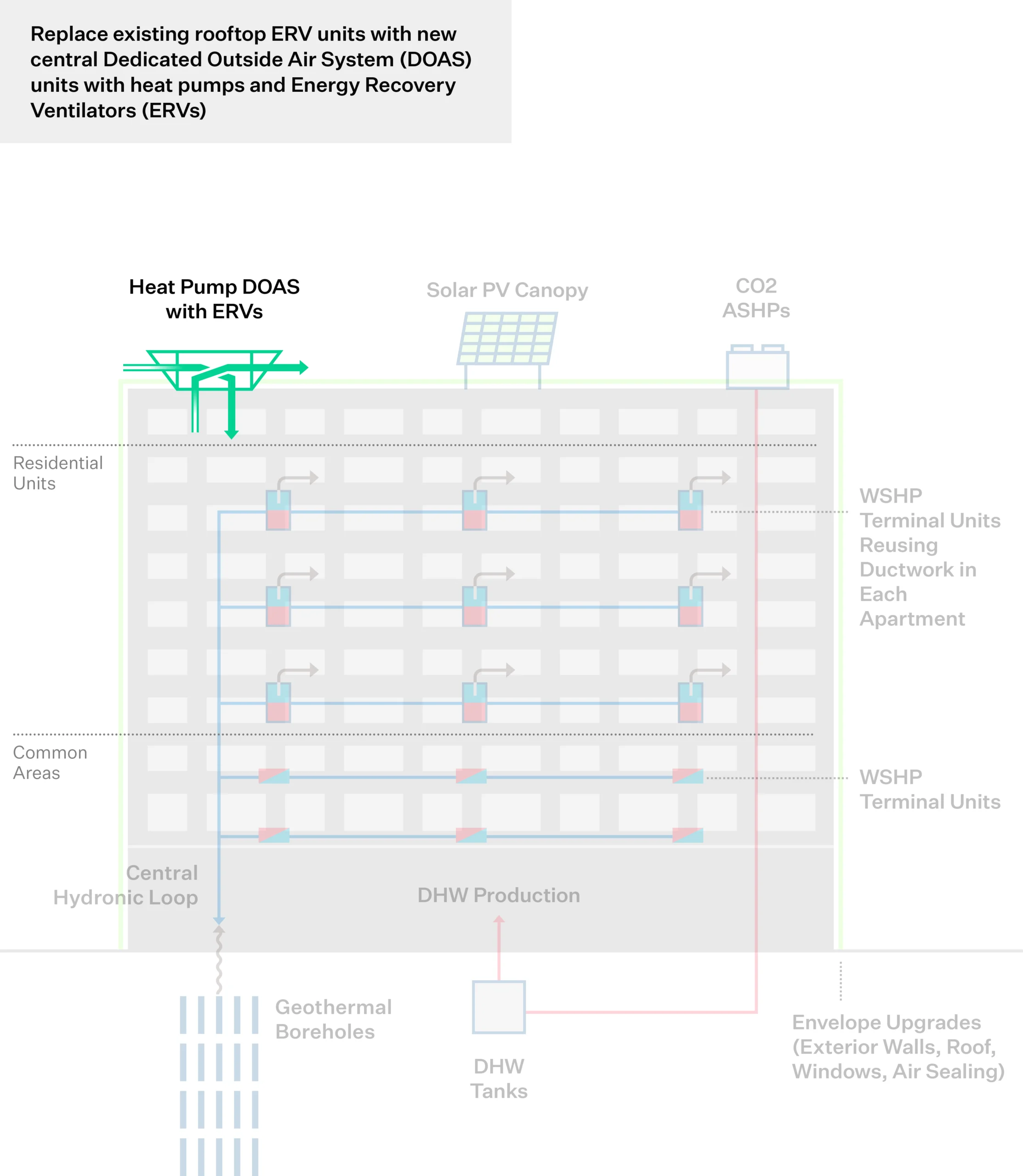
    Ventilation Upgrades
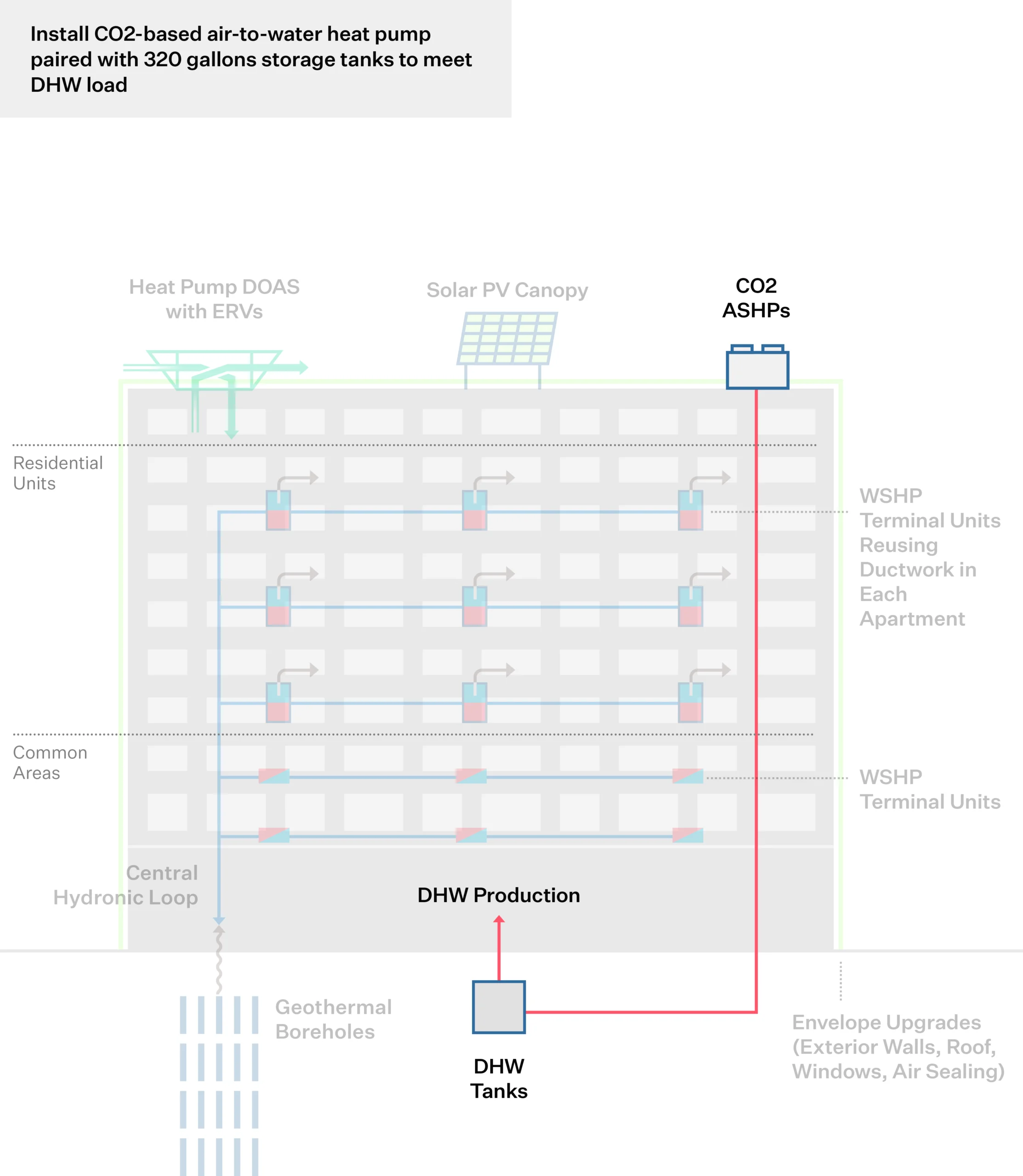
    CO2 Heat Pump for DHW
    Electrical Upgrades and Smart Thermostats
    Solar PV

    Making a business case for strategic decarbonization requires thinking beyond a traditional energy audit approach or simple payback analysis. It assesses business-as-usual costs and risks against the costs and added value of phased decarbonization investments in the long-term.

    Retrofit Costs

    Decarbonization Costs

    $13.2M

    Cost of ECM #1 – Exterior Envelope Insulation: 2.5M.

    Cost of ECM #2 – Triple Pane Windows: 1.2M.

    Cost of ECM #3 – Roof Replacement: 1.1M.

    Cost of ECM #4 – Geothermal/Water-Source-Heat-Pump System: 3.1M.

    Cost of ECM #5 – DHW Central CO2 Air-to-Water Heat Pump: 805k.

    Cost of ECM #6 – Energy Recovery Ventilation: 2.2M.

    Cost of ECM #7 – Electrical Upgrades: 2.1M.

    Cost of ECM #8 – Rooftop Solar PV: 194k.

    Cost of ECM #9 – Smart Thermostat: included in mechanical number.

    Avoided Risks

    Business-as-Usual Costs

    $4.6M

    Energy cost savings: 37k.

    BAU cost of system replacement/upgrades: 4.5M.

    Avoided Risks

    Business-as-Usual Risks

    $0

    Added Value

    Decarbonization Value

    $8.4M

    Incentives/Tax credits: 1.4M.

    Valuation: 7M.

    Net Present Value

    TBD

    Net difference between the present value of cash inflows and outflows over a period of time.

    The decarbonization scope of work was selected because it achieves performance objectives while limiting capital cost, maximizing operational cost and carbon emissions savings, and preserving original architectural features important to the local community. The total cost of the ECMs is approximately $13,240,378 and the total development cost of the renovation is $43,180,406. While these costs are high, they are in line with similar deep energy retrofit projects, far more affordable than new construction, and beneficially create new deed restricted housing for the State of New York. The EBC scope is anticipated to reduce operational costs by $37,000 annually, which will help with long-term operations; however, energy cost savings alone do not support overall Project costs. 

    This level of investment is only possible with state resources such as NYSERDA’s Empire Building Challenge funding and LIHTC financing, which will allow Winn to create new affordable housing that is also energy efficient and fossil fuel free. In the absence of a LIHTC award, another real estate developer could acquire the property and upgrade interiors and replace systems in kind for $4.5 million, which would be a short term and short-sighted undertaking that invests in new gas infrastructure. The sustainability goals for the project are integral to the property’s transformation, the marginal cost of which cannot be supported with energy cost savings alone.  However, the true net cost of ECMs, less business-as-usual in-kind replacement, NYSERDA funding, investment tax credit, and other incentives, is $4,327,764, which can be supported with debt and equity. The decarbonization roadmap provides many benefits to Stovroff Towers, including carbon neutrality by 2040, futureproofing against carbon mandates and stranded assets, and marketability. Stovroff Towers are better and stronger with the decarbonization scope and are worthy of this level of investment.  

    An emissions decarbonization roadmap helps building owners visualize their future emissions reductions by outlining the CO2 reductions from selected energy conservation measures. This roadmap is designed with a phased approach, considering a 20- or 30-year timeline, and incorporates the evolving benefits of grid decarbonization, ensuring a comprehensive view of long-term environmental impact.

    More Like This
    Case Study
    NYSERDA supported
    Case Study

    The Victory

    Energy conservation analysis at midtown tower

    Energy conservation analysis at midtown tower
    The Victory Case Study
    Case Study
    Case Study

    The Towers

    Oldest US multifamily co-op transforms wastewater into clean energy

    The Towers Case Study

    Case Study

    High Temperature Heat Pump 101 Guide

    A baseline assessment is key to understanding current systems and performance, then identifying conditions, requirements or events that will trigger a decarbonization effort. The assessment looks across technical systems, asset strategy and sectoral factors.

    Building System Conditions
    Asset Conditions
    Market Conditions

    Effective engineering integrates measures for reducing energy load, recovering wasted heat, and moving towards partial or full electrification. This increases operational efficiencies, optimizes energy peaks, and avoids oversized heating systems, thus alleviating space constraints and minimizing the cost of retrofits to decarbonize the building over time.

    Making a business case for strategic decarbonization requires thinking beyond a traditional energy audit approach or simple payback analysis. It assesses business-as-usual costs and risks against the costs and added value of phased decarbonization investments in the long-term.

    Retrofit Costs

    Decarbonization Costs

    Avoided Risks

    Business-as-Usual Costs

    Avoided Risks

    Business-as-Usual Risks

    Added Value

    Decarbonization Value

    Net Present Value

    An emissions decarbonization roadmap helps building owners visualize their future emissions reductions by outlining the CO2 reductions from selected energy conservation measures. This roadmap is designed with a phased approach, considering a 20- or 30-year timeline, and incorporates the evolving benefits of grid decarbonization, ensuring a comprehensive view of long-term environmental impact.

    This guide from The Clean Fight and RMI helps building owners and managers understand how high-temperature heat pumps can decarbonize steam and hot-water space heating systems. It outlines key benefits, technology basics, example products, and strategies for effective retrofit integration. High-temperature heat pumps offer a new, less disruptive path to electrification for buildings with steam or hot water distribution.

    More Like This

    Sorry, no content found.

    Case Study

    Charrette Templates: Supporting Preliminary Retrofit Plan Review

    A baseline assessment is key to understanding current systems and performance, then identifying conditions, requirements or events that will trigger a decarbonization effort. The assessment looks across technical systems, asset strategy and sectoral factors.

    Building System Conditions
    Asset Conditions
    Market Conditions

    Effective engineering integrates measures for reducing energy load, recovering wasted heat, and moving towards partial or full electrification. This increases operational efficiencies, optimizes energy peaks, and avoids oversized heating systems, thus alleviating space constraints and minimizing the cost of retrofits to decarbonize the building over time.

    Making a business case for strategic decarbonization requires thinking beyond a traditional energy audit approach or simple payback analysis. It assesses business-as-usual costs and risks against the costs and added value of phased decarbonization investments in the long-term.

    Retrofit Costs

    Decarbonization Costs

    Avoided Risks

    Business-as-Usual Costs

    Avoided Risks

    Business-as-Usual Risks

    Added Value

    Decarbonization Value

    Net Present Value

    An emissions decarbonization roadmap helps building owners visualize their future emissions reductions by outlining the CO2 reductions from selected energy conservation measures. This roadmap is designed with a phased approach, considering a 20- or 30-year timeline, and incorporates the evolving benefits of grid decarbonization, ensuring a comprehensive view of long-term environmental impact.

    Charrette Overview

    A charrette is a focused, collaborative convening of diverse stakeholders. In planning a building decarbonization project, charrettes are a powerful tool for establishing a holistic understanding of a building’s existing conditions and needs, aligning stakeholders, developing creative solutions, and accelerating the retrofit design process.

    Context

    While charrettes can be used within multiple contexts, this resource has been developed to support the review of a preliminary retrofit plan. The preliminary retrofit plan scope is developed based on existing building conditions, high-level energy data and calculations, as well as the team’s expertise and prior project experience. Having a charrette at this point in the process allows for early feedback about the retrofit scope and alignment with project goals. It provides an opportunity for collaborative problem-solving and the development of creative solutions, as multi-disciplinary stakeholders are brought together to iterate on the retrofit. More detailed energy and financial analysis will occur after the charrette and may drive scope change as the team uses results to optimize the retrofit.

    Templates Overview

    The following templates have been developed to reduce the effort required to include a charrette in retrofit planning and guide project teams through the charrette process. The format of the templates is intentionally basic so your organization(s)’ presentation format and logos can easily be added.

    The templates are intended to be used by the design team to gather feedback and develop consensus from project stakeholders on the following topics:

    • Project goals
    • Retrofit triggers
    • Proposed retrofit plan

    Three templates are available for download and are designed to work together. These include:

    Pre-Read Template: Use this template to develop a project-specific pre-read document that can help inform the charrette discussion. This template offers a preset agenda for the charrette and provides space to clearly define project goals, trigger events, and a high-level summary of the retrofit plan. To maximize benefit from the charrette it is important that attendees arrive with a solid understanding of the information provided in the pre-read. Therefore, it is recommended the document remain as concise as possible and is sent to attendees with sufficient time for them to review.

    Download the Pre-Read Template

    Charrette Presentation Template: This easily customizable slide deck template provides a framework and content to guide project teams through the charrette. The intended outcomes from the charrette are level setting stakeholders on the project’s status and plans, collecting feedback, and ideation.

    Download the Presentation Template

    Post-Charrette Report Template: Use this template to capture outputs from the charrette and distribute to project stakeholders. The report is intended to support the team in coming to consensus on goals, retrofit triggers, and the preliminary retrofit plan. Once finalized, it can be used as a basis for moving into the detailed analysis phase.

    Download the Post-Read Template

    More Like This

    Sorry, no content found.

    Case Study

    Strategic Decarbonization Planning Training Series

    A baseline assessment is key to understanding current systems and performance, then identifying conditions, requirements or events that will trigger a decarbonization effort. The assessment looks across technical systems, asset strategy and sectoral factors.

    Building System Conditions
    Asset Conditions
    Market Conditions

    Effective engineering integrates measures for reducing energy load, recovering wasted heat, and moving towards partial or full electrification. This increases operational efficiencies, optimizes energy peaks, and avoids oversized heating systems, thus alleviating space constraints and minimizing the cost of retrofits to decarbonize the building over time.

    Making a business case for strategic decarbonization requires thinking beyond a traditional energy audit approach or simple payback analysis. It assesses business-as-usual costs and risks against the costs and added value of phased decarbonization investments in the long-term.

    Retrofit Costs

    Decarbonization Costs

    Avoided Risks

    Business-as-Usual Costs

    Avoided Risks

    Business-as-Usual Risks

    Added Value

    Decarbonization Value

    Net Present Value

    An emissions decarbonization roadmap helps building owners visualize their future emissions reductions by outlining the CO2 reductions from selected energy conservation measures. This roadmap is designed with a phased approach, considering a 20- or 30-year timeline, and incorporates the evolving benefits of grid decarbonization, ensuring a comprehensive view of long-term environmental impact.

    About the Series

    NYSERDA and Building Energy Exchange, in collaboration with RMI, University of Cincinnati, and Ember Strategies, are excited to offer a comprehensive three-part Strategic Decarbonization Planning training series designed to help industry professionals tackle complex retrofit projects with confidence. Tailored for professionals in engineering, real estate, and technology, this training series will equip participants with the tools and knowledge to drive practical, cost-effective low-carbon retrofits in large buildings. Grounded in lessons learned from NYSERDA’s Empire Building Challenge and their innovative retrofit demonstration projects, participants will learn how to:

    • Identify effective retrofit strategies by evaluating technical solutions and real estate conditions;
    • Make the case for low-carbon retrofits with compelling business narratives that resonate with decision-makers; and
    • Turn plans into action by creating clear, step-by-step decarbonization roadmaps for real-world projects.

    Live training sessions for all three courses are coming this spring. Read more about our high-impact, solutions driven training series below:

    Course 1

    SDP: RED Framework and Technical Solutions (1.5 AIA LU)

    This first course of the series will explore Resource Efficient Decarbonization (RED) as a replicable solutions framework used to develop carbon neutrality roadmaps for large buildings in cold climates. Using real-world examples from Empire Building Challenge retrofit projects, participants will learn how to apply the RED framework to create comprehensive, long-term decarbonization plans for their buildings. Additionally, the training will review a range of technical solutions for decarbonizing buildings, highlighting how prioritization of these technologies can optimize retrofits.

    Sign up for March 18

    Take Course 1 On-Demand

    Course 2

    SDP: Building the Business Case for Better Decarbonization (1.5 AIA LU)

    The second course will focus on the finance and asset planning components of strategic decarbonization. Participants will learn how to evaluate and align technical solutions with economic realities and long-term asset strategies to inform decision-making. This course will also provide guidance on crafting compelling business case narratives that build stakeholder support and unlock investment for retrofits. By the end of the training, participants will be equipped to develop persuasive business cases that advance building decarbonization projects.

    Sign up for March 18

    Take Course 2 On-Demand

    Course 3

    Let’s Decarbonize! A Hands-on Building Decarbonization Workshop

    The third course of the series will be a highly interactive session offering a hands-on introduction to building decarbonization planning – delivered in a dynamic, game-based format. The session begins with a brief review of key concepts from the first two courses, then, participants will break into small groups to create a mock decarbonization plan for a real-world building scenario. Teams will evaluate strategies to reduce greenhouse gas emissions while weighing factors such as costs, trigger events, and other site- specific considerations. Come prepared to collaborate, apply your skills, and dive into the decision- making process behind effective building decarbonization.

    This material was developed at the University of Cincinnati by Amanda Webb, Barry Abramson, Katherine Castiello Jones, and Heather Cheng. It is based upon work supported by the National Science Foundation under Award No. 2339386.

    Sign up for March 19

    More Like This

    Sorry, no content found.

    Case Study

    High Rise | Low Carbon Multifamily

    A baseline assessment is key to understanding current systems and performance, then identifying conditions, requirements or events that will trigger a decarbonization effort. The assessment looks across technical systems, asset strategy and sectoral factors.

    Building System Conditions
    Asset Conditions
    Market Conditions

    Effective engineering integrates measures for reducing energy load, recovering wasted heat, and moving towards partial or full electrification. This increases operational efficiencies, optimizes energy peaks, and avoids oversized heating systems, thus alleviating space constraints and minimizing the cost of retrofits to decarbonize the building over time.

    Making a business case for strategic decarbonization requires thinking beyond a traditional energy audit approach or simple payback analysis. It assesses business-as-usual costs and risks against the costs and added value of phased decarbonization investments in the long-term.

    Retrofit Costs

    Decarbonization Costs

    Avoided Risks

    Business-as-Usual Costs

    Avoided Risks

    Business-as-Usual Risks

    Added Value

    Decarbonization Value

    Net Present Value

    An emissions decarbonization roadmap helps building owners visualize their future emissions reductions by outlining the CO2 reductions from selected energy conservation measures. This roadmap is designed with a phased approach, considering a 20- or 30-year timeline, and incorporates the evolving benefits of grid decarbonization, ensuring a comprehensive view of long-term environmental impact.

    A global survey of 14 high-rise multifamily retrofit profiles that achieved deep energy reductions.

    More Like This

    Sorry, no content found.

    Case Study

    Retrofit Playbook Event Series: New Decarbonization Tools from ASHRAE, USGBC, and The Retrofit Playbook

    A baseline assessment is key to understanding current systems and performance, then identifying conditions, requirements or events that will trigger a decarbonization effort. The assessment looks across technical systems, asset strategy and sectoral factors.

    Building System Conditions
    Asset Conditions
    Market Conditions

    Effective engineering integrates measures for reducing energy load, recovering wasted heat, and moving towards partial or full electrification. This increases operational efficiencies, optimizes energy peaks, and avoids oversized heating systems, thus alleviating space constraints and minimizing the cost of retrofits to decarbonize the building over time.

    Making a business case for strategic decarbonization requires thinking beyond a traditional energy audit approach or simple payback analysis. It assesses business-as-usual costs and risks against the costs and added value of phased decarbonization investments in the long-term.

    Retrofit Costs

    Decarbonization Costs

    Avoided Risks

    Business-as-Usual Costs

    Avoided Risks

    Business-as-Usual Risks

    Added Value

    Decarbonization Value

    Net Present Value

    An emissions decarbonization roadmap helps building owners visualize their future emissions reductions by outlining the CO2 reductions from selected energy conservation measures. This roadmap is designed with a phased approach, considering a 20- or 30-year timeline, and incorporates the evolving benefits of grid decarbonization, ensuring a comprehensive view of long-term environmental impact.

    As climate-forward policies have gained momentum and high-performance building technologies have continued to advance, building owners are feeling increasing pressure to decarbonize while navigating a growing array of retrofit options and requirements. How can project teams chart a course through this evolving and overwhelming landscape to confidently plan and implement decarbonization retrofits?

    The newly released Guide to Strategic Decarbonization Planning, produced by ASHRAE, U.S. Green Building Council (USGBC), and supported by New York State Energy Research and Development Authority (NYSERDA), presents a comprehensive suite of best practices to operationalize deep decarbonization in buildings by following the strategic decarbonization planning (SDP) framework. SDP is a proven approach to decarbonization planning that integrates holistic technical solutions with pragmatic asset management strategies, enabling project teams to deliver cost-effective, flexible decarbonization projects.

    Join ASHRAE, USGBC, and the Retrofit Playbook for Large Buildings team on September 23rd to learn more about the Guide to Strategic Decarbonization Planning and explore how it connects with the tools, case studies, and planning resources available on the RetrofitPlaybook.org. Whether you’re just getting started or refining a long-term roadmap, this session will help you learn how to apply the SDP framework and other practical resources to actualize low-carbon, future-ready building retrofits.

    Opening Remarks

    Sophie Cardona, Senior Project Manager, NYSERDA

    Moderator

    Molly Dee-Ramasamy, Director of Deep Carbon Reduction Group, JBB

    Presenters

    Laurie Kerr, Principal Climate Advisor, USGBC
    Phil Keuhn, Principal, RMI

    Panelists

    Adam Hinge, Managing Director, Sustainable Energy Partnerships
    Laurie Kerr, Principal Climate Advisor, USGBC
    Phil Keuhn, Principal, RMI
    Laura Humphrey, Senior Director of Energy & Sustainability, L+M Development Partners

    More Like This

    Sorry, no content found.

    Case Study

    Large Building Decarbonization Price Index

    A baseline assessment is key to understanding current systems and performance, then identifying conditions, requirements or events that will trigger a decarbonization effort. The assessment looks across technical systems, asset strategy and sectoral factors.

    Building System Conditions
    Asset Conditions
    Market Conditions

    Effective engineering integrates measures for reducing energy load, recovering wasted heat, and moving towards partial or full electrification. This increases operational efficiencies, optimizes energy peaks, and avoids oversized heating systems, thus alleviating space constraints and minimizing the cost of retrofits to decarbonize the building over time.

    Making a business case for strategic decarbonization requires thinking beyond a traditional energy audit approach or simple payback analysis. It assesses business-as-usual costs and risks against the costs and added value of phased decarbonization investments in the long-term.

    Retrofit Costs

    Decarbonization Costs

    Avoided Risks

    Business-as-Usual Costs

    Avoided Risks

    Business-as-Usual Risks

    Added Value

    Decarbonization Value

    Net Present Value

    An emissions decarbonization roadmap helps building owners visualize their future emissions reductions by outlining the CO2 reductions from selected energy conservation measures. This roadmap is designed with a phased approach, considering a 20- or 30-year timeline, and incorporates the evolving benefits of grid decarbonization, ensuring a comprehensive view of long-term environmental impact.

    Purpose by Design Architects
    Sunamp
    RMI
    Dextall logo
    Capital Logo
    Winn Co
    Gitel
    SWBR
    SoC Housing Logo
    SHA Logo
    Rise Boro Logo
    PCA Logo
    Mangrann Logo
    LaBella Logo
    KOW Logo
    Kelvin Logo
    Joe NYC logo
    IAE logo
    Hanac logo
    First Service Residential Logo
    Fairstead Logo
    Ettinger Logo
    Cycle Retrotech
    Chartered Properties Logo
    Ascendant Logo
    Trinity Church Wall Street Logo
    Hines Logo
    Norges Bank Investment Management
    Energy Machines logo
    Consigli logo
    URBS Logo
    Inglese Architecture + Engineering Logo
    Invesco logo
    Sharc Energy logo
    Loring Consulting Engineers logo
    Curtis + Ginsberg Architects logo
    Bright Power Logo
    Paths LLC logo
    EN-Power Logo
    Egg Geo Logo
    Blueprint Power logo
    JB&B logo
    Ryan Soames Engineering logo
    Steven Winter Associates, Inc. logo
    Corentini logo
    Skanska logo
    Reos Partners logo
    Quest Energy Group logo
    Luthin Associates logo
    Johnson Controls logo
    Buro Happold logo
    Beam logo
    Jonathan Rose Companies logo
    Rudin logo
    Silverstein Properties logo
    Equity Residential logo
    The Durst Organization logo
    Vornado Realty Trust logo
    Tishman Speyer logo
    Omni New York LLC logo
    LeFrak logo
    LM Development Partners logo
    Hudson Square Properties logo
    Empire State Realty Trust logo
    Brookfield Properties logo
    Boston Properties logo
    Amalgamated Housing Corporation logo

    This resource is available to aid design teams and building owners in navigating the complexities of rapidly shifting supply chains. It will provide up-to-date information on lead times and pricing for key equipment essential to the design and implementation of low-carbon building and retrofit projects in large commercial buildings. It will be updated semi-annually to reflect changes in the supply chain.

    More Like This

    Sorry, no content found.

    Case Study

    The Role of Design Charrettes in Building Decarbonization Planning

    A baseline assessment is key to understanding current systems and performance, then identifying conditions, requirements or events that will trigger a decarbonization effort. The assessment looks across technical systems, asset strategy and sectoral factors.

    Building System Conditions
    Asset Conditions
    Market Conditions

    Effective engineering integrates measures for reducing energy load, recovering wasted heat, and moving towards partial or full electrification. This increases operational efficiencies, optimizes energy peaks, and avoids oversized heating systems, thus alleviating space constraints and minimizing the cost of retrofits to decarbonize the building over time.

    Making a business case for strategic decarbonization requires thinking beyond a traditional energy audit approach or simple payback analysis. It assesses business-as-usual costs and risks against the costs and added value of phased decarbonization investments in the long-term.

    Retrofit Costs

    Decarbonization Costs

    Avoided Risks

    Business-as-Usual Costs

    Avoided Risks

    Business-as-Usual Risks

    Added Value

    Decarbonization Value

    Net Present Value

    An emissions decarbonization roadmap helps building owners visualize their future emissions reductions by outlining the CO2 reductions from selected energy conservation measures. This roadmap is designed with a phased approach, considering a 20- or 30-year timeline, and incorporates the evolving benefits of grid decarbonization, ensuring a comprehensive view of long-term environmental impact.

    As the world grapples with the urgent need to reduce greenhouse gas emissions, the built environment has become a critical focus area to deliver progress. Buildings are significant contributors to global carbon emissions, and transitioning to more sustainable, low-carbon operations is essential for meeting climate goals. Planning for that transition now, through a thoughtful and rational approach, is key to achieving success over time.  

    Design charrettes are an important tool project teams can use to support their decarbonization planning work. These collaborative design review workshops bring together diverse stakeholders to develop and refine strategies for reducing carbon emissions from buildings over time.  

    What is a Design Charrette?

    A design charrette is an intensive, multi-disciplinary workshop aimed at finding and refining solutions to complex problems. The term originated in 19th century Paris and refers to the practice of design students working intensely on their projects until the last minute, when a cart or “charrette” would be wheeled around to collect their final designs. The term has evolved to describe collaborative sessions that bring together developers, designers, domain experts, community members, and an array of other stakeholders to reach mutually beneficial outcomes. In the context of building decarbonization, design charrettes facilitate the rapid development of actionable (and at times substantially more innovative) strategies to reduce emissions from buildings, with alignment among multiple interested parties.  

    Why Use Design Charrettes to Achieve Resource Efficient Decarbonization?

    1. Collaborative Problem-Solving: Building decarbonization requires input from a wide range of experts, including architects, engineers, asset managers, environmental scientists, and community leaders. A design charrette brings these diverse voices together in a collaborative setting, ensuring that all perspectives are considered. 
    2. Intensive Focus: The concentrated nature of a charrette allows participants to delve deeply into the problem at hand. Over several hours (or days), stakeholders can explore various scenarios, analyze data, and develop detailed plans that might otherwise take months to create using traditional methods. 
    3. Iterative Process: Charrettes are designed to be iterative, with multiple rounds of feedback and refinement as needed. This approach ensures that the final outcomes are well-vetted and robust, with broad support from all stakeholders. 
    4. Creative Solutions: The collaborative and open nature of charrettes fosters creativity and challenges deeply held assumptions about how to approach a problem by the charrette participants.  Participants are encouraged to think outside the box and develop innovative solutions that might not emerge in a more conventional planning process. 
    5.  Achieving Resource Efficient Decarbonization (RED): Charrettes enable stakeholders to develop highly strategic plans to transition a building away from on-site fossil fuel over time in a way that does not diminish high-performance operations, contains operating and capital expenses, and maintains a complex urban systems perspective including considerations relating to infrastructure and natural resources.

    The Design Charrette Process

    Charrettes are conducted just after a decarbonization concept plan is created and initial decarbonization measures are framed. A successful charrette requires being prepared to discuss the existing conditions of the building in detail, various decarbonization measures and approaches considered, and an understanding of the social and market conditions influencing the building owner’s decision making. The charrette process includes: 

    1. Preparation: Successful charrettes require careful preparation. This includes identifying key stakeholders and inviting them to join, gathering relevant data, and setting clear objectives for the workshop.  
    2. Workshop Session: During the charrette, the project team presents their building existing conditions and decarbonization approaches and engage in brainstorming, design review, and business discussions with a team of technical experts and industry leaders.
    3. Iteration and Feedback: Ideas generated during the sessions can be reviewed and refined through multiple rounds of feedback and additional charrettes as needed. This iterative process helps to improve and perfect the proposed solutions. 
    4. Implementation and Follow-Up: The final step is to translate the charrette outcomes into a formal strategic decarbonization plan and business case that leads to real-world actions. This may involve further planning, securing funding, and ongoing community engagement. 

    Design charrettes are a powerful tool for addressing complex decarbonization challenges, especially in the planning and early implementation phase. With collaboration, creativity, and iteration, charrettes enable the development of effective and sustainable strategies to reduce carbon emissions from buildings.

    Want to review your decarbonization plan with our team of experts?

    Request a design charrette.

    More Like This

    Sorry, no content found.